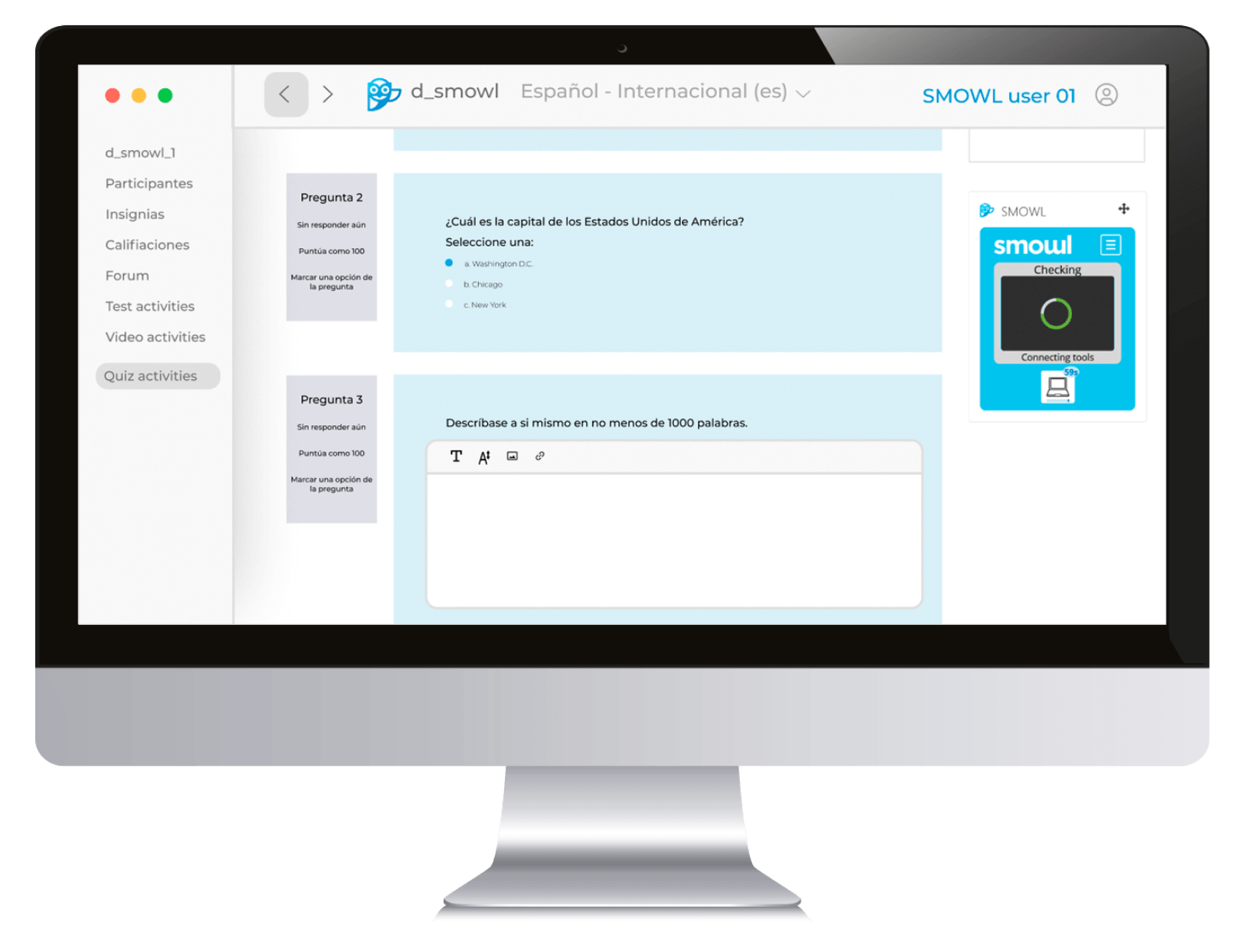
Designing an online course can support your traditional learning strategies or expand the possibilities for students with scheduling conflicts.
However, well-designed online courses provide flexibility, accessibility and a significant degree of customization.
However, this type of teaching is not limited, despite what you might think, to having learners watch videos, take tests and repeat the information learned.
The design of online courses is much broader and includes numerous activities that, to be successful, must be coherent and involve the learner from the very beginning.
With the idea of providing you with information on this subject, we have prepared this article in which we will explain how to design an online course step by step.

Designing an online course: Is it difficult?
The degree of difficulty of designing an online course depends on the subject matter you are going to propose, the level of detail you need and the evolution your learners need to make to achieve the objectives.
Perhaps the most difficult thing to do is to establish the right structure, because the rest of the necessary steps to create it will depend on it.
It goes without saying that once you get practice in designing online courses, it will become easier and easier, especially if you consider that there are endless tools that allow you to automate processes, use templates, etc.
We are talking about learning management systems (LMSs), integrated learning management platforms that offer a management interface for administrators and a virtual environment for the learner.
Do you want to stay on top of the latest trends in eLearning, EdTech, and Human Resources?
Fill out the form to receive our weekly newsletter with industry insights from our experts.
How to create an online course step-by-step
If you need to know how to design an online course, pay attention to the 6 steps we detail right now to become an expert.
Set objectives
Before you start planning your online course, you need to know what objectives you want your students to achieve and link them closely to the subject or program you are going to work on.
In any case, the objectives must be clear and achievable, and they must be the backbone of the whole course so as not to lose the ultimate goal of the course.
In this sense, you can opt for multiple approaches. One of them is to adopt the reverse design. It consists of creating a course that does not focus on a predefined program, but on what you want the students to know how to do at the end of a module or the whole course.
From there you must determine how the goals will be assessed, create learning activities, and ultimately create the content.
Ultimately, you can organize the following sections in the order that best suits your methodology and learning approach.
Analyze the needs and starting point of the students
An educational program’s success lies in understanding your students’ demographics and needs.
Study them, analyze their competencies and educational level, and check if they have prior knowledge of the subject matter. With this information, you will be able to tailor the structure so that they will be able to achieve the objectives.
This procedure also allows you to determine if some of the students will need support material or specific follow-up reinforcement.

Design the structure
As for the structure, this contains the modules or thematic packages that will work on specific aspects of the course and should be articulated in such a way that they are cumulative. It is also advisable to use methodologies that simplify this process, such as lean methodology.
This helps to consolidate learning as students acquire knowledge and develop skills and competencies. You can help yourself with educational strategies such as microlearning, a way of dealing with information in small pills that are easy to assimilate.
Likewise, it is important that you map the online course to detect if you have all the necessary components for its development.
To start with, you can use a table with a simple outline like the one we propose and improve it with practice and the contents you need:
| Objectives | Competencies addressed | Type of evaluation | Didactic material | Activities |
Specify the characteristics of the evaluation
Assessing learning is essential, both for the teacher, who must check whether his or her strategy is being effective, and for the learners, as it makes them aware of their progress and motivates them through a sense of achievement.
Keep in mind that you can do continuous evaluations or a single one at the end of the course, and that they can take different forms, including self-evaluation and peer evaluation.
Something that usually gives very good results is to establish an evaluative path for each student that allows them to reach milestones at their own pace.
Define and organize the contents
Educational contents are highly relevant to learning, and often the success of the course depends on them.
The key to creating quality digital content is for you to be systematic and structured in devising a detailed roadmap that describes exactly what you need in each topic or module to appeal to each type of learner.
Remember that what may seem really complicated is greatly simplified with the use of an LMS. The more structured the curriculum is, the easier it will be to implement it on this type of platform.

Make your evaluations safe and fair
In addition to clearly communicating the operation, purpose, requirements and criteria for the assessment of each learning unit or entire program, all learners must have access to fair and equal testing.
Whether you conduct flexible assessment surveys, real-time remote proctoring or any other assessment system, you need to respect the privacy of your users and avoid impersonation or unacceptable testing behavior such as using third parties or unauthorized material.
At Smowltech, we have solutions for this: our proctoring plans that integrate perfectly with most LMSs for fair and effective assessments.
Don’t hesitate to request a free demo to discover in detail how we can help you.
And finally, if you want to improve the design of online courses add to your list of tasks these 5 points:
- Involve the learner at all times and ask for their feedback to check that they have understood the content, detect gaps, and reinforce their commitment and enthusiasm in the tasks.
- Incorporate discovery-learning that asks for the learner’s active role in acquiring knowledge. You can use a Know, Want and Learned (KWL) chart to help your students organize information and activate prior knowledge.
- Encourage peer collaboration and create a learning community by adapting the channels to the characteristics of your learners, digital learners will be able to share ideas, help each other, and deploy their creativity.
- Participate in Professional Learning Communities (PLC) to exchange ideas, solve problems or develop content in teams with other instructors.
- Engage in a process of continuous improvement of your content to meet the challenges of an ever-changing world.
8 interesting facts about proctoring
Fill out the form and download the guide where we cover everything about online monitoring and help you choose the best software.