In today’s fast-paced business landscape, staying ahead of the curve means embracing the latest technologies that promise to revolutionize the way we work.
From artificial intelligence to blockchain, emerging technologies are powerful tools that can reshape entire industries.
If you’re wondering what emerging technologies are and why they matter for your business, you’re in the right place.
What is Emerging Technology?
Emerging technologies are those innovations that are in the early stages of development but show significant potential to change the way industries operate. They might not be fully established yet, but they are gaining momentum and have the potential to disrupt existing business models.
Whether it’s improving efficiency, reducing costs, or creating entirely new markets, these technologies are set to be game-changers.
Why businesses should care about emerging technologies
Why should you care about emerging technologies as a business owner or leader?
For starters, they provide a competitive edge.
Businesses that adopt these technologies early often find themselves ahead of the competition, offering innovative products or services that others can’t match.
Furthermore, many of these technologies (like, for example, supervised learning) lead to cost savings and efficiency improvements, allowing companies to do more with less.
Imagine automating routine tasks, analyzing vast amounts of data in seconds, or offering customers a completely new experience—thanks to the latest tech.
The businesses that fail to keep up risk being left behind as others harness these tools to innovate and grow.

Latest Emerging Technologies Shaping the Future of Business
Let’s dive into some of the latest emerging technologies that are making waves in the business world today:
Artificial Intelligence (AI) and Machine Learning (ML)
AI and ML are transforming how businesses operate, enabling machines to learn from data and make decisions with minimal human intervention.
AI and ML are already in action, from automating customer service through chatbots to personalizing marketing efforts.
Companies like Amazon use AI to predict what you might buy next, while Netflix leverages machine learning to suggest shows based on your viewing history.
The potential applications are vast, spanning from predictive analytics in finance to AI-driven product design in manufacturing.
Do you want to stay on top of the latest trends in eLearning, EdTech, and Human Resources?
Fill out the form to receive our weekly newsletter with industry insights from our experts.
Blockchain Technology
Blockchain is more than just the technology behind cryptocurrencies like Bitcoin. I
t’s a decentralized ledger that offers transparency and security, making it ideal for industries like finance, supply chain management, and even voting systems.
By reducing the need for intermediaries, blockchain can streamline processes, lower costs, and increase trust among parties.
For example, Walmart uses blockchain to track its food supply chain, ensuring that products are fresh and traceable from farm to store.
Similarly, financial institutions are exploring blockchain to secure transactions and prevent fraud.
Internet of Things (IoT)
IoT is all about connecting everyday devices to the internet, allowing them to communicate and share data. In business, this means smarter operations.
Think of sensors in a factory that monitor equipment in real-time, alerting managers before a machine breaks down. Or consider smart shelves in retail stores that automatically reorder stock when levels get low.
IoT is revolutionizing industries like manufacturing, logistics, and retail by making operations more efficient and data-driven.
5G Technology
The rollout of 5G is set to supercharge connectivity. With faster data speeds and lower latency, 5G will enable massive amounts of real-time communication and data transfer.
This has huge implications for remote work, telemedicine, and any industry that relies on fast, reliable internet.
For businesses, 5G means enhanced mobile communication, better video conferencing, and the ability to deploy IoT devices more effectively.
The possibilities are endless, from remote surgery to fully autonomous vehicles communicating with each other in real-time.

Emerging technology trends to watch
While the technologies we’ve discussed are already making an impact, several trends are poised to shape the future in even more profound ways.
Quantum Computing
Quantum computing promises to solve problems that are currently impossible for classical computers.
This could revolutionize industries like finance, where quantum algorithms could optimize portfolios in ways that traditional methods can’t match. In healthcare, quantum computing could lead to breakthroughs in drug discovery by simulating molecular interactions at unprecedented speeds.
However, quantum computing is still in its infancy, and businesses will need to watch this space closely as the technology matures.
Extended Reality (AR, VR, MR)
Extended Reality (XR), which includes Augmented Reality (AR), Virtual Reality (VR), and Mixed Reality (MR), is changing how we interact with the digital world.
These technologies are already being used in retail to create immersive shopping experiences, in training to simulate real-world scenarios, and in entertainment to create entirely new forms of media.
For businesses, XR can offer new ways to engage customers, train employees, and even design products.
Edge Computing
As more devices connect to the internet, the demand for fast, efficient data processing is growing.
Enter edge computing, which processes data closer to where it is generated, reducing latency and bandwidth use. This is particularly important for IoT devices, where real-time decision-making is critical.
Edge computing enables faster responses and more efficient data management, making it a key technology for businesses relying on IoT and big data.
Autonomous Vehicles
Autonomous vehicles, including self-driving cars and drones, are no longer the stuff of science fiction. Companies like Tesla are leading the charge with self-driving cars, while
Amazon is experimenting with drone deliveries. The implications for logistics, transportation, and even urban planning are huge.
Imagine a future where goods are delivered autonomously, reducing costs and speeding up delivery times. Or a world where city traffic is managed by AI, reducing congestion and emissions.
Emerging Technology for Education
The impact of emerging technologies isn’t limited to traditional business sectors. Education is undergoing a tech-driven transformation as well. AI-powered tutoring systems, virtual classrooms, and personalized learning experiences are just the beginning.
Technologies like immersive VR allow students to experience historical events or explore the human body in 3D, making learning more engaging and effective.
With the rise of online learning platforms, education is becoming more accessible and flexible, allowing learners to acquire new skills anytime, anywhere.

Conclusion
As we’ve explored, emerging technologies are not just a glimpse of the future—they are the tools shaping the present.
Businesses that embrace these innovations will be better positioned to lead their industries, drive growth, and stay competitive in an increasingly digital world.
Whether it’s through AI, blockchain, IoT, or the other technologies we’ve discussed, the future of business is undoubtedly tech-driven.
Now is the time to prepare, adapt, and thrive in this ever-evolving landscape.
This involves using security measures such as user authentication, data encryption, access control, and proctoring to identify and mitigate possible threats.
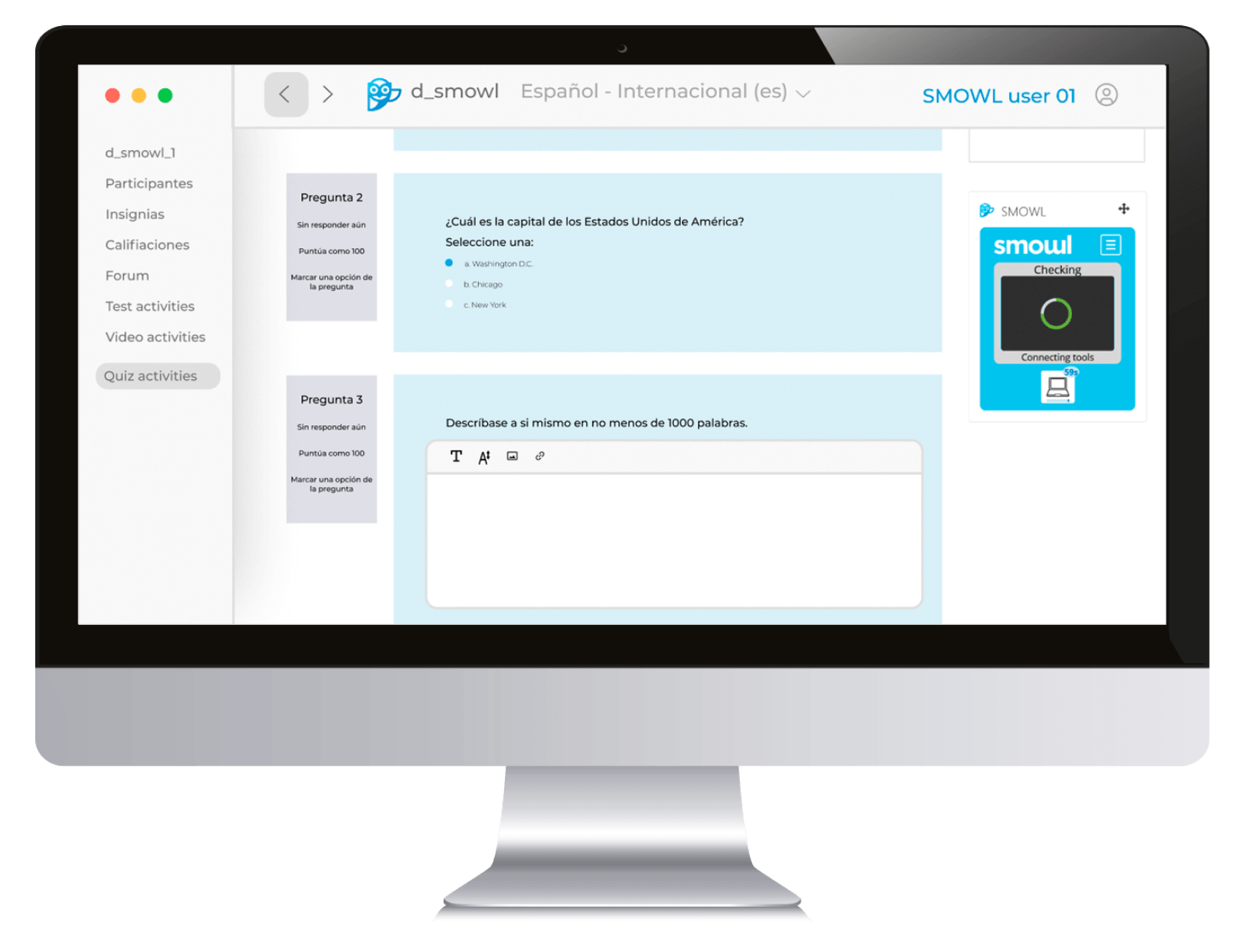
SMOWL proctoring products can provide that extra level of security you need if you want to start using technological tools in your digital ecosystem.
Request a free demo from us and discover the advantages they can bring to your company or institution.
8 interesting facts about proctoring
Fill out the form and download the guide where we cover everything about online monitoring and help you choose the best software.