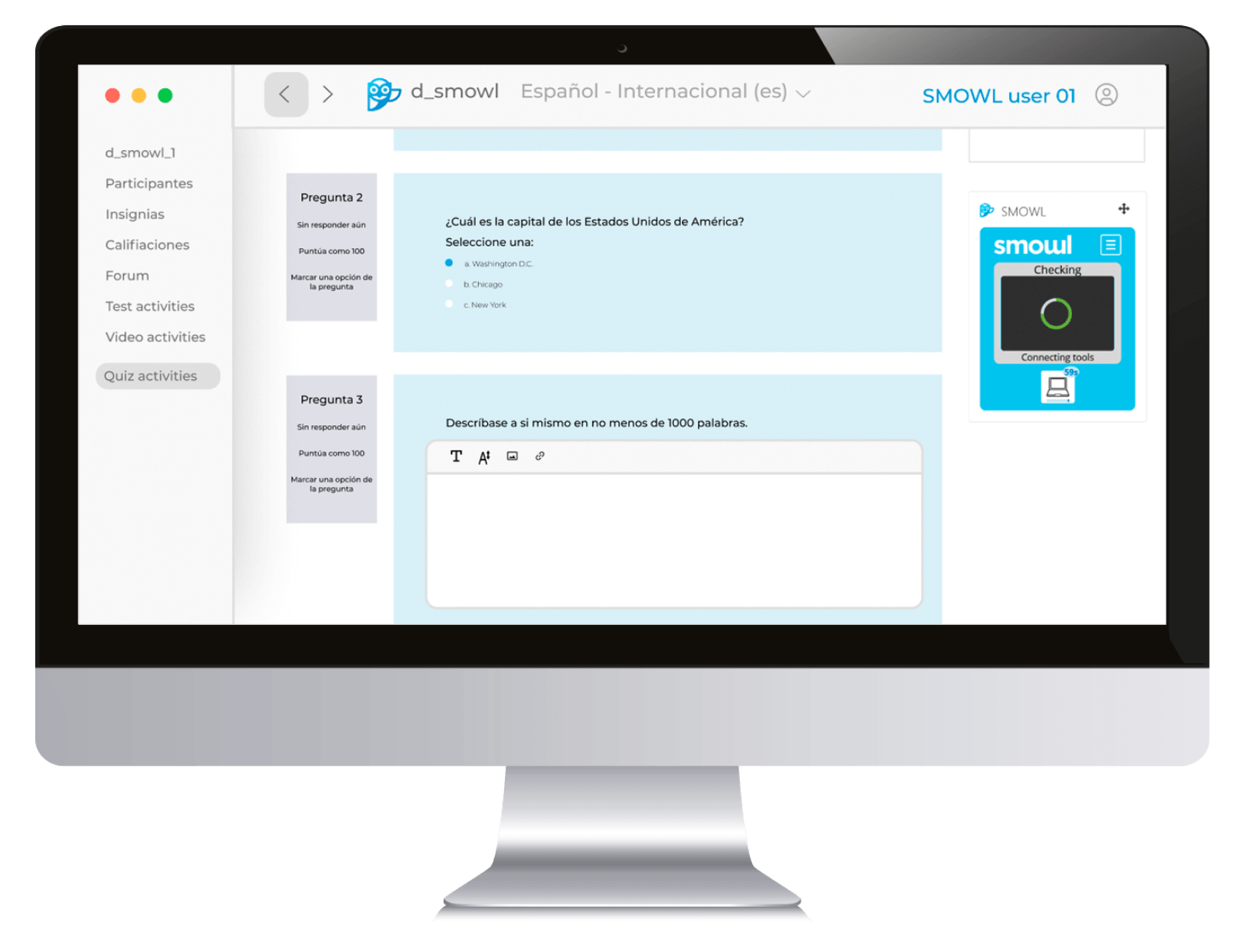
Formative assessment strategies are pedagogical approaches to monitor and improve student learning in real time, focusing on immediate feedback.
Unlike summative assessments, which only reveal final results, formative assessment provides immediate feedback that detects knowledge gaps and allows teaching to be adjusted before blockages and problems become entrenched.
Using techniques such as guided discussions, quick quizzes, peer assessments, or learning portfolios, students are guided to develop skills such as metacognition, self-regulation, and assertive communication.
Educational teams that incorporate this type of assessment will be able to improve student outcomes and transform learning in real time. Let us explain.
What are formative assessment strategies?
Formative assessment strategies are a dynamic and planned set of strategies that teachers use to gather ongoing information about their students’ learning as it occurs.
These practices make it easier for teachers to assess progress and obstacles in real time, allowing them to adjust programs to the pace and specific needs of their students.
But it’s not just the student who is evaluated; the teacher can also self-evaluate their own progress through observation and student feedback, in order to review their working methodology, the content they provide, the tools they use, etc.
In this sense, it is a transformative tool that facilitates tailored two-way feedback and self-evaluation by both the student and the teacher, while directing educational progress towards clear and relevant goals.
Thanks to these strategies, the teaching-learning process is aligned with the demands of today’s education: personalization and continuous adaptation to successfully overcome changing environments, as well as the creation of secure digital environments that protect people’s integrity and privacy.

How are formative assessment strategies useful to the teacher?
Formative assessment strategies are characterized by being flexible, immediate, and focused on continuous improvement. They focus on learning, not grading, serving as a guide for students and a method of improvement for the teaching team.
Among their distinctive features, in addition to providing immediate and continuous feedback for both students and teachers, the following stand out:
- Interactivity. They require the active participation of students and teachers.
- Applicability. To different practices such as discussions, self-assessments, collaborative work, etc.
- Diagnostic and predictive actions, which allow for the rapid detection of problems of various kinds, such as knowledge gaps, misunderstandings, information deficits or saturation, etc.
- Versatility. They can use different types of techniques, including questionnaires, concept maps, debates, peer evaluations, etc.
- Adaptability and flexibility. They allow teaching to be adjusted to the specific and current needs of students. To achieve this, they follow the evidence-adjustment-improvement cycle.
- Collaborative approach. They promote reflection and teacher-student co-construction of meaningful learning.
- Inclusiveness. They use varied and accessible formats and techniques for different learning styles and educational needs, taking cultural differences into account.
Two of their great advantages are that they are applied in small doses and on a regular basis, and they minimize student anxiety since, as we have mentioned, the focus is on improving learning, not on a final grade.
Applying the five key strategies of formative assessment in the classroom
The success of these formative strategies depends largely on how they are integrated into teaching practice. To do this, it is necessary to understand the five essential keys on which they are based. We will develop them one by one in the following points, but first it is important to clarify their theoretical framework.
It is based on the studies of Wiliam and Thompson, who propose the model of the five key strategies of formative assessment as a bridge between three central assessment processes that allow us to establish:
- Where students are.
- Where they should go.
- How they can get there.
This set of strategies draws on the work of David Ausubel, who argues that the basis of meaningful learning is to be aware of the student’s starting point, what they know, and their initial cognitive structure.
In this way, strategies for acquiring new knowledge can be developed that will be anchored in what Ausubel calls subsumers, anchors of prior knowledge necessary to fix new information.
Taking this theoretical basis into account, the five strategies will function as levers to activate the three basic processes we have just mentioned, creating interactive channels of communication between the teacher and the student.
In this regard, we might think that this type of teaching is better suited to face-to-face training. However, thanks to technology, the same bridges of collaboration between teachers and students can be built. All that is needed is to choose the right tools for adaptation to digital feedback, asynchronous reflections, or digital tools that facilitate metacognition, that is, reflection on one’s own learning.
Now, we invite you to discover what these five strategies consist of, with practical examples for each one.
Establish learning intentions and success criteria
Every strategy begins with a definition of accessible objectives that is precise, relevant, and clear. The objectives must be accompanied by look-fors, that is, relevant and measurable indicators that allow for observation of a work environment.
The essential condition is that trainers ensure that students have fully understood these objectives. This will allow them to reinforce their commitment, self-assess, and track their own progress.
How does this translate into practice? Through actions such as:
- Before starting an exercise, establish what is going to be done in it (“today we are going to talk about the causes and effects of…”), and propose elaborative questioning to connect criteria (“Why do you think these causes are connected?”).
- After defining the objectives, ask students to define them in their own words and to ask any questions that may arise.
| Recommendations for institutions |
| Create a shared library of success criteria so that teachers have resources and don’t have to start from scratch.Create a repository of evaluation rubrics by subject and grade level. |
Engineering effective classroom discussions and tasks
This second strategy focuses on encouraging students to think, explain, and justify their reasoning, moving away from mechanically responding to what they have learned. This technique helps consolidate information retention and improve the transferability of knowledge to future contexts.
One of the resources you can use is probing questions, open-ended questions that allow you to delve deeper into the understanding of a task by asking students to explain or compare proposals such as “Can you explain this in more detail?”.
You can set up small discussion groups or encourage peer discussion, which helps your students build collective knowledge.
Some examples you can apply are:
- Invite students to solve a problem and then share their conclusions in small groups so that each person can defend their position or methodology.
- Ask students to read a book and then develop hypotheses about the characters’ motivations based on the text, and then compare them with those of their classmates.
- Encourage guided discussions so that students can argue their answers and compare different approaches. They can use outlines or mind maps to support their ideas, for example.
Do you want to stay on top of the latest trends in eLearning, EdTech, and Human Resources?
Fill out the form to receive our weekly newsletter with industry insights from our experts.
| Recommendations for institutions |
| Train teachers in designing disruptive and participatory questions.Create banks of open-ended and higher-order thinking questions for each discipline.Design and incorporate inclusive and adaptive classroom discussion protocols. |
Providing feedback that moves learners forward
As we have already mentioned, assessment should not be limited to making corrections, but rather to providing suggestions so that students can improve their learning. It is important to reinforce what students do well and indicate how they can improve their weak points.
Here we find a teacher who takes on the role of facilitator and guide, of co-constructor of learning. Here are some examples:
- Instead of pointing out an error as such, writing “calculation error,” what you can do is explain and guide the student by writing “I have noticed an error in the operation. Check the sign in step X and recalculate to see if the operation is correct with this modification.” As you can see, it’s about guiding toward success, not focusing the assessment on the error.
- Virtual activities also allow you to link comments and corrections to resources, interactive clues, etc.
However, for this technique to work, feedback must be timely, continuous, and sufficient, in a dynamic of instructional scaffolding that leads to the student’s future autonomy.
Likewise, you need to build opportunities and environments that facilitate two-way feedback so that students can ask questions, reflect, and react to the comments they receive.
| Recommendations for institutions |
| Promote a culture of feedback as a central part of learning.Train teachers in successful techniques such as the sandwich technique (start with a positive aspect, mention areas for improvement, and finish with constructive feedback). |

Activating students as learning resources for one another
This strategy is based on peer assessment, meaning that students evaluate or comment on the work of other classmates. What does this allow? It allows both the evaluator and the evaluated to reflect on the quality of the work, methods used, resources, results, etc.
In this dynamic, students develop skills such as critical thinking, assertive communication, and active listening, which will be strategic in their work experience.
Here again, feedback must be constructive and positive, based on criteria for success rather than general opinions:
- Ask students to exchange work and comment on their classmates’ work using a version of the criteria for success: “Did you notice if your classmate included relevant information? How could this practice be improved?”
- Encourage immediate feedback forums, always moderated by the teacher. This is relatively easy to implement thanks to digital platforms. The goal is for students to publish their research, work, and results so that their peers can leave constructive comments.
| Recommendations for institutions |
| Create training workshops for teachers on peer feedback. Design guides so that students know what to look for when evaluating their peers.Foster a culture of respectful and assertive communication. |
Activating students as owners of their own learning
This latter strategy, which empowers students, is based on three pillars:
- Metacognition. Students reflect on their thinking and learning.
- Self-assessment. They are able to analyze and judge their own progress and performance and identify their strengths and areas for improvement.
- Self-regulation. They learn to manage their cognitive, behavioral, and emotional processes when it comes to achieving their goals.
You can incorporate this approach with actions such as inviting students to reflect after a formative test on what they think they did well or what they could change next time, or on what was most difficult for them, for example.
| Recommendations for institutions |
| Train teachers to teach metacognition explicitly.Encourage teachers to incorporate a final reflection in each class. |
Practical resources for implementing the five key strategies of formative assessment
Before delving deeper into the topic at hand, we would like to share with you a table containing some resources that you can use in each of the five strategies we have just explained:
| Strategy | Resources |
| Establish learning intentions and success criteria. | Rubrics, checklists, infographics, examples of previous work, digital boards. |
| Engineering effective classroom discussions and tasks. | Open-ended question cards (Bloom’s taxonomy), role cards, interactive applications. |
| Providing feedback that moves learners forward. | Digital portfolios, instant feedback systems, self-assessment checklists. |
| Activating students as learning resources for one another. | “Two stars and a wish” templates (identifying two positive aspects and one opportunity for improvement), LMS forums, cross-reviews. |
| Activating students as owners of their own learning. | Learning journals, guided self-assessments, mind maps of personal goals. |
Why formative assessment strategies are important? 7 strategic advantages
When discussing the different strategies on which formative assessment is based, you have probably already realized why they are important in the teaching-learning process.
To provide further clarity, we have compiled seven strategic benefits:
- It facilitates continuous monitoring of learning. Thanks to this, teachers are able to detect students’ difficulties early on and verify their progress.
- It promotes immediate, timely, and constructive feedback, focused on helping students understand their mistakes and actively participate in resolving them.
- It promotes metacognition and self-regulation, processes that are essential for students to become aware of their strengths and weaknesses. This allows them to develop the skills necessary for autonomous learning.
- It focuses on personalizing teaching, which is essential for creating inclusive education that caters to diversity.
- It boosts motivation and commitment through active student participation. Student responsibility for their own learning also plays a decisive role in this methodology.
- It improves performance on final exams. Students have been reinforcing their understanding and application of knowledge, creating meaningful and reflective learning. In addition, all these techniques allow them to become familiar with assessments, limiting feelings of control or anxiety when facing decisive tests.
- It ensures equity in the classroom: all students have opportunities to achieve the educational goals set.

Challenges and best practices in the implementation of formative assessment
The implementation of formative assessment strategies poses certain challenges that you need to be aware of.
We have prepared a table to make the presentation clearer, which you can use as a quality control for your proposals, and which also contains solutions that you can consider applying in each case:
| Most common challenges | Best practices for overcoming them |
| Unclear success criteria. | Co-construct success criteria with students. |
| Unequal participation in the classroom. | Use simple peer participation protocols to balance interventions. |
| Superficial or vague feedback. | Focus feedback on key points linked to success criteria. |
| Lack of skills for students to provide peer feedback. | Train students in constructive feedback with guided exercises. |
| Resistance to self-assessment. | Incorporate reflection routines after each class or activity. |
| Lack of security and privacy in digital environments. | Use professional technological solutions such as proctoring. |
When it comes to assessments, it is essential to create an atmosphere of trust so that students feel safe and are not afraid to express their opinions about their classmates’ work or to receive feedback.
The importance of safe assessment environments
Beyond the pedagogical work that trainers must do in this regard, privacy and security are two unavoidable issues in digital contexts.
Here you can count on a strategic ally: SMOWL and our proctoring plans. These are remote monitoring solutions with robust security and privacy measures to ensure that you comply with current regulations. We implement practices such as data anonymization and advanced security protocols that include access control and data encryption.
These and other measures ensure that data processing is carried out according to ethical criteria and in accordance with applicable legislation, improving the student experience.
If you request it, you can access a free demo. This will allow us to explain in detail how we can help you with your training project with solutions that are fully tailored to your needs.
5 formative assessment strategies to improve learning
Before concluding, we would like to share with you a short checklist that summarizes the essential points we have discussed in this article, which can help you improve your students’ learning:
- Set clear objectives and success criteria, and verify that students understand them.
- Use open-ended questions to check that the class understands the practice.
- Invite students to make micro-summaries to explain what they have learned, what has been easiest, and what obstacles they have encountered.
- Give constructive feedback, encouraging students to participate in resolving errors.
- Encourage reflective self-assessment and peer assessment.
These techniques will help you get into the swing of this type of assessment and assess the best way to include them in your classes.
Recommended resources and tools
Now that you have a theoretical basis for how to get the most out of formative assessment strategies, we are going to suggest some resources that may be useful for you to start practicing:
- Digital formative assessment platforms. These are tools that allow you to create interactive quizzes, gamified activities, and real-time feedback, as well as collect evidence of learning. You can try Learning Management Systems (LMS) such as Moodle or platforms such as Kahoot!, Socrative, Gimkit, and Flipgrid.
- Padlet. This is one of the most widely used collaborative platforms that allows students to upload ideas or projects to a virtual wall. It is ideal for encouraging cooperative work and peer assessment.
- Evidence Based Education. This is a virtual laboratory that collects analyses case studies and teacher reflections on formative assessment strategies.
- LessonUp Teacher Community. This is a space where teachers share trends, tools, and techniques for formative assessment.