Learning analytics (LA) enables data-driven decisions to personalize learning experiences, identify bottlenecks, intervene early, and improve educational performance.
Can you imagine a system that can automatically detect when a student needs support in key parts of the course? This and much more is what learning analytics offers by combining educational research, human-centered design, and data analysis. The result? A total transformation of the way we learn and teach.
In this article, you will understand exactly what learning analytics is, how it is being used in different contexts, and how you can start implementing it in your strategies.
What is learning analytics?
Learning analytics is a discipline that collects, measures, analyzes, and reports on information generated in educational processes (from grades to interaction patterns on digital platforms) with the aim of optimizing learning.
In other words, it is about gaining a deep understanding of the educational ecosystem through research, human-centered design, and data analysis to drive evidence-based improvements and facilitate academic success.
Thanks to this set of techniques, you can predict student behavior, personalize their learning, and improve the instructional design of resources.
Learning analytics draws on social network analysis (SNA). Learning analytics has adopted and adapted its tools to interpret digital interaction networks, which it complements with environmental data, as Oleksandra Poquet and Srecko Joksimovic note in their article Cacophony of Networks in Learning Analytics published in the Handbook of Learning Analytics by the Society for Learning Analytics Research (SOLAR).
This has made it possible to enhance the study of social and cognitive processes in digital educational environments.
Applications of learning analytics
Learning analytics covers a wide range of applications, including the following:
- It allows the identification of risk situations for students in the early stages.
- It analyzes and improves instructional materials.
- It facilitates automated feedback, promoting intelligent and adapted instructional scaffolding, with solutions such as natural language processing and discourse analysis.
- It delves into social interactions and knowledge construction in collaborative and personal learning environments.
- It enables the development of rich educational models for decision-making, thanks to the analysis of large volumes of data and methods.

Computational techniques in learning analytics
Current analytical methods are organized based on three computational approaches:
- Network analysis. This measures the relationships between students, but also between students and the proposed resources. In this way, you can access valuable information about behavior patterns and collaborative structures.
- Process analysis. In this case, they focus on the temporal dynamics of students’ interactions and cognitive activities. This can be achieved through sequence mining or hidden Markov models (HMM), which analyze how the state of a process changes over time.
- Content analysis. One of the central strategies for content analysis is natural language processing (NLP) to evaluate the quality of discourse, identify topics, and assess semantic cohesion. These are essential for evaluating and providing feedback on processes.
Advanced methods combine these three approaches to maximize results.
How are predictive analytics and machine learning related
Predictive analytics and machine learning are closely related, although they are not the same.
Predictive analytics makes predictions about future outcomes based on historical and current data, using techniques such as data mining. In contrast, machine learning (ML) is a set of algorithms that automatically improve predictions, i.e., without needing to be programmed for that purpose.
Let’s say that predictive analytics is the goal (for example, predicting the risk of dropping out of school), and ML is one of the means to achieve it. That’s why it’s possible to do predictive analytics without ML, for example through time series analysis, but it’s not common in advanced systems.
Essential technology stack for learning analytics
The essential technology for LA usually includes these types of solutions:
- Data ingestion and collection layer. These are technologies that enable the collection of large data flows in real time from different sources. These can be learning portals or external educational resources, such as Apache Kafka or Learning Record Store (LRS).
- Learning Management Systems (LMS). These facilitate comprehensive management of distance learning programs, tracking all learning activities and assessments. Moodle, Canvas, and Blackboard are some examples of this type of central repository for student interactions.
- Data processing and modeling frameworks. These help perform predictive analytics, generate reports from data sets, and facilitate machine learning. Here we find Apache Kafka again, in addition to other solutions such as Google Dataflow.
- Analytics and visualization. These encompass different analytics dashboard solutions that capture, process, analyze, and present educational data. In other words, they transform data into actionable and visually appealing information, as well as being able to create early warnings. Business intelligence tools such as Microsoft’s Power BI, Google Data Studio, or Tableau can help you.
- Content delivery. These include different types of auditing tools that focus on how the student receives information. The most innovative systems allow you to create interactive learning courses with artificial intelligence, augmented reality, and interactive experiences such as ClassVR or CoSpaces. You can also work with microlearning platforms to offer short, dynamic lessons such as EdApp or Axonify, or adapt your own LMS.
- Audit tools. Essential for designing, evaluating, and improving the learning experience. Some robust options you can explore are Articulate 360, Adobe Captivate, or iSpring Suite.
Do you want to stay on top of the latest trends in eLearning, EdTech, and Human Resources?
Fill out the form to receive our weekly newsletter with industry insights from our experts.
Advanced learning analytics: from descriptive to prescriptive
The evolution of learning analytics has brought about a change in perspective, moving from a purely descriptive and reactive approach to a prescriptive, and therefore proactive, approach.
Descriptive vs. prescriptive perspective in learning analysis
Descriptive analytics reveal trends in past performance, helping organizations and institutions understand aspects such as participation rates, student engagement, and whether or not established goals have been achieved.
Some of the student interactions with learning systems that are typically measured in this approach include time online, visit cadence, material read, and tests taken.
In contrast, prescriptive analytics focuses on recommending actionable strategies to optimize learning, often with the help of automation through algorithms. For example, if a student has not logged into the LMS for a certain amount of time, they may receive a personalized message encouraging them to log in.
As such, the evolution of learning analytics not only helps predict behavior, but also allows specific actions to be suggested.
Will data analytics be replaced by AI?
No, AI will not replace data analytics, but rather amplifies the possibilities of learning analytics, taking it from descriptive to prescriptive.
This powerful tool, which is revolutionizing all sectors, allows processes to be automated and complex patterns to be detected that would otherwise require a lot of resources.
What is indisputable is that, with the incorporation of AI, human judgment and pedagogical analysis remain irreplaceable.
How to start with learning analytics: step-by-step implementation
As we have revealed in the preceding lines, the purpose of learning analytics is to optimize learning and teaching through the collection, analysis, and interpretation of data. However, for it to really work, you must work on careful planning, covering technical, ethical, and organizational aspects.
In the following sections, we offer a basic guide to help you understand the implications of implementing this analytical dynamic in your educational project.
Step 1. Form a multidisciplinary team
Ideally, the first step is to form a team that invites all stakeholders who may be affected by or involved in the process to participate.
Therefore, include educators, technologists, data analysis experts, and student representatives in the working team. Their mission is clear: to define the objectives, scope, and strategy of LA.
In this first phase, in addition to thinking about the objectives you want to achieve, identifying the uses, and announcing the expected results, you need to consider the ethical and privacy implications.
It may also be necessary to train the team appropriately to avoid failure, frustration, or lack of involvement.
Step 2. Define the objectives
The objectives will become the foundation of the process, and its success depends largely on them. To provide you with clear guidance, we advise you to always base your objectives on SMART criteria. These are objectives that must be Specific, Measurable, Achievable, Realistic, and Time-bound.
With these characteristics in mind, you can try to achieve goals such as:
- Improving student retention with techniques that identify patterns of early dropout.
- Personalizing attention to at-risk students through alerts.
- Evaluating the effectiveness of your content, activities, and strategies.
Good objectives will allow you to evaluate the impact and usefulness of your analytics system.

Step 3. Identify and collect data
Another important step in implementing a learning analytics system is to determine what data you have and what is relevant to achieve in your objectives. This is the cornerstone of the project, as the quality of the results depends on the data.
Depending on the project, it can come from various sources, such as:
- Learning Management System (LMS).
- External collaboration applications.
- Multimedia content platforms.
- Administrative and demographic data.
- Surveys and qualitative observations on student experience and satisfaction.
When it comes to data collection, be very careful about privacy and compliance with current regulations. In this regard, you should include anonymization or pseudonymization measures that protect students and digital security solutions, to give two examples of recommended measures.
It may be necessary to obtain formal documents such as Data Protection Impact Assessments (DPIAs).
Step 4. Configure the system
The next step focuses on system configuration, which involves:
- Choosing data storage and processing technologies (including, for example, the analytics platforms to be used or output formats for visualization, etc.).
- Designing the necessary analytical models, such as data mining or predictive models, among other possibilities that will depend on the needs of each project.
- Implementing dashboards and reports that are easily accessible and usable by teachers, students, and administrators.
Remember that a human-centered approach should be paramount throughout the process. In addition, the information must be of high quality and promote informed, unbiased decisions.
Step 5. Activate a pilot test
Once you have finalized the design, and it has been approved, activate a pilot test. This step prior to global implementation will allow you to validate the technical and methodological aspects of the project in a controlled environment.
Thanks to this test, you will be able to detect flaws and limitations, evaluate relevant aspects such as usability and usefulness, or the relevance of the data collected.
In the same vein, don’t forget to take into account feedback from key users. With all this information, you will be able to adjust protocols and resources.
Step 6. Implement on a large scale
Take note of the advice that experts tend to agree on: implement the system gradually and in a controlled manner. Otherwise, you will not be able to ensure its proper adaptation or continuity.
It is important to plan for ongoing training of system users and a clear definition of roles and responsibilities for its proper implementation and maintenance, as well as ongoing monitoring.
Several factors come into play at this stage: good leadership skills and institutional support.
Step 7. Establish a continuous evaluation methodology
The effectiveness of a learning analytics system lies in its ability to adapt to changing circumstances and improve over time.
For this reason, we recommend that you implement a continuous evaluation cycle that allows for systematic updating of the project through periodic measurements, technical updates, legal and ethical reviews, and publication of results.
A great resource is to have good Key Performance Indicators (KPIs) that allow you to measure and manage success against established goals. Some that you can use are:
- Quality of teaching materials.
- Student comprehension of the material.
- Performance-based assessment.
- Satisfaction with the experience.
- Completion and dropout rates.
The most important thing in this regard is to adapt them to the needs of the system.
Bonus: learning analytics implementation checklist
To start implementing learning analytics in your educational project, here is a simple checklist for the first steps:
| Learning analytics implementation checklist | ||
|---|---|---|
| Define your objectives | What do you want to achieve? Improve retention, measure pedagogical effectiveness, etc.? | |
| Analyze your data | Check what data your LMS collects and determine what you need to collect. | |
| Choose a pilot program | Start by working on a small course or a small unit. | |
| Select the right tools | You can compare several platforms, evaluating factors such as cost, ease of integration, and usability. | |
| Define clear success indicators | For example: achieve 10% more participation. | |
| Check privacy and confidentiality | Ensure compliance with FERPA or any other applicable regulations. | |
| Plan for scaling | If the pilot test works, start preparing the roadmap for expansion. | |
Privacy and ethical framework for learning analytics
Privacy and the ethical framework are two issues that are often a source of concern in learning analytics. In fact, they are essential to ensuring responsible and fair use of data.
In any case, the design of learning analytics solutions must be people-centered and involve all stakeholders (students, teachers, institutions, and others) throughout the entire process, from creation to implementation.
This dynamic must integrate universal principles of fair information practices, such as:
- Recognizing the contextual and changing identity of the student.
- Ensuring transparency in the management of user data.
- Including participatory processes so that the parties involved can influence the creation, selection, and refinement of tools.
- Considering the visual impact and setting equity as a goal to avoid gaps and biases in algorithms.
In this regard, the U.S. Federal Trade Commission (FTC) framework on Privacy By Design and the New Privacy Framework stands out, as it includes best practices for protecting privacy in the design and development of products and services. Linking this to learning analytics will reinforce an ethical and responsible approach, promoting a culture of integrated privacy.
Benefits of learning analytics and effects
The benefits of learning analytics have a positive impact on the entire educational community.
Advantages of learning analytics in organizations
In organizations, it improves evidence-based decision-making, helping to identify the areas of a course or program that are most effective or what type of material yields the best results.
For example, a teacher may think that including videos in each unit will improve student understanding and engagement. However, when analyzing their behavior, they realize that many do not open them, and that most do not finish watching them.
Given these facts, the instructor can see that their hypothesis has not worked, so they will have to continue working on designing other types of activities and content to optimize student performance.
Added to this benefit is predictive analytics, which empowers organizations by enabling them to forecast future events and performance.
All of this translates into cost savings thanks to more efficient learning, and an improvement in the collaborative culture among teaching teams, as they can base their decisions on empirical data when defining strategies and content.
Impact of learning analytics on students
The positive impact of learning analytics on students is based on benefits such as those listed below:
- Improved engagement and collaboration. As learning analytics allows for the identification and analysis of student engagement and disengagement behaviors, it detects patterns that affect student performance at an early stage. This allows for the necessary corrective measures to be taken to improve the results of educational strategies.
- Promotion of personalization and adaptive learning. Customized e-learning facilitates the adaptation of strategies to the individual needs of students through algorithms capable of recommending activities, actions, or resources based on their performance and preferences. This adaptation also helps students make informed decisions about their own learning process, allowing them to reinforce their autonomy.
- Personalized feedback. Timely and relevant feedback based on students’ academic and behavioral data helps improve their performance, reinforce knowledge acquisition, and identify areas for improvement.
- Improved inclusivity. Analytical systems make it possible to proactively identify at-risk students before their situation worsens. This is possible thanks to the analysis of factors such as participation or activity patterns.
- Development of strategic skills. The use of learning analytics promotes the progressive acquisition of effective strategies that help develop skills such as collaboration, communication, creativity, and critical thinking.
- Reduction of biases. Since this analytical dynamic is based on working with objective information, it helps detect and correct biases associated with human judgment.
All these benefits are put into practice from the human-in-the-loop paradigm, which highlights the relevance of human decision-making in education.
That is why we talk about empowerment, because learning analytics empowers teachers, institutions, and students, inviting them, thanks to evidence, to actively participate in the evolution of educational processes.
How to maximize the benefits of learning analytics with proctoring?
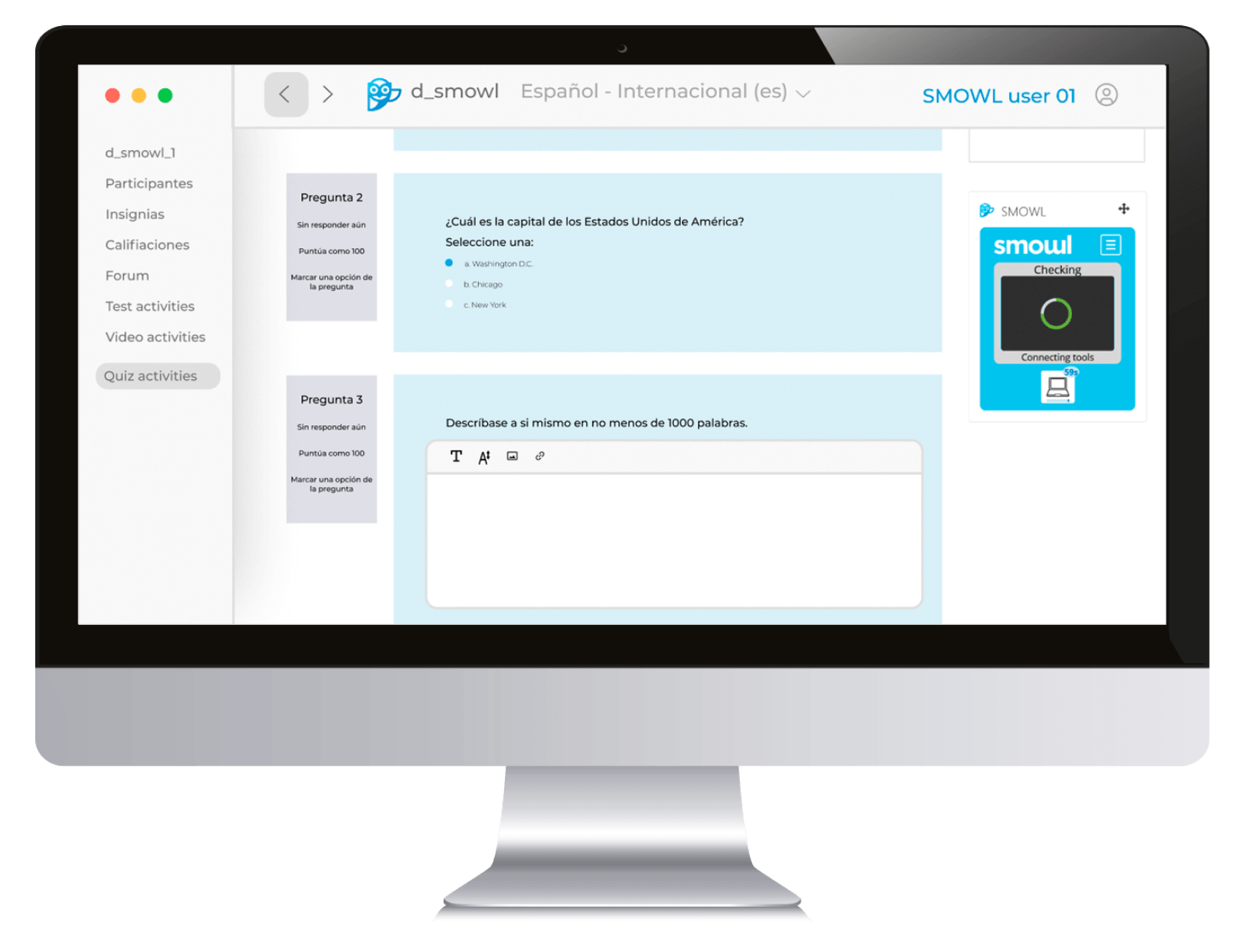
This approach is naturally complemented by Smowltech’s proctoring plans, which respect academic integrity, privacy, and accessibility, allowing for ethical and flexible supervision of online exams. In addition, they integrate seamlessly with LMS platforms and allow you to adjust the level of supervision and monitoring.
By combining learning data analysis with intelligent supervision, you will bring key benefits to your students. You will achieve the following effects:
- Build trust and credibility without being invasive, protecting and enhancing the student experience and ensuring the integrity of online assessments.
- Protect student privacy and autonomy with scalable, tailored controls ranging from simple webcam monitoring to advanced artificial intelligence detection.
- Ensure quality, equitable, and sustainable education by facilitating the expansion of digital learning and breaking down physical barriers.
Want to see for yourself how our proctoring solutions work? Request a free demo and we’ll show you how we can boost your educational project.
Practical learning analysis tools and resources to take you further
One of the great advantages of the digitization of education is the many resources you can access to further explore the benefits of learning analytics.
Here are a few to get you started:
- Learning Analytics Center of Excellence (LACE). A center at the University of Wisconsin-Madison that supports data-driven educational practices.
- Penn Center for Learning Analytics. A space at the University of Pennsylvania that combines large- and small-scale methods to apply learning analytics with a multidisciplinary approach.
- Learning Analytics 101 – NYU Steinhardt. This is an interesting project from New York University that serves as a structured introductory guide to understanding the fundamentals, methods, and challenges of learning analytics.