In meaningful learning, students connect new content with prior knowledge, promoting deep understanding and long-term retention.
Unlike rote memorization, this educational approach, proposed by David Ausubel, encourages active student participation, reflection on their learning process, and the construction of their own knowledge.
Among its main advantages are improved motivation, the development of critical and analytical skills, and enhanced transfer of learned knowledge.
We invite you to keep discovering the foundations of this theory, how to create meaningful learning, and why it’s so valuable to do so.

What is meaningful learning?
Meaningful learning is a constructive cognitive process in which the acquisition of new information is substantively and non-arbitrarily related to the learner’s existing mental structure.
The new knowledge is incorporated into the learner’s prior, specific, and relevant information, composed of what Ausubel called subsumers or anchor ideas. The result is stronger knowledge, deeper understanding, long-term retention, and improved transfer of learning to new contexts.
Specifically, it is a non-arbitrary process through which meanings are acquired by interacting with relevant existing knowledge that acts as an integrative matrix.
As for substantiveness, meaningful learning doesn’t involve memorizing words or literal expressions; rather, what is learned is the essence or substance of the new knowledge. Thus, it’s not just a simple association but a deep relationship that fosters a dynamic reorganization of both old and new meanings.
In short, this process is based on the deep relationship among ideas, concepts, or propositions that interact to generate new knowledge and modify the learner’s cognitive structure.
As Marco Antonio Moreira notes in his article So, what is meaningful learning after all?, the concept of meaningful learning underlies other constructivist theories, such as Piaget’s assimilation scheme, Kelly’s personal construct, or Johnson-Laird’s mental model.
Importance of subsumers’ quality
Because new knowledge anchors to existing knowledge or subsumers, these must be clear, stable, and distinguishable, highlighting the importance of ongoing professional development strategies.
To illustrate this, if you want a student to understand thermodynamics, they must already have solid, “anchored” knowledge about work, energy, and temperature in their cognitive structure.
Meaningful vs. mechanical or rote learning
Ausubel contrasts meaningful learning — non-arbitrary and substantive — with mechanical or rote learning, which is arbitrary and disconnected from prior knowledge, leading to shallow and short-lived retention.
Theoretical foundations of meaningful learning
According to David Ausubel’s theory, the principle of assimilation explains how new knowledge integrates into an existing cognitive structure through two mechanisms:
- Progressive differentiation: introducing general concepts that are later detailed.
- Integrative reconciliation: establishing relationships of similarity and difference between previous and new ideas.
In this process, prior information transforms and integrates with the new into more complex yet more stable psychological meanings, though subject to partial forgetting or obliterative assimilation.
For example, if a student understands “trash” as waste, they can then learn the concept of “recycling.” This new concept integrates into prior knowledge, which changes — “trash” no longer only means waste but also usefulness (proper waste management). This understanding also enables deeper exploration of related topics such as the importance of recycling and its environmental impact.
Do you want to stay on top of the latest trends in eLearning, EdTech, and Human Resources?
Fill out the form to receive our weekly newsletter with industry insights from our experts.
The principle of obliterative assimilation
Obliterative assimilation is the process following meaningful learning that involves forgetting. However, it’s not an inability to recall; it’s part of cognitive reorganization in which more general and stable knowledge persists while recent details tend to fade.
In essence, it’s a kind of economy of thought (similar to linguistic economy, where the goal is effective communication): it’s easier and more efficient to retain general, stable concepts than new, specific details.
Levels of learning in obliterative assimilation
Throughout knowledge acquisition, memory reorganizes and cognition develops hierarchically and dynamically through three types of learning:
- Subordinate. New concepts are included under broader preexisting ones. For example: once a person knows the concept of “mammal,” they can learn that whales belong to this group, expanding an existing concept.
- Superordinate. Occurs when new information organizes and generalizes previous concepts. For example: a person who already knows what a whale, a lion, and a dog are learns the concept of “mammal.” This new knowledge encompasses existing data and reorganizes it by generalizing previous notions.
- Combinatorial. In this case, new information establishes non-inclusive, non-specific relationships with previous cognition. For example: if someone knows about healthy eating habits and the Mediterranean diet, when they learn the importance of a balanced diet, they can relate it to those previous concepts, creating cross-connections in their cognitive structure based on points of contact.
What types of meaningful learning can be developed in education?
According to Ausubel’s theory, there are three types of meaningful learning: representational, conceptual, and propositional—each with increasing complexity. Let’s look at them in detail.
Representational learning
Representational learning is the most basic and foundational type. It involves attributing meaning to specific symbols that were previously arbitrary, which may represent objects, events, or concepts. It connects perception to meaning.
For example: Imagine a child perceiving a specific object — a car — while simultaneously learning the word “car.” At that moment, they are constructing the meaning of the word that represents what they see.
Importantly, this is not just a simple association between symbol and object. As Ausubel said, “the child relates them in a relatively substantive and non-arbitrary way, as a representational equivalence with relevant content already present in their cognitive structure.”
Therefore, representational learning acts as a kind of cognitive bridge based on direct perceptual experience, linking it to linguistic symbols (words, signs), and creating a meaningful equivalence between both. This lays the foundation for more complex learning.
Conceptual learning
Conceptual learning is a more complex process that involves grouping elements sharing common characteristics to form categories. This knowledge acquisition goes beyond recognizing an object or situation; it focuses on differentiation, understanding, and relation among concepts.
In other words, it allows a person to distinguish characteristics yet recognize that they belong to the same concept. For example, someone understands that “mammal” refers not only to dogs and cats but to a group of animals sharing common biological traits, also distinguishing them from reptiles.
This type of learning unfolds through two processes:
- Formation: through direct experience and hypothesis testing.
- Assimilation: expanding vocabulary via combinations available in the cognitive structure.
Through this learning, people can classify, relate, and understand the world around them, and apply this knowledge in daily, academic, and professional situations.
Propositional learning
Propositional learning is the most advanced type, as it involves understanding the meaning of ideas expressed in meaningful chains (propositions or word combinations). This happens through combining several concepts to create a meaning greater than the sum of its parts.
In this sense, new, elaborated cognitive content is generated and assimilated into the existing structure. This mechanism enables humans to develop complex philosophical, scientific, and mathematical reasoning.
These three types of meaningful learning don’t function independently but support each other according to the complexity of the learning process.
Meaningful learning vs. discovery and reception learning
Before addressing how to make learning meaningful, it’s important to clarify that meaningful learning and discovery or reception learning are different categories, but they can coexist.
Discovery learning is an active methodology where students must discover or reconstruct content themselves, reorganizing information through their experiences. However, this method doesn’t guarantee meaningful learning because it depends on whether the student has suitable subsumers. Otherwise, new knowledge will be acquired mechanically and arbitrarily.
In reception learning, content is presented to the student in its final form rather than discovered independently, but this doesn’t automatically make it passive. If the student actively links new information with what they already know, learning becomes meaningful.
This highlights that what truly matters is not the method itself. Learning isn’t inherently passive or active; what’s essential is how the student integrates what they learn into their cognitive structure.
To make learning relevant and solid, certain conditions must be met, which we’ll now explore.
How to make learning meaningful: Ausubel’s 3 requirements
According to Ausubel, three conditions are necessary for meaningful learning: the material must be potentially meaningful, an adequate prior cognitive structure must exist, and there must be an intentional attitude toward learning.
Potentially meaningful material
Instructional design must be coherently and clearly organized so the student can understand how general concepts relate to more specific ones, and progressively differentiate and assimilate them.
Adequate prior cognitive structure
The second requirement is that the student possesses subsumers that can act as anchoring points for new information. Therefore, the organization and stability of existing knowledge are essential.
Readiness for meaningful learning
The learner’s willingness to learn is a key factor in the success of any educational method—and this case is no exception. The student must show readiness to learn in a substantive, not literal, way. After all, this process requires cognitive skills such as selective and sustained attention, activation of prior knowledge, and active elaboration.
All three requirements must occur simultaneously to ensure that the learning process is meaningful, and for that, the teacher’s role is crucial.

The teacher’s role in meaningful learning
As discussed, teachers play a fundamental role in this approach and must:
- Identify what the student already knows before introducing new content to detect anchoring points.
- Design active learning situations so students can engage with the material through activities, resources, and didactic materials.
- Act as a guide or mediator rather than a mere transmitter. Methods that foster metacognition — encouraging students to reflect on how they think and learn — such as guided self-assessments, are very useful.
- Provide ongoing, constructive feedback to help students overcome difficulties.
- Select methodologies and approaches aligned with educational goals and proposed content, such as group dynamics, case analysis, or simulations.
The main challenge, as you can infer, lies in preparing the teaching community to successfully fulfill their role as designer, facilitator, guide, and strategic evaluator.
Methodologies for meaningful learning in the classroom
At this point, you’re probably wondering what specific methodologies you can implement in the classroom to foster meaningful learning.
There are many possibilities, especially with the technological revolution in education, but the key is to combine expository, demonstrative, interrogative, and discovery methods.
Here are a few examples:
- Elaborative interrogation: Connects new information with existing concepts by asking “why” and “how” questions.
- Cooperative learning: Encourages students to build collective knowledge through social interaction.
- Project-based learning: Students solve real, complex problems using knowledge from multiple fields.
In any case, remember that to create meaningful learning, it’s essential to meet Ausubel’s three requirements: potentially meaningful material, adequate prior cognitive structure, and student readiness.
8 core advantages of meaningful learning
A good way to summarize the importance of meaningful learning is through its main advantages:
- Optimization of information acquisition and storage: Students connect new knowledge with previously consolidated information.
- More durable, stable long-term retention, minimizing the effects of the forgetting curve.
- Active participation: The student becomes the protagonist of their own learning.
- Development of critical thinking: The learner acquires skills to relate, question, and deeply analyze information.
- Deep understanding and transfer of information: Since understanding is deeper and anchored to prior knowledge, students can apply what they’ve learned in different contexts—fostering lifelong learning relevance.
- Greater motivation and autonomy: The learner becomes aware of the value of knowledge, integrates it into their reality, and understands how to enhance their own learning.
- More effective education: The educational process promotes personalized, high-quality learning that empowers students and improves their academic performance.
- Future readiness: It equips learners with problem-solving skills and the ability to face new situations, enhancing academic, professional, and personal growth. It also enables lifelong autonomous learning.
All these benefits show how this type of learning transforms education, promoting deep understanding, long-lasting retention, and independent, effective knowledge transfer.
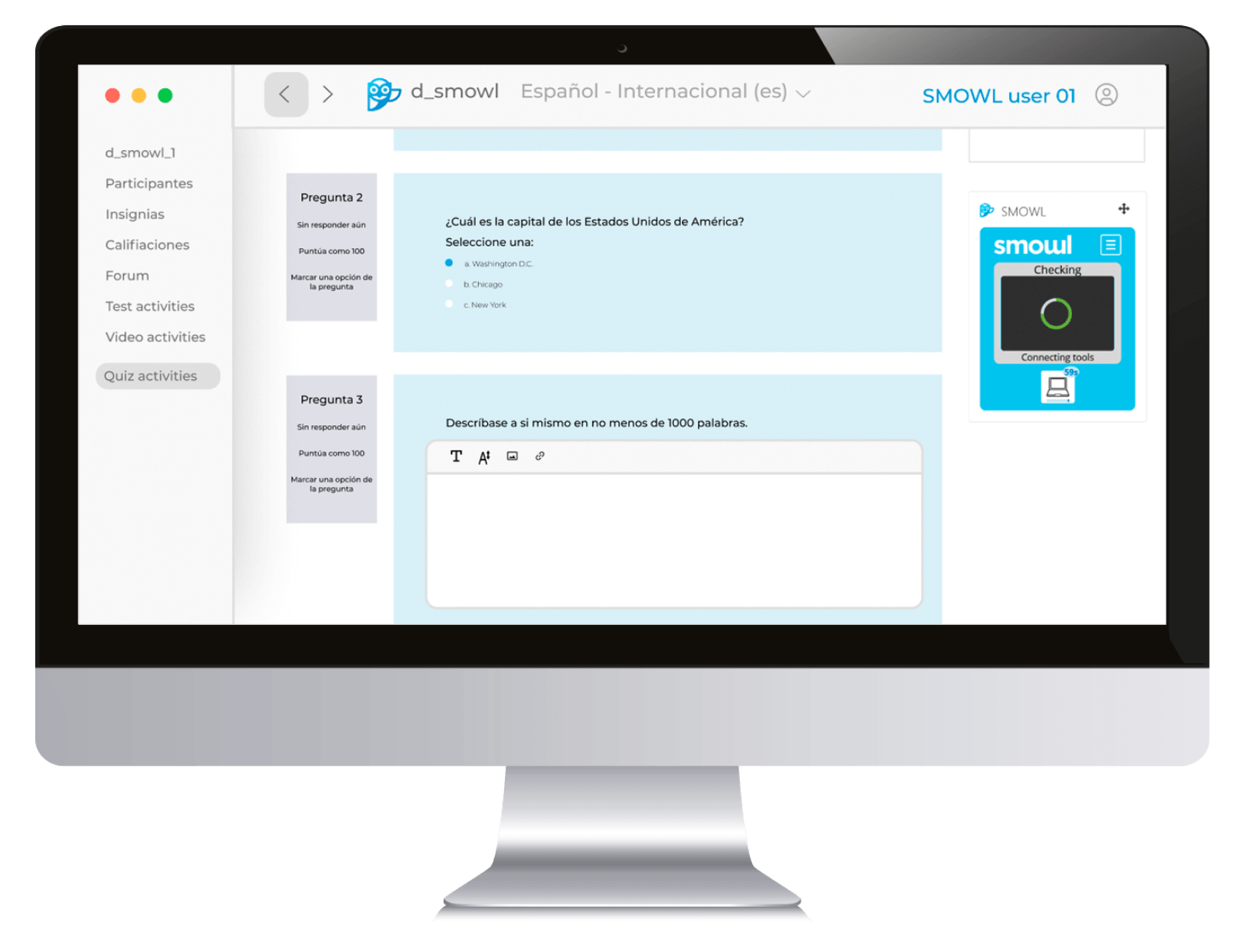
In meaningful learning, proctoring tools like SMOWL complement assessment to ensure academic integrity during remote exams and tests.
Thanks to resources like artificial intelligence, our proctoring plans ensure that your evaluations reflect true content assimilation. You can request a free demo in just a few minutes to discover how we can help.
Resources to further explore meaningful learning
Below are several scientific studies that allow you to delve deeper into meaningful learning and its transformative power:
- The Use of David Ausubel’s Theory of Meaningful Learning in Professional Health Education (Maebara et al., 2024). This paper reviews the application of Ausubel’s theory in health professional training.
- Meaningful Learning Theory and Science Teaching Through Research (Ferreira et al., 2022). Discussion of meaningful learning theory and science education.