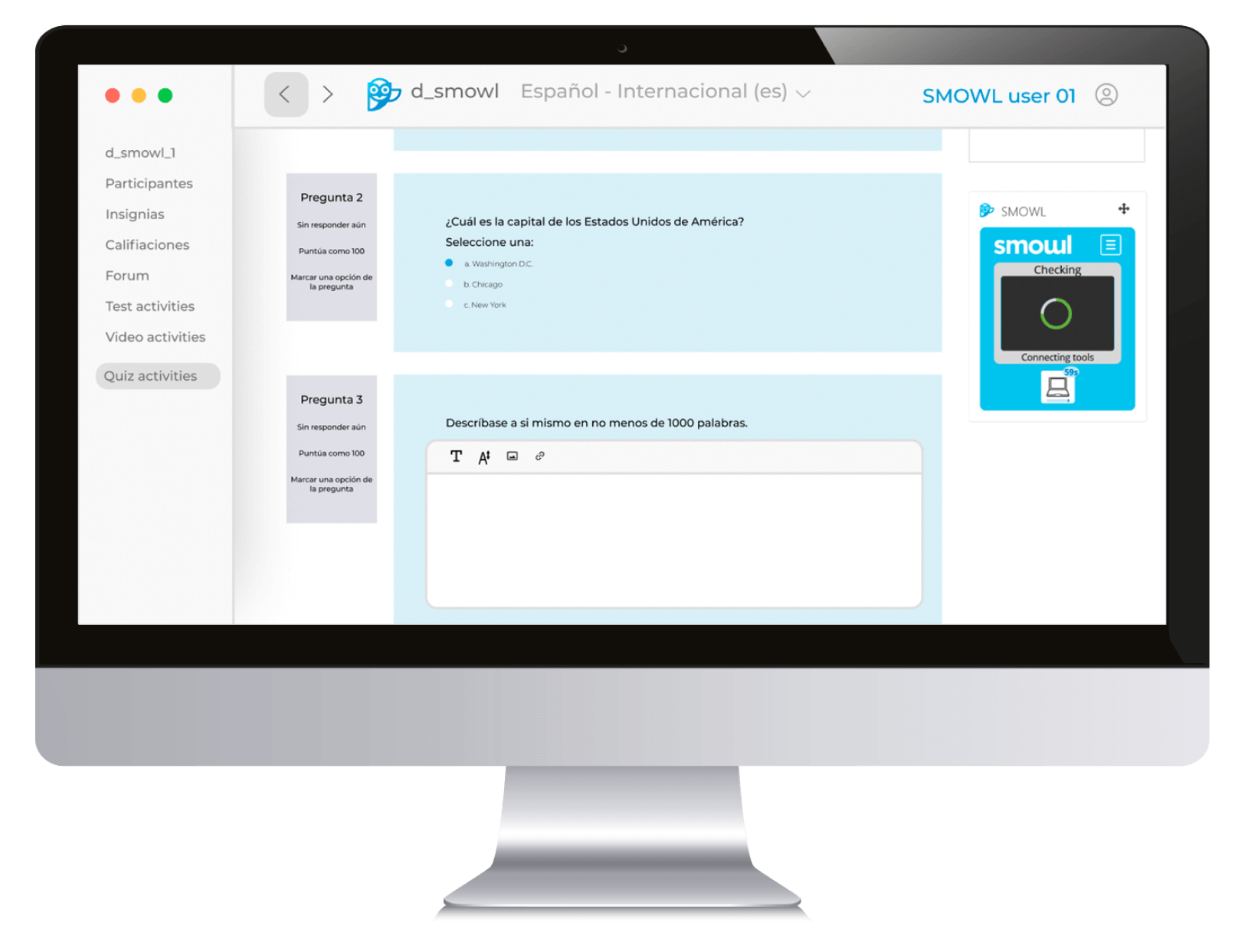
Online tests have become a handy tool for validating and accrediting the knowledge of students and candidates in specific subjects.
A series of applications and tools have emerged for an online exam to obtain the same security and reliability guarantees as a face-to-face exam. SMOWL stands out thanks to its on-demand services and competitive prices.
We invite you to read on so you can have a complete overview of what an online exam is and all that it entails, as well as its advantages and disadvantages.
What is an online test or exam?
An online exam is a test that students and candidates can take online to measure their knowledge or understanding of a subject.
The figure of the examinee covers different profiles and thus may be: a student, a job candidate, an employee seeking training and certification, etc.
The online exams, like the face-to-face ones, may consist of theoretical or practical tests (although these, in some cases, have a series of limitations when the test modality is online).
The most obvious example is the practical driving tests, which the examinee must take in person. Another clear example is the scientific or chemical tests carried out in laboratories with specialized equipment.
Once the test has been completed, the examinees may receive a certificate or diploma accrediting their correct performance in the subject matter, with the examiner in charge of scoring such performance.

How does an online test work?
The online test is also known as a digital or electronic exam. This is because they require remote access via the Internet or a corporate intranet that allows the candidate to take an online test through the platform or the device that will serve as the test vehicle.
A large part of online exams is designed using quick question processing modules. This ‘system’ allows examiners to quickly correct the results, which are ready almost as soon as the test is over.
However, an online test can also be designed to give open and multiple-choice answers.
Some online tests also include a time limit component, blocking the option of new answers once the established time has expired.
Finally, the examinees can receive their results by e-mail or by accessing this information on the examining organization’s website, virtual campus, or provided software.
How is an online test conducted?
The way an online test is conducted depends largely on its purpose and the stakes involved. A low-stakes test, such as a short quiz to gauge general knowledge and adjust future lessons, does not require the same level of rigor as an exam that determines whether a student qualifies for a degree.
The same applies in professional settings: a quick test to confirm employees understand a new tool can be simple, while pre-hire assessments — where career opportunities are on the line — demand stricter procedures.
When the risk of cheating is high, advanced proctoring tools are used. These technologies are designed to prevent fraud and encourage honest behavior by making it the easiest option.
Depending on the exam, measures may include locked browsers, computer monitoring, webcams, secondary cameras, audio recording, or a combination of these. Such solutions ensure reliability while maintaining the flexibility that makes online testing so appealing.
History and evolution of online tests
Online exams trace their origins back to educational platforms in the late 1990s and early 2000s, when systems like Moodle and Blackboard began allowing digital assessments in closed environments.
However, it wasn’t until the rise of e-learning in the 2010s — and more specifically, during the COVID-19 pandemic — that online exams became established as a real and necessary alternative for all types of educational and corporate institutions.
Today, with the development of technologies such as artificial intelligence, remote proctoring, and biometrics, online exams have reached a level of maturity and reliability that makes them comparable to — and in some contexts even superior to — traditional assessments.
Online test proctoring services: maintaining academic integrity in the digital age
With the rapid digitalization of education, institutions and organizations face the challenge of ensuring that remote exams are just as trustworthy as traditional in-person assessments.
Online test proctoring has become a key solution, helping maintain academic integrity in remote settings while also being useful for monitoring digital in-class exams.
As we will explain later, online assessments bring far more advantages than drawbacks, which is why more institutions are moving toward digital programs. Proctoring plays a vital role in this transition, ensuring that exams are fair, secure, and reliable across all types of courses and certifications.
Beyond academia, proctoring solutions are increasingly valuable in the corporate world. Recruiters and HR professionals rely on them to carry out fair and efficient evaluations throughout hiring, professional certification, and post-training processes.
In this way, proctoring has become a cornerstone of modern evaluation, bridging trust and technology in both education and the workplace.
Comparison between online tests and in-person assessments
As the use of digital technologies has become more established in both educational and professional settings, more and more people are asking themselves whether it’s better to choose an online exam or stick with the traditional in-person format.
Both systems have particular characteristics that address different needs, contexts, and objectives. That’s why it’s important to understand the differences between these two evaluation formats in depth.
Below, you’ll find a comparison that highlights the advantages and drawbacks of each one based on key criteria such as accessibility, cost, flexibility, and security.
| Feature | In-person test | Online test |
| Accessibility | Limited | High |
| Logistical costs | High | Low |
| Scheduling flexibility | Low | High (depending on modality) |
| Supervision | Direct | Remote (with proctoring) |
| Environmental impact | High (paper use, travel) | Low (digital) |
| Automatic grading | No | Yes (in many cases) |
| Need for travel | Yes | No |
| Time to publish results | Slow | Immediate or very fast |
What are the advantages and disadvantages of online tests?
Knowing the advantages and disadvantages of online exams will allow you to decide when to implement this type of assessment in your process.
Awareness of the disadvantages of online exams can also be the best way to neutralize them and find solutions or alternatives.
Advantages of taking an online test
The digital transformation that has taken place in most companies and educational centers (both public and private) has brought solutions and advantages never seen before.
Proctoring guarantees control and safety
One main disadvantage of online exams is the lack of security and control systems around this type of testing.
Companies like Smowltech are aware of this handicap. To overcome it, they offer online exam proctoring software solutions that allow their clients to access proctoring systems that ensure proper test performance.
Ubiquity and accessibility
An online exam allows the user to choose where to take it: from home, workplace, etc.
A computer and an Internet connection are practically the only requirements you need to carry out an online test, which you can even take at the time of your choice (in most cases, examinees must take it at the agreed time).
Environmentally friendly
Traditional paper-based examinations require indiscriminate felling of trees to convert wood into paper.
This has a huge negative environmental impact compared to the option of taking online exams, where a digital record replaces the printing of documents.
Time-saving
We live in an immediate world where people seek to optimize their time in the best possible way.
Time savings from online testing benefit test takers and examiners, including not traveling or reducing waiting times to start the tests.
Cost reduction
This kind of online qualification also brings a range of financial savings.
- Logistical cost reduction: hiring a space to host the exams is unnecessary.
- Administrative cost reduction: hiring personnel to keep track of registrants and candidates is unnecessary.
- Human cost reduction: the number of staff associated with the evaluations is lower since the institution doesn’t need in-person monitoring (completed by software monitoring).
Automated evaluations
As mentioned above, the evaluation of an online exam can be automatic and even reflected as soon as the test is completed.
This corrections system is practical and agile and makes it possible to remove possible human scoring errors, which are eliminated thanks to the automatic revisions based on templates with model answers.
Do you want to stay on top of the latest trends in eLearning, EdTech, and Human Resources?
Fill out the form to receive our weekly newsletter with industry insights from our experts.
Disadvantages of taking an online test
There are two main drawbacks:
- A lack of control of examinees could exist if systems are not implemented in this sense. The solution is to use an already existing software on the market that measures, for example, answering time per question.
- Greater precision is needed when designing the exam and formulating the questions so the examinee cannot cheat. An excellent professional will overcome this obstacle without any problems by including, for example, long answers that do not allow automatic correction but force the candidate to answer them personally.
Finally, we recommend taking a look at another one of our guides, where we discuss the advantages and disadvantages of online exams, whether written or oral, in more depth.
Profiles that benefit the most from online tests
The online assessment format is not only here to stay but has also proven to offer effective solutions for different profiles with specific needs. Some of the people or groups who benefit the most from online exams include:
- Distance learning students: Since they don’t need to travel and can take their exams from anywhere, this format is ideal for those studying from home or in remote areas.
- Working professionals: Many employees seek to update their skills through online courses or certifications. Digital exams allow them to balance training with their work schedule.
- Job candidates: Companies and consulting firms use online tests to screen or validate skills quickly and securely.
- Trainers and coaches: They can evaluate their students’ progress without geographic barriers, expanding the reach of their training programs.
- People with reduced mobility: This format provides a clear advantage by eliminating the need to physically attend a testing center.
Most common types of online tests
The variety of online exam formats makes it possible to adapt to different types of content, skills, and educational objectives. Below are the most common ones:
- Multiple-choice tests: Allow knowledge to be assessed quickly and objectively, with the advantage of automated grading.
- Open-ended or essay questions: Useful for measuring the examinee’s ability to analyze, synthesize, and argue.
- Case-based exams: Especially common in corporate or professional training, where real-life situations are presented to evaluate decision-making.
- Simulator-based tests: Used in technical or healthcare fields, they recreate interactive environments where the user must act according to predetermined scenarios.
- Adaptive tests: Adjust the difficulty of questions based on the user’s answers, enabling a more personalized assessment.
The choice of exam type will depend on both the learning objectives and the profile of the student or professional being evaluated.
Proctoring functionalities for reliable online test taking
Reliability is one of the most important aspects that determines the success of any evaluation process, especially when it takes place remotely.
In online exams, ensuring that the results truly reflect the examinee’s performance requires a combination of technology, best practices, and planning.
Fortunately, there are multiple strategies that help maintain high standards of security and objectivity without sacrificing the convenience and flexibility that define this format:
- User authentication: Through official ID, facial biometrics, or two-step authentication.
- Environment control: Sound monitoring, screen sharing, external camera, and detection of external devices.
- Suspicious pattern detection: Eye movements, use of external applications, atypical response times.
- Alert and recording systems: For later review by the examiner.
- Practice tests: To allow users to become familiar with the technology.
Common mistakes when implementing online tests (and how to avoid them)
Those practice tests we mentioned in the last section can help prevent mistakes when implementing online exams. Here’s a list of common errors, starting with the one we already highlighted:
- Not running technical tests beforehand: Can cause frustration and access issues on exam day.
- Failing to properly inform students: It’s essential to explain both the technical requirements and the expected behavior during the evaluation.
- Designing unclear or overly broad questions: This can make fair and automated evaluation more difficult.
- Skipping supervision tools: Increases the risk of cheating.
- Overlooking connectivity issues: Protocols must be in place in case of technical failures.
How to take a knowledge test online: tips for examinees
Many students are curious about what it’s like to take an online exam, especially if it’s their first time being monitored by a proctoring tool. While this shouldn’t be a cause for concern, it’s helpful to keep the following points in mind.
Successfully passing an online exam doesn’t just depend on subject knowledge — it also requires prior technical and organizational preparation. Here are some practical recommendations to help you approach this type of test with greater confidence:
Check technical requirements in advance
Make sure your equipment (computer, camera, microphone) and Internet connection meet the requirements set by the exam platform.
Get familiar with the exam tool
If possible, take a mock test or trial run to learn the virtual environment, question types, and available features.
Find a quiet, distraction-free space
Choose a comfortable, well-lit location free of interruptions where you can stay focused for the entire duration of the exam.

Have your documentation ready
Many proctored exam platforms require user authentication with an official ID. Keep it handy and in good condition.
Follow the instructions given
Carefully read the guidelines before and during the exam. Make sure you comply with all rules to avoid issues or invalidation.
Manage your time
If the test is timed, distribute your time evenly across sections or questions.
Avoid using other applications
Close all unnecessary programs on your device to minimize distractions and ensure optimal system performance.
Stay calm in case of unexpected issues
If a technical problem occurs, follow the protocol set by the exam provider and contact support if needed.
Adopting these best practices can make the difference between a smooth experience and one full of setbacks. Proper preparation also helps ensure the evaluation is fair and truly reflects your knowledge.
How to cheat on an online proctored test
It is not uncommon to see students searching online for phrases like “How to cheat on an online test,” “How to cheat in an online webcam test” or “Pay someone to take my online test.”
While taking shortcuts may seem tempting, attempting to bypass modern proctoring systems is strongly discouraged. These solutions are highly effective at detecting academic fraud, providing evaluators with clear evidence that can lead to disqualification.
In fact, trying to figure out how to circumvent advanced proctoring platforms like SMOWL often takes far more time and effort than simply studying and preparing properly for the exam.
SMOWL proctoring for online tests
There’s no denying that online exams are an increasingly established, secure, and versatile alternative for all types of assessments. Thanks to solutions like those offered by SMOWL, it’s possible to guarantee integrity, accessibility, and efficiency in any context.
If, as part of an academic institution or organization, you would like to see for yourself what a proctoring tool like SMOWL has to offer, request a demo with us! It’s free and personalized.
Updated on