Professional skills are skills that enable people to develop well in a work environment and to reach the highest level.
In increasingly competitive and innovative markets, both professional skills and competencies are two dimensions that need to be enhanced.
The good news is that both can be trained and improved. Boosting them in teams guarantees success and talent retention.
Therefore, in this article, we are going to focus on what professional skills are and how you can improve and develop them effectively.
Difference between skills and abilities
As a starting point and to facilitate the understanding of professional skills, it is necessary to clarify the differences between skills and abilities.
In this sense, experts state that abilities are cognitive, while skills are physical and motor in nature. This explains why the term skill has often been translated into English as dexterity.
We point out three fundamental differences between abilities and skills:
- Aptitudes have a permanent character, while skills are adaptable.
- Talents are innate, not learned, while skills are acquired.
- Abilities are inferred from behavior, while skills are observable.
That said, when we speak of competences, we are talking about a combination of knowledge, skills, and behaviors that help to deal with different situations not programmed in advance and in a successful way, that is, that produce effectiveness within a precise context.
Abilities are specific capabilities of people that enable them to learn a task or job position.
We can think of them as the potential capacities to perform or acquire by learning the knowledge, skills, or specific responses that facilitate the adjustment to specific job responsibilities.
What are professional skills?
Professional skills are the capabilities to perform the operations of the job with ease, accuracy, and efficiency that require the contribution of perceptual processes, cognitive decisions, motor control, and even social processes.
They are learned relatively quickly and aim to achieve a goal by being task-specific.Skills are differentiated into soft skills and hard skills.

Soft skills
Soft skills are personal qualities related to emotional and social intelligence learned through practice and enhanced by dealing with and towards others.
Examples include communication skills, teamwork, creativity, thoroughness, integrity, the ability to work under pressure, a sense of organization, etc.
Developing these types of skills can help you even in your private life. For example, management skills can be instrumental in managing family budgets.
Hard skills
Hard skills are what you have learned to do – formally or informally – and improve by attending training or internships.
On the other hand, previously mentioned soft skills are learned through practice and error, requiring a more extended period to modulate them.
We speak of hard skills regarding competence in a foreign language, the ability to use software or a machine, make sales, write a summary, etc.
For this reason, they are also known as technical skills.
Both types of skills are essential in a work environment, as we will discover in this article.
Before continuing, it is important to point out that soft skills are more easily transferable than hard skills, since they are related to the way of working and organizing oneself at work, and the latter requires more time for specialization.
Do you want to stay on top of the latest trends in eLearning, EdTech, and Human Resources?
Fill out the form to receive our weekly newsletter with industry insights from our experts.
List of the most important professional skills: 15 current examples
From a global perspective, the list of the most important professional skills includes the skills closely linked to today’s markets’ changing conditions.
While it is true that each sector and company will require a specific set of professional skills, we can consider the following to be basic, although this list is not exhaustive:
- Adaptability and flexibility. They allow to face changes in a serene way and without affecting the person’s performance.
- Teamwork and collaboration. Facilitates the achievement of objectives thanks to the complementarity of its members.
- Multitasking. This type of profile is able to focus on what is relevant to each task quickly and without losing efficiency.
- Problem solving. It favors planning, and error analysis to find the best solution for all parties.
- Analytical and critical thinking. It is crucial in companies whose projects can be impacted by multiple factors.
- Effective communication. It is essential to know how to communicate decisions, ideas, and doubts in an assertive, respectful and efficient manner.
- Autonomy and time management. It helps to prioritize tasks and meet deadlines, being strategic in project management.
- Emotional intelligence. It allows to channel both frustration and stress, avoiding, in addition, that the worker’s competences are diminished.
- Technological skills. They are essential to boost productivity and competitiveness in a company, and increase the employability of people.
- Negotiation and persuasion. Strengthens the relationship with customers and suppliers, as well as with teams at different levels.
- Cultural competence. It is linked to empathy, the integration of people from different backgrounds and the development of new markets.
- Integrity. Promotes honesty and integrity in human relations within the company, increasing the trust and commitment of employees.
- Project management. Helps to plan, lead and organize any product or service generation strategy based on a budget, working conditions and set objectives.
- Creativity and innovation. Promotes the generation and exchange of new ideas that allow the company to keep up to date and stand out from its competitors.
Proofreading skills. They ensure that the message reaches the reader correctly at all levels: spelling, structure, relevance, and accuracy.

How to improve your professional skills: 5 effective tips
We share with you five recommendations for acquiring new knowledge, putting it into action, and transforming it into experiences that generate results at work:
- Experience.
- Professional education or training.
- Self-training and online training.
- Aptitude tests and online and offline skills.
- Competency tests
We will go into the details below to help you develop your talent and that of your teams.
Experience
Professional experience allows us to constantly improve our skills by repeating different tasks assigned to us as we face new situations.
One way to make the most of your experience and your teams is to conduct periodic evaluations.
Once a project is completed, identify what went well, the obstacles, and what you can improve in the future.
Professional development or training
Training helps improve the skills needed to perform a task correctly or best fit a particular position’s demands.
Many companies are providing professional training to their employees in their commitment to value.
In this context, mentoring and coaching, for example, are effective tools for the transfer of knowledge and know-how, as well as for the acquisition and development of professional skills.
Self-training and online training
A complementary option is self-training through readings, online courses, etc.
Online training is exciting and convenient as long as it is of high quality and has a secure environment with monitoring systems such as proctoring.
Online and offline tests of skills and abilities
Skills can be learned or developed in our lives as behavioral habits.
Knowing the development of each of our skills, we can decide which skills require us to work on them, and for this, professional skills tests are good tools.
Skills tests vary according to the ability to be measured. That is to say, there are tests to evaluate cognitive, vocational, or musical skills, so tests should not mix different abilities.
Competency tests
Finally, you can access basic skills tests, generic skills tests, or specific job skills tests through different methods such as videotaping or DISC profile tests that analyze four factors: decisiveness, influence, serenity, or compliance.
Thanks to these tests, you may even discover skills you didn’t know you had.

Professional skills training tools
In the development of professional skills, the type of tools you use is decisive.
The irruption of Information and Communication Technology in all areas of our society has led to the development of truly practical tools for the development of workers’ skills and competencies.
These types of programs and platforms increase the customization options of your training programs, as well as allowing you to automate certain aspects to improve the individual’s experience.
Here are four examples of such tools:
- Moodle. This Learning Management System (LMS) provides the possibility to easily program the competencies that an employee needs to progress through his or her training program.
- Blackboard. Anthology, in particular, is another intuitive LMS with multiple functions for customizing online learning paths to adapt them to the pace and characteristics of each person.
- Canvas. Another possibility is to develop interactive tutorials and customized programs to develop strategic skills in your teams.
- Brightspace. It also has a skills tool that allows you to update training objectives and propose adapted activities.
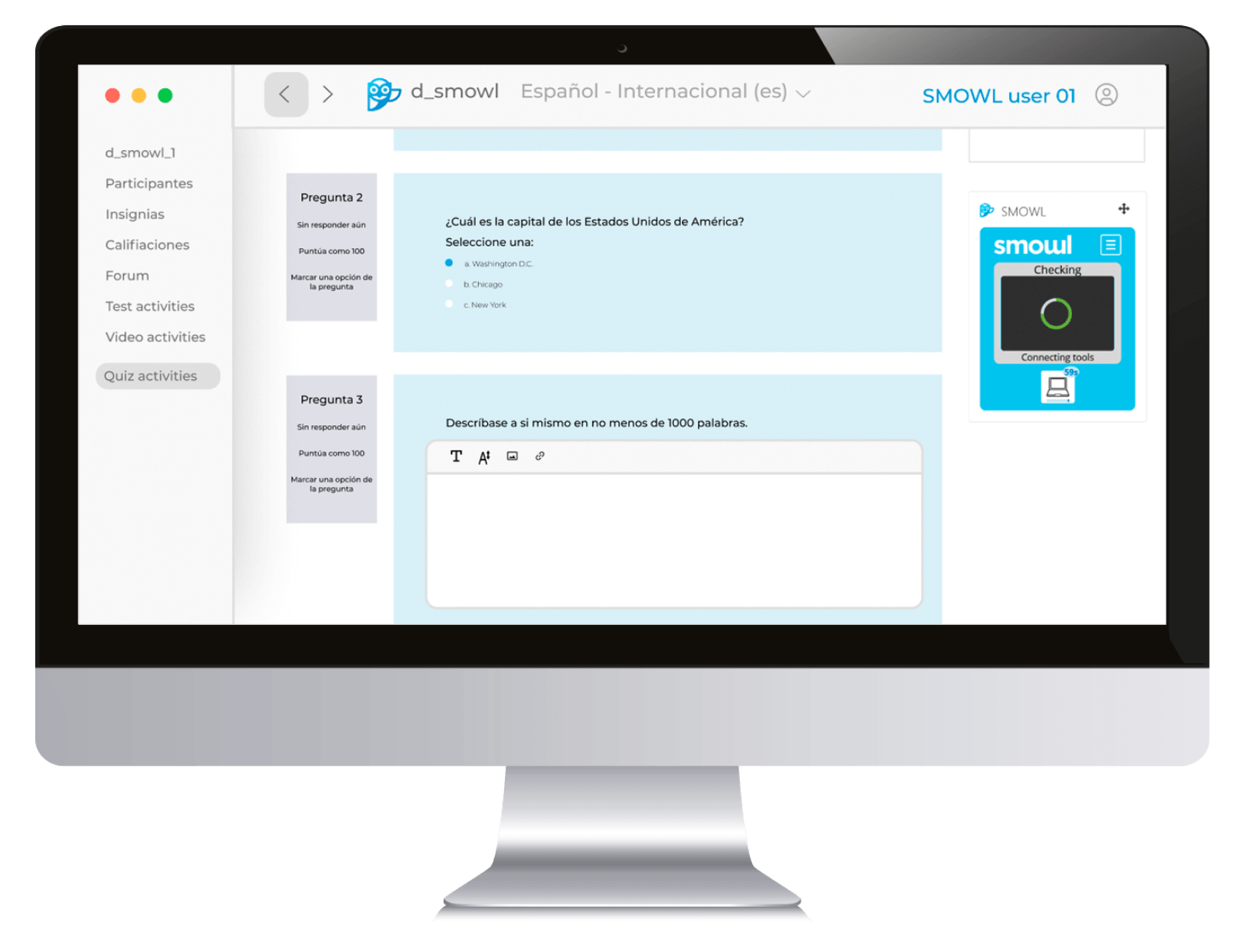
In this order of things and before revealing the most common mistakes in the development of professional competencies, it should be noted that SMOWL integrates effectively with these LMS, ensuring superior performance to enhance the user experience.
Common mistakes when developing professional skills
When developing professional skills, you may be confronted with some mistakes that can jeopardize the results of your training programs.
We have compiled for you the most common ones, according to information from experts consulted:
- Not involving workers in their own development or considering their expectations.
- Not setting clear objectives in training programs.
- Not encouraging social skills such as networking.
- Not conceiving the development of professional skills as a continuous process.
- Not taking into account personal characteristics such as age, digital divide, etc.
- Not adapting the training content to the employee’s expectations and business objectives.
- Failure to monitor the results of training and skills development objectively and effectively.
- Not having respectful online monitoring systems for remote evaluations.
Our proctoring plans offer secure environments that respect users’ privacy and allow you to observe and measure different aspects of tests, training, or coaching to enhance the abilities and skills of your employees.
Request your free demo, and we will explain all the solutions we can offer you.
Updated on
8 interesting facts about proctoring
Fill out the form and download the guide where we cover everything about online monitoring and help you choose the best software.