“What are proctored exams?” is a ubiquitous question in today’s educational community.
With the rise in popularity of distance education, proctored exams have become increasingly common. However, their use is not limited to remote learning, as more institutions are embracing digitalization and conducting exams on-site.
While widely used in education, proctoring solutions are also in demand among organizations for hiring candidates and evaluating employee knowledge.
One of the drawbacks that existed until recently was the difficulty of conducting digital assessments without compromising quality. But then, digital proctoring changed exam supervision forever.
In this article, we will explain what does proctored exam mean, how it works, and how to prepare an examinee for this kind of supervision during an assessment.
We will share best practices and point out behaviors that should be avoided during a proctored exam to ensure a good testing experience for users.
Moreover, we will explain how SMOWL can be beneficial for both institutions and organizations.

Proctored exam: meaning
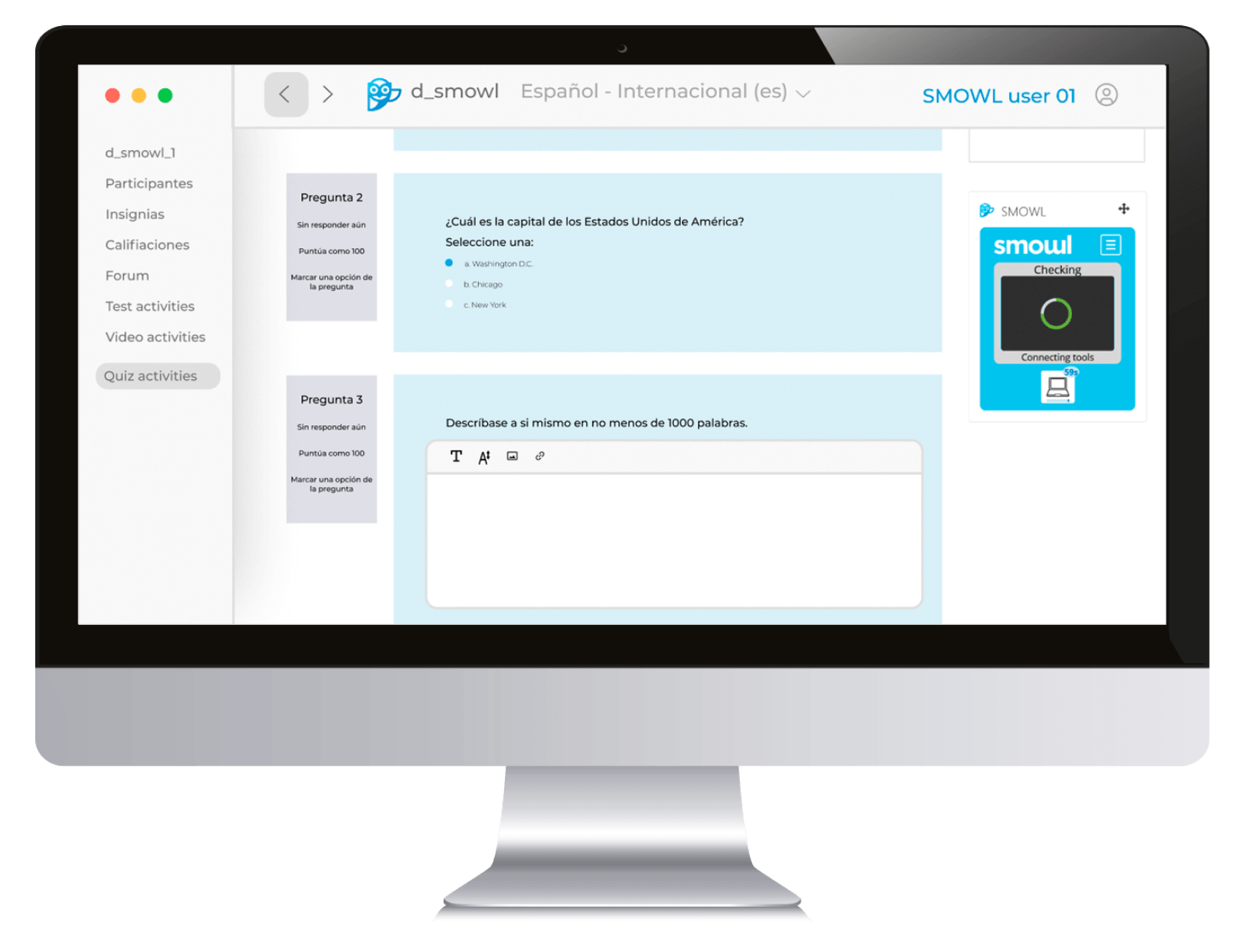
Online proctored exams are a type of remote test supervision where an examinee’s computer (in which the test is taking place) is monitored by proctoring software.
There are different types of proctoring systems, with the most common being locked browsers and computer monitoring solutions.
Institutions and organizations can select the technologies that best meet their proctoring requirements and combine them as needed to maintain integrity during digital assessments.
Exam proctors: from traditional methods to digital solutions
The role of exam proctors dates back centuries, traditionally involving in-person supervision to ensure fairness during assessments.
Proctors were responsible for monitoring test-takers, preventing cheating, and maintaining order in exam halls.
As education expanded and technology advanced, the concept of proctoring evolved.
The rise of distance learning and digital exams led to the development of digital proctoring tools.
Digital proctoring helps maintain academic integrity, making it a vital component of modern assessment practices in both educational institutions and professional environments.
How does a proctored exam work?
The steps involved in a proctored exam can vary based on the specific solution used by the academic institution or organization, as not all proctoring programs function the same way.
Below, we provide a general overview to help you understand how proctored exams typically work. Keep in mind that exam proctoring may also differ depending on the level of supervision selected by the evaluator.
Depending on the software in use, students may be required to register before beginning the exam. Systems with authentication features will later compare their ID or registration photos with the image of the individuals taking the test.
When the exam is launched, the supervision process will begin. Proctoring software can monitor an examinee’s desktop, audio, and webcam (it can record video and audio).
It can also determine which applications the user has opened, which text has been copy-pasted, or which devices have been plugged in or disconnected during the process.
Types of proctoring for exams
Exams can be proctored in different ways, depending on the needs of each institution or organization. Below are the four main types:
- Live proctoring involves real-time monitoring by a human proctor via video.
- Automated proctoring uses AI to detect misconduct.
- Recorded proctoring captures the exam session for later review.
- Hybrid proctoring blends automation with human oversight, reducing false positives.
What happens after a proctored exam?
After examinees have completed their online test, the exam session is saved and can be reviewed by evaluators.
The proctoring software itself will contain a section for results management where institutions and organizations can find all the necessary information for decision-making.
Many proctoring tools block the user in real time if there is any indication that they may be committing a violation in their examination. This disqualifies the student from further testing.
Other remote exam proctoring tools, such as SMOWL, give the possibility to allow the student to finish the exam and then report violations to the examiner.
If the system detects anything suspicious, it will notify the examiner, preventing cheating.
This allows the evaluator to determine the severity of the infraction and make an informed academic decision. In any case, it’s not the proctoring tool that makes the final call.
Do you want to stay on top of the latest trends in eLearning, EdTech, and Human Resources?
Fill out the form to receive our weekly newsletter with industry insights from our experts.
Do proctored exams invade privacy?
Institutions, organizations, and examinees may have concerns about whether proctoring technology infringes on privacy.
This is a valid question, as supervision can sometimes be perceived as intrusive surveillance. However, users of reputable proctoring software can be assured that their digital privacy is respected.
Trusted solutions comply with relevant data protection regulations and limit monitoring strictly to the duration of the exam. Once the assessment is complete, no further supervision occurs.
Does the proctored exam affect the test methodology?
No. Proctoring is just a monitoring tool. The methodology or the format of the exams depends on the LMS (Learning Management System) platform used by the institution or enterprise.
For example, in a platform like Moodle, the most common question formats on a remote test are multiple-choice, open-ended, or fill-in-the-blanks.
Benefits of proctored exams
Proctored exams play a crucial role in maintaining the integrity and credibility of assessments in both academic and professional settings.
As education and recruitment increasingly shift to digital and remote formats, ensuring secure, fair testing environments has become more important than ever.
Key benefits of proctoring include:
- Academic integrity: Helps detect and prevent cheating, ensuring honest performance.
- Fairness: All examinees are evaluated under consistent, monitored conditions.
- Credibility: Enhances the value of academic degrees and professional certifications.
- Remote accessibility: Allows exams to be taken from anywhere without compromising security.
- Confidence in outcomes: Helps employers and educators trust the validity of test results.
- Improved reputation: Demonstrates a commitment to high standards.
- Administrative efficiency: Provides recorded evidence that helps evaluators make informed academic decisions, saving time on manual review.
By incorporating proctoring tools into their assessment processes, institutions and companies can confidently ensure that their programs maintain quality, fairness, and trust.
Cheating in digital times
The digitalization of exams, particularly in remote testing, has made detecting cheating essential for maintaining academic integrity.
The rise of AI means test-takers can quickly search for answers, making it easier to cheat if exams are not properly supervised.
Academic institutions must ensure their online programs uphold the same standards and quality as on-campus courses. However, cheating is not only a concern for educational centers.
Companies also require reliable tools to verify that they are selecting the right candidates and that their employees are properly absorbing training material, and proctoring tools have become the key solution to this challenge.
It’s not uncommon for students to look up answers to queries like “how to cheat on a proctored exam” or “pay someone to take my proctored exam” nowadays, frequently leading to the discovery of inventive approaches.
To stay ahead of the curve, proctoring companies continuously update their technologies, aiming to create systems where honesty is the easier — and only — option.
Comprehensive proctoring solutions are designed to monitor exams so thoroughly that cheating becomes impossible, ensuring fairness and credibility across both educational and corporate assessments.
How to prepare an examinee for a remote proctored exam?
The chosen proctoring solution may require students to install an app or software on their computers.
Other options, such as SMOWL, are integrated within the institutions’ virtual campuses, so they can be launched automatically when the students start the online activity.
The only hardware requirements for students are their computer, a webcam, and a microphone to perform authentication and other checks during the exam.
When required by the institution or organization, examinees will need to use their smartphones as an additional camera.
To help reduce exam-related stress, users are encouraged to follow the guidelines outlined below.

Proctored exams: best practices
Taking a proctored exam can feel intimidating, but following best practices can help students, candidates, and employees stay calm and perform their best:
- Prepare the environment: Examinees should choose a quiet, well-lit space free from distractions. Their desk should be clear of unauthorized materials, and they should ensure they will not be interrupted during the exam.
- Test the technology: Before the exam, test-takers need to verify that their computer, webcam, microphone, and Internet connection are functioning properly. Closing unnecessary applications can help prevent technical issues.
- Familiarize with the proctoring software: Users are encouraged to complete any available practice tests and review instructions to understand what to expect during the exam.
- Follow the rules carefully: Examinees should avoid behaviors that might be flagged as suspicious, such as frequently looking away, speaking aloud, or using unauthorized devices.
- Know where to find support: It is important for candidates to familiarize themselves with the available support options and learn how to seek help if they encounter any issues during the test.
- Stay calm and focused: Taking deep breaths can help reduce nervousness before and during the exam.
By preparing properly and understanding the process, examinees can approach their proctored exam with confidence and focus.

Who can benefit from proctored examinations?
This technology is being adopted by academic institutions and companies that want to train their employees or make their selection processes more secure and efficient, whether it is through remote or on-site digital testing.
Proctoring for education
Digital exam supervision can open the horizons of an institution and attract new students. The fact is that there are still many people who want to train or keep studying but who, due to their obligations, characteristics, or location, cannot access a face-to-face methodology.
In addition to giving a modern and technological image to an institution, proctored exams have an impact on students’ savings by allowing them to participate in distance learning activities.
For example, an American student wishing to take a master’s degree from a European university could carry out the entire process (education + evaluation) remotely, saving the costs associated with traveling and staying in another city to take the exams.
Proctoring for businesses
In the corporate sector, proctoring increases the reliability and quality of assessments while contributing to operational efficiency and cost savings.
The major use cases of proctoring in the corporate sector are:
- Certifications
- Training
- Recruitment
SMOWL can be the proctoring service that you are looking for
At Smowltech, we believe that each institution and organization is unique, and so is its evaluation process. That is why we have a SMOWL plan for each client.
Our service can be customized, but we consider some common elements to be the most significant advantages of SMOWL.
3 reasons to use SMOWL as your online proctoring exam software
- When an examinee is being monitored with SMOWL, the detection is image-based and not video-based, so the files generated are smaller and, hence, it works better in locations with limited Internet connectivity. As a reference, you can review this success story where SMOWL was selected by AMIU (Amref International University in Kenya) partly due to its strong performance on 3G Internet connections.
- Our business core is to maintain privacy by design: we are fully compliant with the European GDPR, the world’s most restrictive data protection regulation. This makes our tool suitable for other legal frameworks globally, like FERPA and CCPA in the U.S.
- It works with the main LMS systems on the market (Moodle, Canvas, Open LMS, Blackboard, Classe365, etc.) and it’s compatible with the most popular browser: Google Chrome. SMOWL also works seamlessly with Microsoft Edge.
Do you still need more reasons? Contact our sales team, and they will give you a couple more! You can also ask for a free trial to learn more about how online proctored exams work.
Updated on