5G technology is revolutionizing the world of telecommunications and marking a before and after in the way we connect.
As the fifth generation of mobile networks, 5G not only promises lightning-fast speeds, but also minimal latency, massive connections and efficiency that will transform both our daily lives and the way industries operate.
Have you ever wondered how it is possible to download a movie in a matter of seconds or how autonomous vehicles can communicate in real time?
All this, and much more, is thanks to 5G.
From smart homes to advances in telemedicine, this technology is laying the foundation for a hyper-connected future.
In this article, we will explore in depth what 5G is, how it works and why it is so important for modern society. We will also compare its advantages over 4G, analyze its impact on key areas such as the Internet of Things (IoT) and resolve common doubts about its adoption.
Join us as we discover how 5G is shaping a new chapter in the history of global connectivity.
What is 5G technology?
5G is the latest evolution in mobile network technology. With promises of higher speed, lower latency and unprecedented capabilities, 5G is not only improving the experiences of individual users, but also transforming entire industries.
Brief history of mobile generations
The evolution of mobile networks has radically changed the way we communicate and use technology.
Each generation marked a before and after in the way we live.
Impact of 1G: The beginning of mobile communication
In the 1980s, 1G introduced analog mobile communication. Although rudimentary, it allowed the first cordless calls. Phones were bulky and expensive, limited to a select audience.
An interesting fact: The Motorola DynaTAC, one of the pioneers in 5g technology, launched in 1983, weighed almost a kilo and offered only 30 minutes of battery life. Even so, it marked the beginning of a revolution.
2G: Digitalization and SMS
With 2G, launched in the 90s, came digital communication and text messaging (SMS). Call quality improved significantly, and SMS became a cultural phenomenon.
Precisely the arrival of SMS gave rise to the abbreviated language we use in chats today. In addition, affordable rates allowed more people to adopt mobile phones.
3G: Mobile Internet
3G marked the beginning of mobile web browsing in the early 2000s. Speeds were high enough to send emails, browse and use basic applications.
In fact, applications like WhatsApp and social networks grew thanks to 3G. It was also the network that drove the launch of the first iPhone in 2007.
Remember Steve Jobs with the iPhone 3G in his hand? Unrepeatable.
4G: Streaming and global connectivity
With 4G, launched in the 2010s, came high-definition streaming, online video games and real-time video calls, transforming the way we consume entertainment and work remotely.
In this decade, which is already much closer to us, platforms such as Netflix and YouTube thrived thanks to the capacity of 4G.

How does 5g technology compare with 4g technology
This is where 5G shows its true potential. How does it compare to 4G?
Let’s see:
| Feature | 4G | 5G |
| Speed | Up to 100 Mbps | Up to 10 Gbps |
| Latency | 20-50 ms | 1 ms |
| Connections | Thousands per km² | Millions per km² |
| Energy efficiency | Limited | Highly efficient |
In summary, 5G technology has greater support for advanced technologies such as IoT and augmented reality. In addition, a more efficient infrastructure that reduces energy consumption per connected device.
Main features of 5G
Strange as it may seem, 5G is not simply an improvement on 4G, but a rebuild from the ground up.
And its features are designed to meet the demands of an increasingly complex digital world. For example
High connection speed
Imagine downloading a full movie in high definition in less than 10 seconds.
That’s possible with 5G, which offers speeds up to 100 times faster than 4G. In real-world tests, 5G has reached up to 10 Gbps under certain conditions.
This allows for seamless experiences, such as 8K streaming, instant downloads and smoother online gaming.
Although, as with everything, the fact that you see the iconic ‘5G’ on your mobile does not mean that you are browsing at 10Gbps.
Low latency
With a latency of only 1 millisecond, 5G eliminates the delay in real-time communications.
This is vital for applications such as remote surgery and autonomous vehicles, where every millisecond counts. It also improves the gaming experience, offering immediate responses.
Massive connections
5G is designed to connect up to one million devices per square kilometer, which is essential in smart cities and dense environments.
This means that we can have sensors, cameras and other IoT devices connected seamlessly. In addition, networks do not collapse in mass events such as concerts or football matches or congested urban areas.
Do you want to stay on top of the latest trends in eLearning, EdTech, and Human Resources?
Fill out the form to receive our weekly newsletter with industry insights from our experts.
How does 5G technology work
The operation of 5G technology is based on using frequency spectra, an innovative network architecture, and advanced technologies such as MIMO (Multiple Input Multiple Output).
But the first thing you should know is that 5G uses three types of frequency bands that determine its range, speed and capacity:
- Low frequency (Sub-1 GHz):
This band offers wide coverage and solid signal penetration, even indoors. It is ideal for rural and suburban areas where long-distance coverage is crucial. Although its speed is lower compared to other bands, it is still faster than 4G. - Mid frequency (1-6 GHz):
Balances speed and coverage, making it perfect for dense urban and suburban areas. This band offers remarkable speeds and can handle a significant number of devices connected simultaneously. - High frequency (mmWave):
Millimeter waves are the jewel of 5G. They offer ultra-fast speeds of up to 10 Gbps, but have limited range and do not penetrate obstacles such as walls well. They are mainly used in dense urban areas, stadiums, airports and shopping malls.
5G is not only about faster frequencies; it also introduces a smarter and more flexible network architecture that improves data management:
- Virtualized networks: 5G uses technologies such as “network slicing”, which allows a single network to be divided into multiple virtual networks. This means that specific resources can be allocated for different applications, such as streaming, IoT or autonomous vehicles, without interfering with each other.
- Smart Core: The core of the 5G network is more advanced than in previous generations, allowing for more efficient data distribution and latency reduction.
- Use of Dense Base Stations: To ensure uniform coverage, 5G relies on a greater number of base stations, which transmit signals in small areas to maintain a constant, high-quality connection.
In addition, as we have already introduced previously, 5G employs massive MIMO (Multiple Input Multiple Output) technology, which uses multiple antennas in a single base station to transmit and receive multiple data streams simultaneously.
Imagine a stadium full of people using their phones at the same time. With 5G and MIMO technology, each device can stay connected seamlessly, as the antennas efficiently distribute data among all users.
This significantly increases network capacity and coverage, even in congested environments. In the past, with 4g, all the people who connected, for example, during the halftime of a game, had connectivity problems.

What is 5G used for?
In our daily lives, 5G redefines the way we interact with technology. Video calls will now be smoother, without interruptions or signal loss, even in high definition. In addition, 4K and 8K streaming will become the norm, providing cinematic-quality visual experiences.
Also, thanks to its low latency, augmented reality applications will be integrated into daily activities such as education, entertainment and shopping, offering interactive and personalized experiences in real time.
In the business world, 5G is driving efficiency and innovation. Smart factories leverage connected IoT sensors to automate processes and monitor every detail of production.
In agriculture, 5G-enabled drones monitor crops in real time, optimizing resources and increasing productivity.
The commercial sector is also being transformed, using virtual reality to create immersive shopping experiences, such as virtual fitting rooms or interactive store tours.
Areas of application of 5G
The impact of 5G extends to multiple key sectors, from smart homes to medical advances, driving a new level of connectivity and efficiency.
How does 5g technology enhance the Internet of Things?
5G is the foundation that powers the growth of the Internet of Things. Thanks to its ability to manage millions of connected devices at the same time, it eliminates communication bottlenecks and ensures fast and reliable data transmission.
This allows devices such as thermostats, security cameras, appliances and sensors to work in an integrated manner, facilitating smarter homes, cities with optimized traffic and fully automated factories.
For example, in a smart city, connected sensors can monitor traffic in real time, adjust traffic lights and reduce traffic jams, improving the quality of life of its inhabitants.
Autonomous vehicles
5G is essential for the safe and efficient operation of autonomous vehicles. Its real-time communication capability allows cars to interact with other vehicles, with infrastructure such as traffic lights and with pedestrians.
This reduces the risk of accidents, improves road safety and optimizes transport routes.
For example, an autonomous car can receive immediate information about an obstacle on the road and adjust in milliseconds to avoid it.
Health and telemedicine
In the health sector, 5G breaks down geographical barriers, making it possible for doctors and patients to be connected despite the distance.
Remote surgeries, performed with connected robots, are now a reality thanks to 5G’s low latency. In addition, IoT medical devices allow continuous patient monitoring, sending real-time alerts to medical personnel in case of emergencies.
Imagine a patient in a rural area who can be diagnosed and treated by a specialist located hundreds of miles away, all thanks to 5G connectivity.
Entertainment and augmented reality
Entertainment is also undergoing a transformation with 5G. Immersive games with virtual and augmented reality offer seamless interactive experiences.
Live events, such as concerts and sporting events, can now be broadcast in 360 degrees and 8K quality, allowing viewers to feel part of the event, no matter where they are.

5g advantages and disadvantages
5G is not just a technological improvement; it is a tool for social and economic progress. Its ability to connect people, devices and systems has profound implications for the way we live and work.
Digital transformation
The massive connectivity of 5G is accelerating the digitization of key sectors such as education, industry and commerce.
In the educational field, it allows access to interactive learning platforms, eliminating geographical barriers for students.
In industry, automated factories powered by IoT can operate with unprecedented precision and efficiency, reducing costs and improving product quality.
Creation of new jobs
The development of 5G is generating a wide range of job opportunities.
From engineers specializing in networks to cybersecurity experts and innovative application developers, the expansion of this technology is driving the creation of new business models.
This, in turn, contributes to economic growth and labor inclusion in various sectors.
In short, 5G is much more than an improvement in connectivity; it is the engine of a new digital era that promises to transform our daily lives, drive innovation and redefine the limits of what is possible in our society.
Barriers to overcome
Not everything is perfect with 5G technology. There are still barriers to overcome to achieve its global adoption.
Here are some challenges:
- Necessary infrastructure: The deployment of 5G requires significant investment in antennas, base stations and compatible devices.
- Government regulations: Governments must establish clear regulatory frameworks to ensure fair and safe implementation of 5G.
- Security and privacy issues: With more connected devices, cybersecurity risks and data privacy concerns increase.
Myths and realities about 5G
5G technology has been the subject of debate, rumors and misunderstandings since its launch. Some of these myths have generated concern among people, but it is important to analyze them based on facts and scientific evidence to clarify any confusion.
Does 5G affect health?
One of the most widespread myths is that 5G can have harmful health effects due to the electromagnetic radiation it uses.
However, multiple studies by international organizations, such as the World Health Organization (WHO), have concluded that the frequencies used by 5G do not pose a significant risk to human health.
These radiations are within the safety limits established by international regulations and are similar to those used in previous technologies such as 4G and Wi-Fi.
Does 5G have a negative environmental impact?
It is true that the construction of 5G infrastructure, such as antennas and base stations, can generate an initial environmental impact.
However, in the long term, 5G is more energy efficient than its predecessors. This means that it consumes less energy to transmit the same amount of data, which reduces its carbon footprint.
In addition, this technology allows the optimization of resources in other sectors, such as transport and energy, indirectly contributing to a lower environmental impact overall.
The future of 5G and beyond
Although 5G represents a huge leap in global connectivity, it is only the foundation upon which future generations of wireless technologies will be built.
6G, which is already in early stages of research and development, promises to push current limits, offering capabilities that today seem like science fiction.
6G: Revolutionary Speeds and Immersive Connection
6G is expected to reach speeds of up to 1 terabit per second (Tbps), the equivalent of downloading 100 high-definition movies in just one second.
These speeds will allow for fully immersive experiences in areas such as virtual reality (VR) and augmented reality (AR), eliminating any sensation of lag or interruption.
In addition, 6G will seek an even deeper integration between humans, machines, and intelligent environments, allowing for instantaneous and barrier-free communication between devices and systems.

Ubiquitous Connectivity and Advanced Applications
With 6G, connectivity will be virtually ubiquitous, allowing any location, from remote rural areas to densely populated areas, to have access to ultra-high-speed internet.
Technologies such as digital twins will benefit enormously, allowing physical environments to be replicated in the virtual world with real-time accuracy, which will be crucial for industries such as medicine, manufacturing, and urban planning.
The Role of Artificial Intelligence in 6G
Another outstanding feature of 6G will be the integration with artificial intelligence (AI). The network will be able to dynamically adapt to user needs and automatically optimize itself to improve its performance.
This will open the door to more intelligent and autonomous systems, such as vehicles that communicate directly with urban infrastructure or robots that interact seamlessly with humans in work environments.
Social Impact and Digital Transformation
6G will also play a key role in further bridging the digital divide, bringing connectivity to communities that currently lack internet access.
In addition, its ability to handle massive data flows instantaneously will drive new industries and transform areas such as education, health, and commerce, redefining how we live and interact with the world.
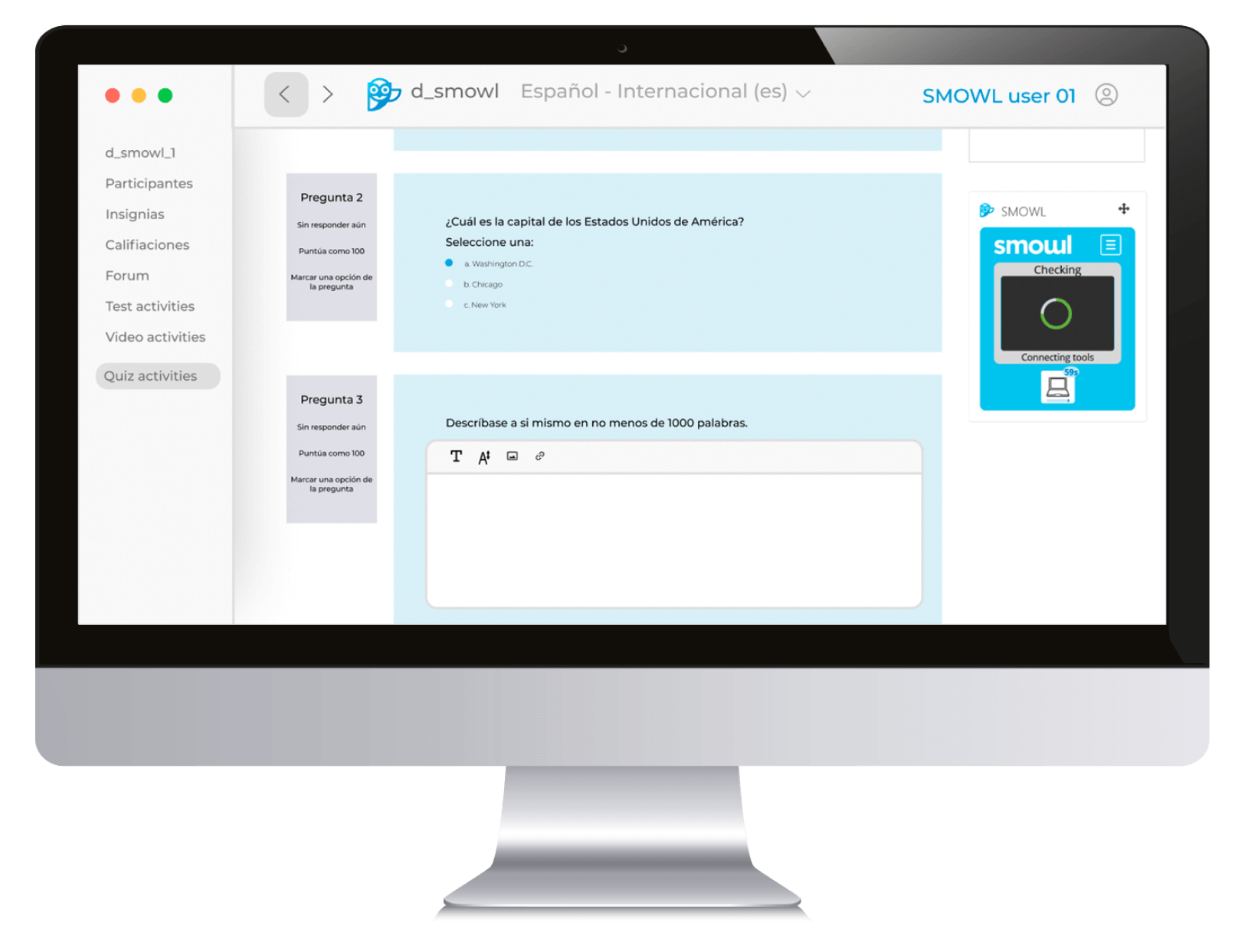
In conclusion, thanks to 5G technology, SMOWL can offer an even more efficient and reliable remote supervision experience, ensuring that educational institutions and companies can seamlessly and accurately monitor students and candidates during assessments.
Request a free demo and discover how SMOWL proctoring plans, along with 5G technology, can help you guarantee academic and professional excellence in your online assessments.
8 interesting facts about proctoring
Fill out the form and download the guide where we cover everything about online monitoring and help you choose the best software.