Cyber security risk assessment is an indispensable process for analyzing, detecting, and managing vulnerabilities in an organization’s digital systems.
Nowadays, practically all companies are connected to the Internet and have an Information Technology (IT) infrastructure. Knowing the magnitude of the risks to which you may be exposed, as well as their consequences, is necessary to protect the continuity of your project and its reputation.
In this sense, understanding what is a cyber security risk assessment is essential.

What is a cyber security risk assessment?
Cyber security risk assessment is a systematic process to identify and evaluate potential vulnerabilities and internal and external threats related to information technology (IT) environments within an organization.
The objective of this risk analysis is to protect confidential information, information systems and other critical assets exposed to cyber threats.
These threats can come from many different sources. They can come from the actions of cybercriminals such as data breaches or social engineering attacks or dark patterns, but they can also be due to other factors such as outdated applications and unsecured networks, among others.
Performing a cyber security risk assessment helps to raise awareness of the risks to which an organization may be exposed and to involve all members of the organization to avoid them and/or mitigate material and reputational damage to the company.
The fact of carrying out periodic risk assessments also allows organizations to remain at the forefront of cybersecurity and ensures compliance with regulatory frameworks on data protection and information integrity.
In this way, information society companies actively participate in the creation of a continuously evolving risk culture.
What is an NIST risk assessment?
NIST (National Institute of Standards and Technology) risk assessment is one of the most important cyber risk assessment frameworks.
It proposes a set of guidelines to help organizations avoid potential cyber-attacks and manage their risks, which are articulated in the following 5 basic steps
- Identify risks.
- Protect assets by implementing security controls.
- Detect security incidents.
- Respond by applying established protocols for each identified risk.
- Recover data and systems.
In that sense, the international standard ISO 27001 is a standardized framework that provides guidelines for implementing an information security management system (ISMS) based on specific requirements

How to conduct a cyber security risk assessment: 7 steps and example
Cyber security risk assessment is a system for assessing vulnerabilities and threats to identify the risks to which an organization may be exposed, predict their impact and implement the best responses.
We share with you the steps to follow and examples for you to consolidate your information
Do you want to stay on top of the latest trends in eLearning, EdTech, and Human Resources?
Fill out the form to receive our weekly newsletter with industry insights from our experts.
Determining the scope of the assessment
This systematic approach to risk can be comprehensive or it can be applied to specific organizational needs. In either scenario, it is important to have the support and participation of your stakeholders.
Proceeding in this way will enable your teams to become familiar with risk assessment terminology and will make it easier for you to implement mandatory requirements to protect your physical and personal assets.
| Examples |
| Depending on your industry, you will have to consider laws such as HIPAA (Health Insurance Portability and Accountability Act), Sarbanes-Oxley or PCI DSS (Payment Card Industry Data Security Standard). |
Identify and inventory network asset vulnerabilities
Once you have determined at what level you are going to act, you must identify and document all the components of your technical infrastructure such as hardware, software, applications and platforms, types of access and also the third-party services you have contracted.
In other words, you should audit all cyber processes, both internal and external, including the systems for secure data storage, to detect possible security gaps.
| Examples |
| Classify assets, devices or systems according to their value, commercial importance and legal status by creating a network architecture diagram. Remember to add relevant information to each element such as whether it is hardware or software, the date of the last update, etc. |

Identify and use sources of information on cyberthreats
You must have a database of official sources of information on cyberthreats to keep abreast of cybercriminals’ techniques, vulnerabilities that may affect you, etc.
| Examples |
| National sources such as the National Cyber Awareness System or InfraGard may be useful. You can also turn to local sources specific to your activity. |
Identify internal and external threats
We tend to think that cyber threats are only external, but this is not the case, accidental manipulations or malicious actions of an employee can put your company at risk.
That’s why it’s so important to identify and document threats linked to the vulnerability of processes and records.
Resources such as the ATT&CK Mitre or the Cyber Threat Alliance can serve as a reference at this point of your cybersecurity risk assessment.
| Examples |
| Some of the most common indicators of vulnerabilities are unusual user activity, unexpected account lockouts, unexpected diversion of network traffic flows, detection of vulnerability scanner usage, etc. |
Perform an analysis of risks and their impacts
Now that you have identified the risks, the next step is to classify them according to their likelihood and potential impact on all system dependencies and resources, including shared ones.
| Examples |
| Create a risk matrix that identifies and documents the risks. For example, detail the threat (a cybercriminal wants to steal data), the vulnerability (data storage without access control), the consequences (theft of confidential data, reputational damage and possible fines). |
Identify and prioritize risk responses
Risk-based decisions should be prioritized according to relevance, severity of consequences and probability.
In organizing responses, set up an accessible system that collects the contact information of those who may be impacted and those who must be involved to activate the action protocol in the event of a cyber attack.
Implement a risk register and monitor results.
Having an up-to-date risk register is essential to your cybersecurity strategy.
It should include information such as the risk scenario, the date of identification, the security controls, the level of risk, the person responsible and the protocol for action with technical controls (data encryption, firewalls) or with preventive policies that reflect best practices in this regard.
Finally, monitoring the results must be a continuous task that will also allow you to apply the necessary corrective measures to minimize cyber risks.
You can implement periodic audits, drills, cybersecurity training, awareness-raising sessions, etc.

Importance of risk assessment in cyber security
By now you have been able to discover the importance of risk assessment in cyber security, which can be summarized in the advantages it provides to an organization (to teams, customers and suppliers), and to society as a whole because it raises awareness of the dangers existing in digital environments.
Thus, cybersecurity risk assessment translates into greater security for everyone, better availability of information, reduced risk of exposure to sanctions, optimization of resources and, finally, cost reduction.
At this point, you have already discovered how important it is to be proactive in risk management and to limit security breaches as much as possible.
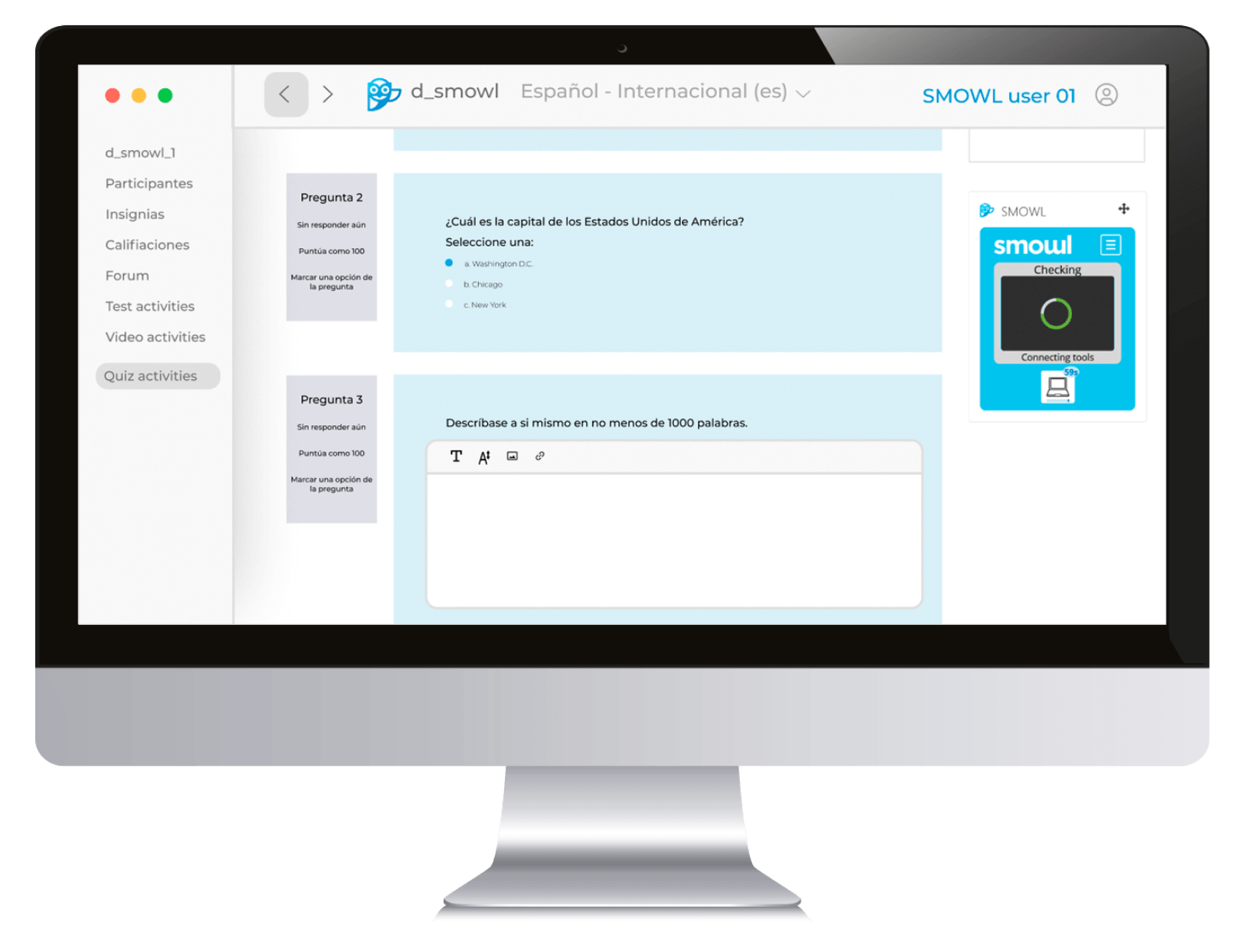
With SMOWL products, you can monitor your users remotely, while protecting their right to privacy thanks to proctoring plans specially designed to create fair and secure assessments.Ask for a free demo, so we can explain the solutions we can offer you.
8 interesting facts about proctoring
Fill out the form and download the guide where we cover everything about online monitoring and help you choose the best software.