Instructional scaffolding is an educational strategy of personalized accompaniment that supports students when they need it to promote their autonomy.
This pedagogical dynamic prevents students from becoming blocked and disconnected from the learning process, making it an ideal complement to other strategies such as differentiation.
Knowing what is the instructional scaffolding and what are its techniques will allow you to improve the experience of your students and encourage them to enhance cognitive skills that will improve their learning. If you want to continue to delve into this type of educational support, read on.
Teaching instructional scaffolding definition
Instructional scaffolding is a pedagogical methodology based on providing temporary support to students who cannot complete certain tasks by themselves and gradually removing it until they acquire greater independence and mastery of the content.
Its name is a reflection of what it supposes: a scaffold that facilitates the student who needs it to be able to save blocks by himself with resources such as guided questions, additional explanations, decomposition of tasks or complex contents, etc.
In short, to understand what is instructional scaffolding you should not lose sight of its ultimate goal: to facilitate learning while promoting the student’s autonomy.

Scaffolding vs. Differentiation
Scaffolding and differentiation are two different educational approaches, but they are often used in a complementary manner.
While scaffolding focuses on temporary student support, tailored to their precise needs, differentiation addresses the needs of students in a broader way, adjusting content and strategies so that all students can learn effectively, but without considering their initial skills.
Combining both perspectives enhances the student experience and increases their commitment to learning.
Types of scaffolds in education
The instructional scaffolding that educators can use can be different, according to the needs of their students:
- Of content. It consists of breaking down the content into simpler parts to assimilate based on the theory of microlearning that shows that humans better assimilate brief, visual and repetitive information.
- Of language. It helps students understand the academic language needed to solve the proposed tasks. It may consist of teaching key vocabulary, examples illustrating the most complex concepts, etc.
- Cognitive strategies. It includes different techniques that favor the retention of information, such as mnemonic rules, conceptual maps or information synthesis techniques.
- Tools and resources. It enhances the use of technology and visual materials to boost students’ understanding.
- Of interaction. It is an essential scaffolding that encourages collaboration between students, which helps exchange ideas and encourages them to learn from each other.
Teaching scaffolding techniques and examples
Teaching scaffolding techniques collect many different types of supports, strategies and tools that can be introduced by instructors at the right time, and only when necessary, to maximize the learning of their students.
Below we will detail some of the most used techniques that can be complementary to each other.
Modeling
Modeling is an instructional scaffolding technique that involves the teacher showing, through clear reasoning, how students should perform a task.
It is often of great help in teaching complex skills, as it provides a direct model for students to follow.
A common example can be found in mathematical problem-solving modeling. The instructor explains step by step the mathematical operations necessary to solve an equation and then proposes different exercises to the students to replicate the model, adapting it to each case.
Do you want to stay on top of the latest trends in eLearning, EdTech, and Human Resources?
Fill out the form to receive our weekly newsletter with industry insights from our experts.
Guiding questions
Guiding questions are questions designed to direct students’ thinking so they can better understand a topic or certain concepts.
Thanks to these questions, the teacher guides the students to discover for themselves the resolution of a problem using reflection, analysis and critical spirit.
Take a look at the following examples of guiding questions:
- What evidence do you have to support your response to this problem?
- What happens if you change a key element of your project?
- Do you think you can organize your exhibition information more clearly? Maybe changing the focus?
Visual content
In the educational content of the age of hyperconnectivity, visual content is a valuable resource when it comes to improving people’s understanding.
Graphic organizers, diagrams, charts, infographics, videos, etc., any resource that facilitates the quick understanding of a concept or topic makes the information more accessible and motivating.
Structured discussions
Structured discussions allow exploring a topic in depth by proposing to students guided conversations that propose the approach they should adopt.
Students are actively involved so they feel encouraged and are more willing to exchange ideas and enhance collaborative learning.
Surely you have been able to participate in this type of activity in the context of learning a foreign language. For example, when the teacher proposes to read an article and poses questions to the class to guide the discussion, encouraging students to reflect on the text and improve their reading comprehension, oral expression and critical thinking skills.
Feedback
Constant feedback is practically an indispensable requirement, rather than a technique, of the instructional scaffolding that allows to guide and adapt the learning optimally.
Constructive feedback helps to adjust the approach and develop the self-assessment skills necessary for the learner to place themselves at the center of their own learning, and be aware of it.

Benefits of instructional scaffolding
At this point in the article, you can deduce that the most relevant advantage of instructional scaffolding is the autonomy that students will get, which will allow them to appreciate more their learning process and improve their results.
As a consequence of this support that is gradually being withdrawn, students develop cognitive skills that allow them to continue learning autonomously.
Another important pillar in this educational strategy are assessments that must be continuous and formative so that educators can measure student progress regularly to adjust the scaffolding they need.
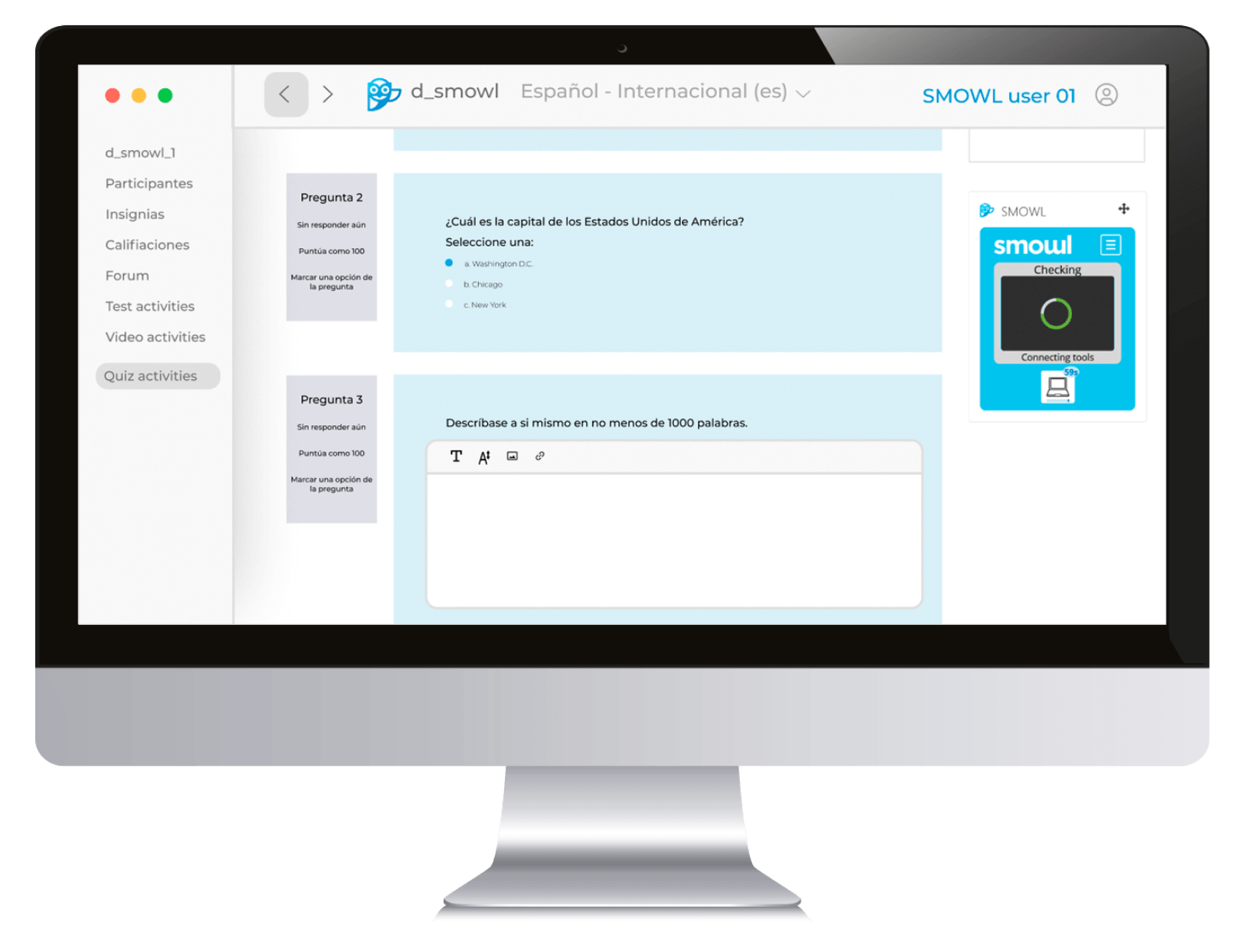
In these contexts, the proctoring plans that we propose at Smowltech can be of great help, since they facilitate the creation of safe and non-invasive environments for your remote supervision.
As we also provide you with detailed reports of your evaluation processes, you can improve the analysis of your students to adjust your content and techniques more precisely.
Request a free demo so we can explain in detail how we can help you.
8 interesting facts about proctoring
Fill out the form and download the guide where we cover everything about online monitoring and help you choose the best software.