Educational psychology studies how people learn and how to optimize the teaching-learning process in any context.
To achieve this, it is not limited to the classroom: it accompanies learners throughout their lives in various settings, including educational, professional, and personal environments.
In this article, we will delve into what educational psychology is, what specific goals it pursues, and what the role of an educational psychologist is.

What is educational psychology?
Educational psychology is a scientific discipline focused on understanding and optimizing teaching and learning processes, studying different aspects that modulate students’ cognitive development. It analyzes how people acquire knowledge, develop skills, and navigate the environments where they learn.
The educational psychologist is a key figure who intervenes in human behavior within formal academic ecosystems and non-school contexts, also serving as a mediator between students, families, and teachers.
The factors under study are not only intellectual, as you can see, but also contemplate the emotional, social, and contextual, because the way a person learns is contingent upon their cognitive abilities, motivation, relationships, and the environment in which they operate.
Among the essential functions of educational psychology are diagnostic assessment, vocational guidance, and the design of preventive programs to improve socio-emotional well-being and academic performance.
One of the most important characteristics of educational psychology is that it shifts the focus from “the child in school” to something much broader: any situation in which learning and development occur.
Disciplines related to educational psychology
Educational psychology is considered a “bridge discipline” that extracts knowledge from scientific psychology to apply it to pedagogy. It is frequently linked, in addition to psychology, to pedagogy and didactics, the sociology of education, and neuroeducation.
In practice, the profile of the educational psychologist in public centers is associated with the guidance model, assuming pedagogical and psychopedagogical functions backed by the education system.
Educational psychology vs. school psychology
While educational psychology deals with the processes of change produced by participation in educational activities in a broad sense of the term, school psychology is more specific and focuses on the sphere of the formal educational system and school centers.
The main distinctions between the two approaches are the following:
Breadth of the concept
Educational psychology encompasses the study of human behavior in educational situations throughout the life cycle, including non-school contexts such as adult education, family training, or health and prevention programs.
For its part, school psychology is limited to professional activities developed within the guidance services of primary and secondary schools.
Objectives and areas of interest
The objective of educational psychology is to understand and improve education. It seeks to increase the efficacy of learning by applying theories and educational strategies adapted to the needs of students, the practice, and the situation. Its work is linked to research, the design of study plans, and teacher training.
School psychology is oriented toward helping teachers and students resolve social, emotional, and personal problems. In its case, it resorts to techniques of clinical and social psychology, such as behavior modification, beyond academic learning.
Specific functions
The educational psychologist’s role designs, evaluates, and updates training programs at all levels, performs curricular interventions, and analyzes the educational process to orient it toward the development of competencies.
The school psychologist detects problems that affect students and recommends psychopedagogical interventions.
In short, educational psychology develops theoretical frameworks on learning and instruction, while school psychology applies that knowledge, along with other elements, to solve everyday classroom problems and guide students within the institution.
What is the goal of educational psychology? Examples in the classroom
The central objective of educational psychology is the study of reflection, evaluation, and intervention regarding human behavior in educational contexts, whether formal or informal.
If we had to summarize educational psychology in a single objective, it would be to understand and improve education. However, its goals are much broader because it seeks to understand the processes of teaching and learning throughout the entire life cycle.
Understand and improve learning
Understand means finding out how a person really learns, that is, what role memory, attention, emotions, or the environment play, and why two students facing the same content and strategies obtain different results.
Improve implies intervening in those factors so that the learning process is more effective, meaningful, and equitable.
Think of a classroom where several students are not progressing in reading. Educational psychology, once this delay is established, investigates the possible causes (is it a problem of encoding, vocabulary, attention?) and from there adjusts the method.
This same approach extends throughout people’s life cycles.
Increase learning efficiency
This discipline also focuses on increasing the efficiency with which one learns and teaches. Here, applying scientific knowledge about motivation and learning theories to real contexts is essential.
The intervention covers different areas, from sequencing content to designing study plans adapted to the functioning of attention and memory, including techniques to boost student motivation and involvement.
An example of this is microlearning combined with retrieval practice: on one hand, a complex or extensive lesson is fragmented into short blocks to improve its assimilation, and on the other, small spaced reviews are scheduled to consolidate memory and improve retention.
Promote integral development
Educational psychology also helps to develop capabilities and competencies in all aspects of the person: the psychomotor, cognitive, psychosocial, and psychoaffective, all of which are implicated in student well-being and long-term success.
A concrete case is working with students on tolerance for error so that when faced with a failed exam, they can channel frustration toward a process of improvement.
To do this, socio-emotional teaching approaches are needed that decriminalize error and turn evaluations into tools focused on improving learning so that students develop their best version.
Research as an instrument
More than an objective, research assumes a backbone role for all the goals that we have just seen, which would not be possible without scientific support.
Research sustains the discipline, since it allows for the construction of theories that offer a unified vision of teaching, learning, and human development. Thanks to it, the teacher can design and update educational programs based on evidence, optimizing their management.
For example, a series of studies, including that of Mueller and Dweck (1998), on the effect of praise showed that congratulating the student for their effort, and not for their intelligence, favors persistence in the face of difficulties, while praise for ability makes them more vulnerable to failure.
Do you want to stay on top of the latest trends in eLearning, EdTech, and Human Resources?
Fill out the form to receive our weekly newsletter with industry insights from our experts.
Who is educational psychology directed toward?
While it is true that the central subjects are students, given its broad field of application, the psychology of learning is directed at diverse actors and contexts, in formal and informal learning situations, throughout the person’s entire life cycle.
Following what has been commented, the main recipients of the intervention of educational psychology are the following:
- Students (central subjects): they are the main recipient, from early childhood education to adulthood and old age. The educational psychologist intervenes in both ordinary academic development and attention to diversity, supporting students with special needs, learning difficulties, or behavior and mental health problems.
- Educational agents (indirect intervention): these are the people who guide learning. Educational psychology offers them advice, training, and practical tools. This includes providing specialized support to teaching staff in classroom management, accompanying families in parenting, and collaborating with other professionals in the sociocultural sphere.
- Institutions and the educational system: educational psychologists also intervene in the school and administrative structure, evaluating and boosting the capacities of education centers. Likewise, they participate actively in curricular design, helping to adapt study plans and content so that learning is truly meaningful.
- Coordination with external agents: educational psychology acts as a connection bridge with external services to guarantee comprehensive attention to the student. It can coordinate with health professionals (pediatricians, clinical psychologists), social services, juvenile justice, and various NGOs in the community.
What does educational psychology do? The role of the educational psychologist
To understand what educational psychology does, we must inquire about the role of the psychologist, the key figure for the teaching and learning processes to develop well throughout life.
Their work is understood from their three main action plans: evaluation and diagnosis, intervention and prevention, and advising teachers and families.
Evaluation and diagnosis
The first task of the educational psychologist is to understand what is happening. To assess students’ psychological and socio-emotional development, both individual and group assessments are used.
This helps identify developmental disorders, learning difficulties, and giftedness at an early stage, allowing appropriate support to be provided when needed. Thanks to this early reading, any type of action can be oriented and adjusted to improve learning.
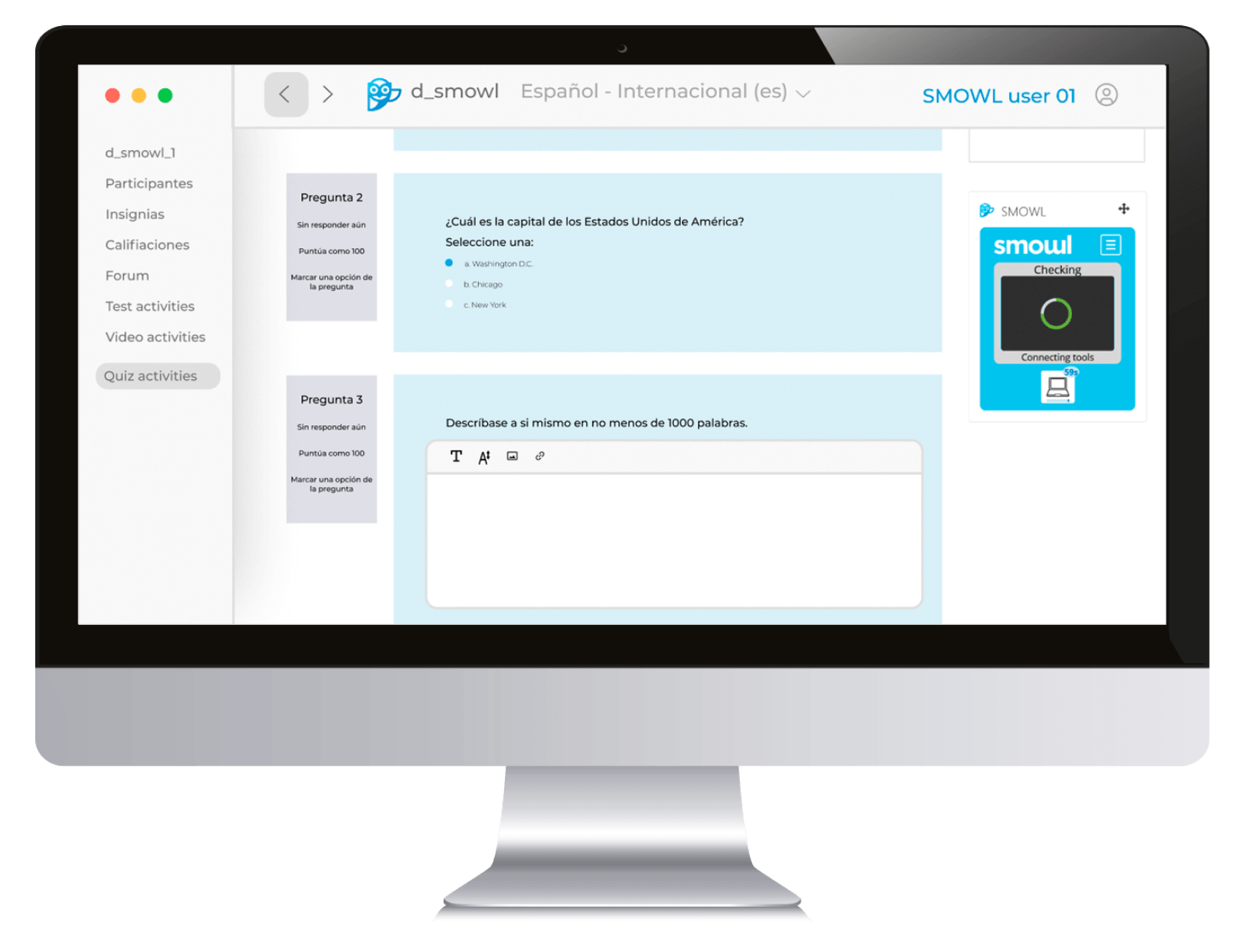
When the evaluation is moved to the digital environment, it is also necessary to adapt remote supervision tools to ensure it is transparent, safe, and fair.
In this sense, SMOWL proctoring plans allow institutions, centers, or any educational or training ecosystem to create secure evaluation environments, which respect the privacy of students and allow professionals to perform a non-invasive evaluation that fosters the well-being of people.
If you wish to know in detail what solutions we can put at the service of your educational project, we invite you to request a free demo.
Intervention and prevention
After the diagnosis, the next step is to design and execute therapeutic, preventive, and development action plans:
- Preventive programs: their objective is to anticipate problems such as school failure, addictions, or violence.
- Development programs: this type of action focuses on developing concrete skills such as attention, memory, social skills, or emotional intelligence.
- Interventional programs: these are comprehensive action plans that frequently mobilize the entire educational environment.
Advising teachers and families
As we have just seen, the educational psychologist provides direct support to students in their learning and guides them in their vocation, but their role is also important for teachers and families.
This professional provides resources and strategies that help manage the classroom, take care of the school climate, and attend to diversity.
They also accompany families in their educational work, informing them of the results of the evaluations and training them through initiatives such as family schools, conscious of the decisive weight of the family context in learning.
These three functions of the educational psychologist are complemented by continuous research to improve educational processes thanks to scientific and practical evidence.
Difference between the generalist counselor and the specialist psychologist
The counselor takes on broader pedagogical responsibilities, while the educational psychologist specializes in three key areas:
- The evaluation of complex psychological problems: such as stress, burnout, or emotional health.
- Intervention in specific difficulties and disorders: such as attention deficit hyperactivity disorder (ADHD) or dyslexia.
- Research and innovation oriented toward teaching: in order to be able to comply with the new needs of information societies and digitalization, educational psychologists must remain attentive to the evolution of content, software, and educational platforms, communication channels, etc.
Benefits of educational psychology
As a bridge discipline, educational psychology provides benefits to its four recipients at the same time: the student body, the teaching staff, the families, and the institution itself:
- Students: students learn better, are more motivated, and are conscious of their progress. Early detection of difficulties or giftedness allows the curriculum to be adjusted to each case, while vocational guidance favors both self-knowledge and regulated learning.
- Teachers: teachers and guides access specialized advice to manage the classroom, confront conflicts such as school bullying, and refine their teaching methods. Another great contribution of educational psychology is that the teaching staff also receives support to take care of their own well-being and prevent professional burnout.
- Families: the educational psychologist helps them understand factors that condition learning and often go unnoticed, such as study habits, nutrition, sleep, or space.
- Institution: educational bodies and institutions improve educational quality through the research, innovation, and evaluation of the programs that are applied in the centers.
The area where this discipline offers the greatest benefits is prevention. Programs designed to prevent school failure, addiction, violence, and mental health issues are essential for addressing these challenges before they develop.
In addition, the cultivation of interpersonal skills such as emotional intelligence, self-esteem, and resilience helps to work on the student’s well-being throughout their life.
Brief history of educational psychology
The roots of this discipline are found in classical philosophy. Plato and Aristotle already questioned the nature of knowledge and the way to transmit it.
Centuries later, thinkers like Pestalozzi demanded the need to develop attentive teaching of the child, but it was Herbart who began to endow education with components that were properly psychological.
The decisive leap occurred between 1880 and 1900 when William James brought new psychology to the educational terrain, Stanley Hall focused on the study of child development, and Alfred Binet laid the foundations for the measurement of intelligence.
In that climate, John Dewey defended the need to develop a bridge science between psychological research and teaching practice. However, the status of the first educational psychologist is usually attributed to Edward Thorndike, due to his studies on the connections between stimulus and response, and his pretension of turning learning into the object of rigorous analysis.
Toward the second decade of the 20th century, the rise of psychometrics and the proliferation of performance and personality tests fostered the self-identity of educational psychology.

Throughout the 20th century, three great paradigms followed one another:
- Skinner’s behaviorism: focused on observable behavior.
- Cognitivism: focused on mental processes.
- Constructivism: analyzes how knowledge is constructed actively and socially.
Toward the end of the 20th century and the beginning of the 21st, educational psychology has been evolving toward a more holistic approach, integrating neuroscience and information and communication technologies (ICTs) in education, which attends to diversity in the classroom.
Materials for further delving into educational psychology
If you want to explore this topic in greater depth, you’ll find a broad and well-documented body of information. Below, we’ve put together a short selection of resources that can help you delve deeper.
- Cognitive and Motivational VR Processes for Hearing-Impaired Language Learners (Pattrawadee Makmee et al., 2025): empirical study on the use of virtual reality to improve verbal aptitude in students with hearing impairment, published in the journal Psicología Educativa of the Official College of Psychology of Madrid.
- The Neurodiverse Classroom – Neurodiversity as a Framework for Inclusive Education (Humpfer-Gerhards et al., 2025): proposes a current approach on how interactions between the school context and psychological processes condition the learning and well-being of the student body.
- Social and Emotional Learning in the age of virtual play: technology, empathy, and learning (Walker et al., 2019): this article analyzes the promotion of resilience and anxiety management in digital educational contexts.