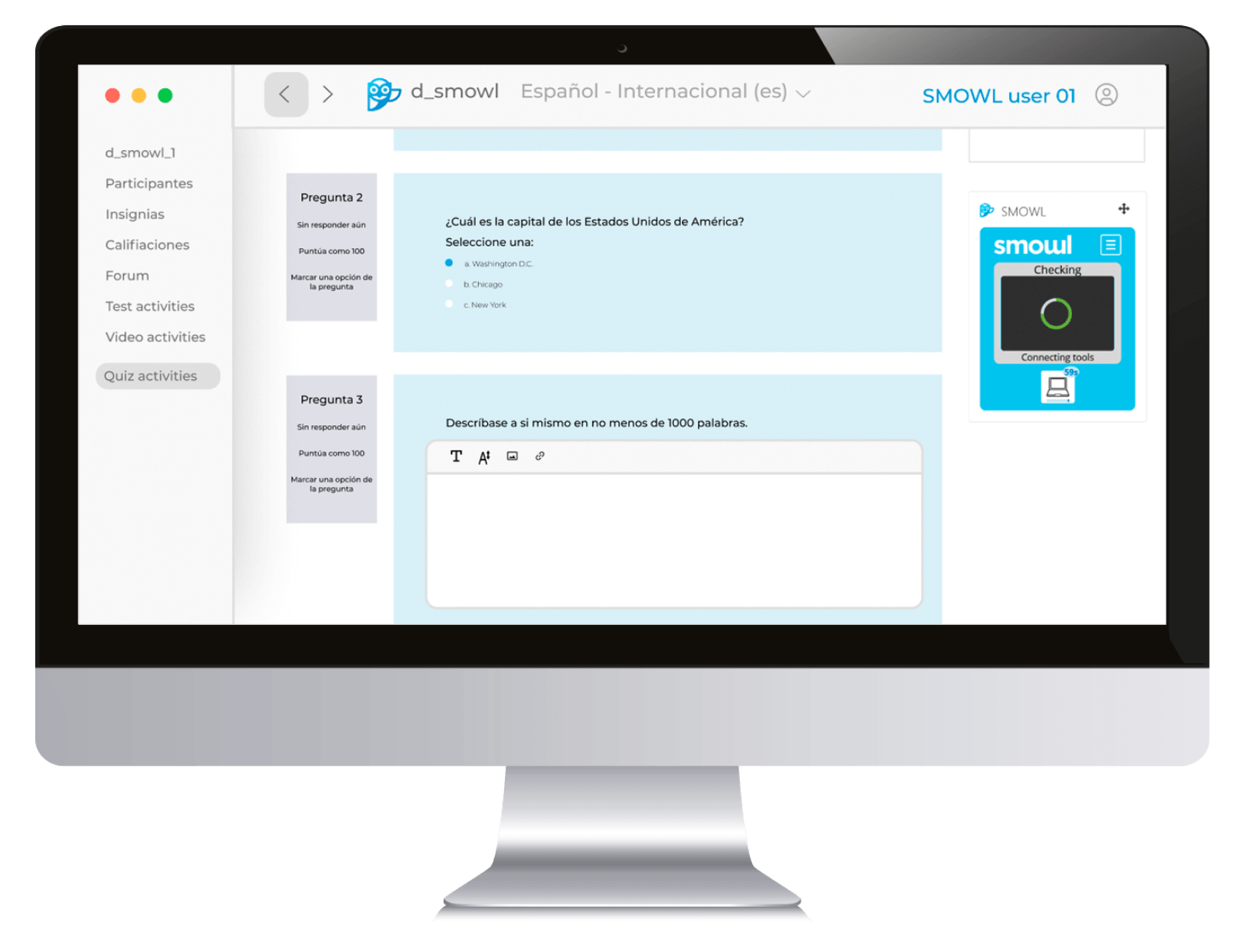
Remote learning can be as effective as face-to-face learning, as long as it is carried out properly and safely for the users.
Today’s societies need to cope with change and adversity by developing characteristics such as flexibility and adaptation, which also affects education and training.
Thanks to new technologies, it is possible to implement entirely remote or hybrid training programs.
In this article, you will discover the benefits of remote learning and find out if it can be an efficient system.

What is the meaning of remote learning and how it works?
Remote learning is a system of knowledge transmission in which teacher and learner do not physically meet in a classroom. Therefore, this system requires technological tools to create a virtual classroom based on the functioning of the traditional ones.
Although more and more educational entities are integrating it, this type of teaching can also involve teachers and students unfamiliar with a virtual environment. This can occur in emergency or force major situations, such as illnesses or natural disasters.
Its basic operation is as follows, although each teacher can adapt it according to the characteristics of the students or the type of content taught:
- The teacher establishes a virtual connection thanks to a specific platform such as Google Classroom or Microsoft Teams, or through LMS such as Canvas, Moodle, Blackboard, among other online educational platforms.
- In these virtual tools, the teacher can, in addition to teaching a class via videoconference, publish assignments and assign them to students, make comments, propose readings or collect work.
- Students connect to this virtual classroom at the indicated class or tutoring time, or to participate in group activities, in addition to being able to retrieve the activities to be performed, the teacher’s instructions or the results of evaluations.
At this point, you are probably wondering if remote learning is the same as virtual learning. We clear up this doubt in the following section.
Is remote learning the same as virtual learning?
Although both terms can be interchangeable, it should be noted that remote learning tends to be articulated in sessions programmed by an instructor, while virtual learning tends to let the student choose the time to dedicate to learning.
In other words, remote learning strives to recreate a classroom in a virtual environment where the instructor schedules videoconferences, group work, discussion forums, etc.
Do you want to stay on top of the latest trends in eLearning, EdTech, and Human Resources?
Fill out the form to receive our weekly newsletter with industry insights from our experts.
Benefits of remote learning
Remote learning offers a number of advantages that can benefit not only virtual environments, but also physical learning that incorporates hybrid models.
Responsibility of the learner
The learner has to connect on a precise schedule, so he is aware that the responsibility falls on him.
On the other hand, by giving them a certain degree of autonomy in learning, and being able to deepen their knowledge thanks to the interactive material available to them, their commitment to learning is greater. This is one of the keys to education for the future.

More engaging content
The tools that you can use in the remote learning allow you to create interactive and progressive contents that favor the retention of the information in the student.
The content paths, for example, offer the possibility of guiding learning in a personalized way, thus increasing the integration capacity in the classroom.
In addition to all this, learning can become more visual, something that favors the assimilation of concepts of the new generations of digital natives.
Learning culture
Since the student will have continuous feedback through periodic comments and resources that can be accessed at any time, a learning culture is fostered that will be beneficial in the future professional environment.
This is reinforced by the boost to the sense of community that can be provided by virtual class meetings, discussion forums or collaborative projects.
More flexible and inclusive education
Sometimes, when having to teach a lot of information in a given time, the physical classroom can leave behind students who need more time to assimilate the information.
In this sense, remote learning makes it easier for these people to reinforce their learning by different means and dedicate the necessary time to it.
All these advantages are equally valid in remote learning in professional development work where it allows to develop skills and competences in a flexible and more attractive way.
By incorporating this type of training, companies improve the efficiency of their teams, which, being better prepared, can face the challenges of today’s labor market more successfully.
Is remote learning effective?
The efficiency of remote learning does not depend so much on the system, since it replicates the structure of a physical classroom, but on the way it is delivered, as it is with traditional education.
The diversification of formats that virtuality allows and the tools it offers enhance the personalization of teaching, which has the effect of improving the student’s success rate, as well as greater commitment and motivation.
Thus, in this type of learning, program design, monitoring and evaluation are crucial to avoid student disaffection.

Tips to improve remote learning efficiency
Both in educational programs and in professional training environments, it is possible to enhance remote learning by considering the following aspects:
- The role of the teacher is essential , so it is necessary that he/she has the resources and digital tools to create solid and attractive virtual classrooms.
- The creation of a routine is also necessary for learning. Classes must be scheduled in advance, beyond the fact that the student can access resources when it is convenient for him/her.
- Two-way interaction is another necessary element for successful learning practice. Likewise, it is necessary to choose the most appropriate channels of exchange for each context and to encourage student participation.
- Interactivity stimulates people’s curiosity and involvement, so explore all its applications in remote learning.
- The supervision of activities must be respectful and guarantee the integrity of the contents, as well as the privacy of the users.
- Evaluations must be based on objective facts to ensure fairness of judgments. To achieve this, you can resort to tools such as remote proctoring.
Smowltech, thanks to its proctoring plans, can help you improve the efficiency of your remote learning programs so that you can benefit from all their advantages.
Performance reporting, multi-factor authentication or environment scanning are some of the solutions that we can offer you and that you can discover by requesting a free demo.
8 interesting facts about proctoring
Fill out the form and download the guide where we cover everything about online monitoring and help you choose the best software.