Experiential learning helps connect theory to practice by creating meaningful experiences for the learner that improve learning outcomes.
In an increasingly connected society, where the creation of attractive content for students can be a challenge, you must know in depth what experiential learning is.
For this reason, in this article, we will discuss its benefits, and you will also learn about practical examples that will allow you to see why it is important to incorporate this strategy in your classes.

What is experiential learning?
Experiential learning (EL) is an educational strategy based on students’ direct experience to increase their knowledge, develop their skills and give meaning to learning.
This is possible thanks to the careful selection of structured experiences that invite the learner to take the initiative in his or her knowledge acquisition process, encouraging reflection, critical analysis and the capacity for synthesis.
In this process, a sine qua non condition is that the activities must be relevant and connected to the real world so that they can be applied outside the academic context.
Thus, it is decisive how the student takes responsibility for their results, building meanings that in turn are shaped as a basis for future learning.
In other words, EL is based on the learning by doing approach, as happens when a human being learns to walk and perfects his technique through practice.
To go deeper into the experiential learning definition, it is necessary to go into detail on its function and objectives.
Do you want to stay on top of the latest trends in eLearning, EdTech, and Human Resources?
Fill out the form to receive our weekly newsletter with industry insights from our experts.
Experiential learning objective and function
The objective of experiential learning is to promote active learning, that is, that the student is involved in the process and uses the introspection of the lived experiences to achieve a deeper learning articulated in 4 essential stages:
- Concrete experience (CE).
- Reflective observation (RO).
- Abstract conceptualization (AC).
- Active experimentation (AE).
In this dynamic, the roles of students and teachers are as follows:
- The student is directly involved, makes decisions, evaluates his experiences and connects his own experience with the theory learned. This also allows them to develop collaborative and knowledge transmission skills, enriching themselves with the perspectives of their peers.
- The teacher is in charge of creating relevant practices in accordance with the learning objectives that facilitate reflection so that students can analyze what they have learned. Likewise, he/she must provide individualized support to adapt to the needs of each student respecting his/her pace, as well as setting limits and facilitating the process.
Before continuing, it is important to emphasize the importance of trainers in this type of education because they are in charge of designing and moderating experiences that maximize learning. This requires a remarkable specialization in learner engagement strategies.
Benefits of experiential learning
The benefits of experiential learning are numerous. In the following list we share with you the most outstanding ones:
- It promotes student engagement at multiple levels (intellectual, social, emotional and physical) and a better understanding of the world around them.
- It gives meaning to the acquisition of knowledge, as students can see how academic concepts can be applied to real contexts.
- It encourages long-term knowledge retention through meaningful experiences that allow them to collaborate with various organizations and social projects.
- It increases the social responsibility of individuals who, when confronted with real situations, become aware of the importance of their decisions and actions for the community.
- It helps students develop power skills that are highly valued in the working world, such as the ability to work as part of a team, problem-solving and the development of leadership skills.
- It promotes critical thinking and adaptability of people, as students experience success, failure, uncertainty and risk-taking.
- It maximizes autonomy thanks to the introspection of each student.
This is in terms of the benefits of experiential learning for students. As far as teachers are concerned, this educational dynamic allows them to make fairer evaluations by becoming aware of their prejudices or overcoming preconceived ideas.
In this way, both the learner and the teacher complement each other in a continuously evolving learning process that allows them to learn from each other in a transactional environment (between the environment, the learner and the teacher).

Types and examples of experiential learning
Experiential learning can be developed in multiple contexts, as you can see in the following examples of the 4 most common types of EL:
- Internships. These structured experiences connect students with business reality, increasing their employability.
- Service learning. This involves participating in valuable projects such as improving neighborhood recycling methodology or creating a volunteer application to help the elderly, combining academic objectives with community service.
- Project-based learning. Students conduct research to solve problems or innovate procedures in real contexts. For example, designing educational programs to prevent disease in vulnerable communities or developing a sustainable water filtration system.
- Simulations and role-playing. Recreate real scenarios to apply the theory learned. This can be the case of staging a medical consultation, a trial, etc.
Difference between experiential learning and learning by doing
The difference between experiential learning and learning by doing is that the former is a structured process in which connection with broader concepts, analysis and critical reflection are essential, while the latter is based on direct practice that may or may not include an explicit theoretical framework.
In other words, learning by doing is a component of experiential learning, an integral methodology that involves a deeper process.
Importance of experiential learning
Experiential learning helps prepare students to successfully face real-world challenges by completing and repeating the cycle proposed by American theorist David Kolb based on the research of Kurt Lewin, John Dewey and Jean Piaget:
- Experiment.
- Reflect.
- Thinking.
- Act.
This experiential learning cycle is inspired by Confucius’ well-known phrase “I hear and forget, I see and remember, I do and understand”, and that is where its importance lies: in not forgetting what has been learned, but in accumulating knowledge to be able to use it throughout life in different situations.
Therefore, according to Dewey, two types of experience must be combined: immediate (collecting sensory data) and mediated (immediate experiences are reflected upon and analyzed).

Assessment in experiential learning
The flexibility and adaptability of this type of learning requires equally flexible supervision that combines self-assessment with formative, performance, reflective and collaborative evaluations.
For example, it can be carried out by analyzing experiential logbooks, through presentations or case studies, or with reflective essays or discussions.
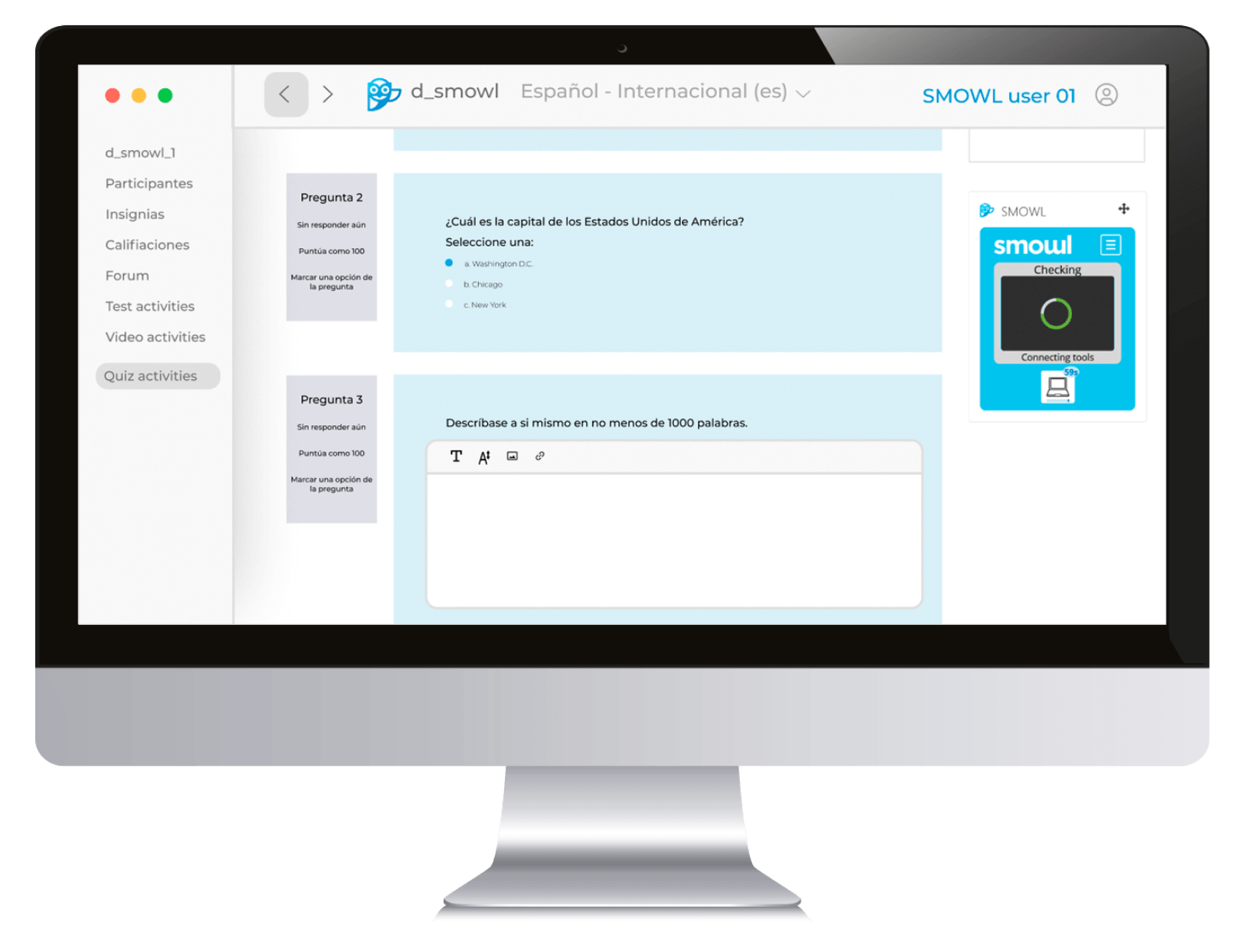
Smowltech’s proctoring plans can help you, as they adapt to all types of educational dynamics so that you can offer assessments that respect the rights of the learner and help the most demanding teachers.
Ask for your free demo so we can take you on a guided tour with one of our consultants.
8 interesting facts about proctoring
Fill out the form and download the guide where we cover everything about online monitoring and help you choose the best software.