Gamification in education allows you to develop active education programs through game elements that promote teamwork and problem-solving while ensuring personalized learning progress at the same time.
This improvement of the student experience presents important challenges that start with setting the objectives and end with the evaluation methodology and tools used.
These resources must meet the needs and demands of an increasingly audiovisual and interactive society while maintaining the objectivity of the evaluation itself.
For these reasons, we want to talk to you in this article about what gamification in education is and what tools you can use for gamified evaluations.

What is gamification in education?
Gamification of learning uses elements characteristic of games to energize teaching to engage students, increase their motivation, and improve their knowledge.
Thus, playful elements are introduced as scoring systems or badges, goals, challenges, rewards, peer competition, or collaborative activities to increase the student’s engagement and boost their progress.
The importance of gamification in education is demonstrated through the advantages it offers:
- It favors active learning.
- It fosters creativity.
- It develops critical thinking.
- It energizes the development of the content.
- It promotes teamwork.
- It stimulates student integration.
- It facilitates personalized learning.
- It improves recurring negative behaviors.
- It helps professionalize the use of Information and Communication Technologies (ICTs), which become a key resource.
It is important to note that you should not confuse gamification with introducing games or video games to develop a theme.
Do you want to stay on top of the latest trends in eLearning, EdTech, and Human Resources?
Fill out the form to receive our weekly newsletter with industry insights from our experts.
Gamification involves a much more complex process that combines the fundamentals of games with those of neuropsychology to maximize long-term benefits.
This implies that teachers who incorporate it into their educational strategy must be familiar with it, have clear objectives in mind, and establish the rules governing the process based on those objectives.
Following this approach, gamified evaluations are of great significance in determining the success of a training program.
Gamification in education statistics: growth and global adoption
The educational landscape has been revolutionized by gamification, which integrates game-design elements into learning. Industry data from Market Reports World indicates that this trend has reached a massive scale, with over 1.2 billion students worldwide now utilizing gamified platforms annually.
The financial trajectory of this sector is exceptionally steep, with Market Data Forecast estimating that the global market value will soar from USD 1.55 billion in 2025 to USD 18.63 billion by 2033, expanding at an annual growth rate (CAGR) of 36.4%.
This rapid growth is fueled by several key factors, including the widespread adoption of e-learning ecosystems and a growing demand for interactive content.
Furthermore, breakthroughs in AI and immersive technologies, alongside a broader shift toward student-centered pedagogical models, are pushing the industry forward.
Geographically, North America remains the leading region regarding gamification in education, boasting over 100 million K–12 active users. Europe follows closely behind, with more than 80 million students currently using interactive platforms that include gamified elements.

Benefits of gamification in education
Gamified assessments provide access to an objective and in-depth analysis of the student’s results, even in a cross-sectional way, as they progress through levels, statuses, or roles based on 3 analysis premises:
- The attitude evaluation. You can establish a score for the behaviors you want to reinforce or those you want to reduce. The score will be positive in the first case and in the second, negative.
- The evaluation of the objectives. This type of evaluation provides clear data on dedication, progress, and achieved objectives through rewards (f.e in the form of badges or levels) representing the student’s evolution.
- The competence level. You can evaluate the quality of the tasks performed by the student based on a set of pre-established requirements and criteria denoting their specialization level.
Types of gamification in education
Gamification in education can take many forms, but some common types include:
- Points Systems: These systems reward users with points for completing specific tasks or reaching certain milestones.
- Leveling Up: Similar to point systems, this type of gamification involves advancing through levels as users complete tasks or reach milestones.
- Badges and Achievements: These are virtual awards that users can earn for completing specific tasks or reaching certain milestones.
- Leaderboards: These displays show users’ rankings based on their performance or progress.
- Progress Bars: These displays show users their progress towards completing a task or reaching a milestone.
- Quests and Challenges: These are structured activities that require users to complete a series of tasks in order to receive rewards or advance to the next level.
- Virtual Worlds and Avatars: This type of gamification creates a virtual world in which users can interact with each other and engage in various activities.
- Narrative-Based Gamification: This type of gamification involves telling a story that users can participate in, with their actions affecting the outcome.
- Augmented Reality and Location-Based Games: These games use GPS and other technologies to create location-based experiences that blend the physical and virtual worlds.
These are just a few examples of the many types of gamification. The type of gamification that is best suited to a particular situation will depend on the goals, target audience, and context of the gamification effort.
Foundations of gamification in education
Integrating game mechanics into the classroom shifts the focus from passive listening to active participation. By leveraging human psychology, gamification fosters an environment where students feel motivated to persist through challenges. The principles that drive this success include:
- Progression and narrative: Structuring lessons as “quests” or levels provides a clear sense of advancement and purpose.
- Scaffolding through challenges: Lessons are designed with an increasing difficulty curve, ensuring the task is never too easy (leading to boredom) nor too hard (leading to frustration).
- Discovery and exploration: Incorporating “hidden” rewards or bonus information encourages students to dig deeper into the subject matter beyond the basic requirements.
- Incentivized mastery: It functions as a motivational gatekeeper. Instead of moving forward based on a calendar, students must prove they have fully grasped a topic to “unlock” more difficult or “premium” content.
- Autonomy and choice: Providing students with multiple pathways or “skill trees” to reach a goal allows them to take ownership of their learning journey.
- Immediate feedback: Real-time rewards like points or badges help students quickly understand their strengths and areas for improvement.
- Safe failure: Allowing students to retry tasks without heavy penalties encourages a growth mindset and experimentation.
- Social dynamics: Features like leaderboards and team challenges promote both healthy competition and peer collaboration.
Ultimately, these principles transform education into a learner-centric journey. By balancing rewards with motivation, educators can cultivate a more deeply engaged and resilient student body.
Gamification in education examples: 5 platforms
In every educational methodology, measurement, monitoring, and analysis of results are essential tools for achieving set goals.
In line with this, gamification tools for evaluations help create conducive environments for these tests, enabling you to determine each one’s success based on personalized parameters.
Additionally, these analysis systems build accessible and enjoyable environments that help improve the learning experience focused on goal attainment.
We’ll provide some examples of effective gamification software that can help you incorporate gamification into evaluations in the classroom.
Moodle
It is a tool conceived from its inception based on social constructivist pedagogy.
This LMS (Learning Management System) allows you to intuitively personalize gamification elements such as badges, leaderboards, roles, etc.

Open edX
This Learning Management System has a robust and flexible architecture that uses the same code as edX, the largest massive open online course platform or MOOC.
Additionally, a significant advantage is that it incorporates its own gamification module.
D2L
This is another of the most widely used LMSs with tools that allow for large-scale and scalable customization.
One of its added values is the emphasis on accessibility that drives multi-device learning.
Litmos
With Litmos, you can set up roles and badges to encourage your students to continue completing courses and levels and facilitate video evaluations.
Regarding the latter, the system integrates AI functionality on the keywords that should be used and those that should not.
Classcraft
This tool uses the principles of the game to help your students reach their full potential through customizable avatars that turn students into epic heroes.
Finally, online gamification in education also requires a secure environment that allows you to establish a relationship of trust with your students.
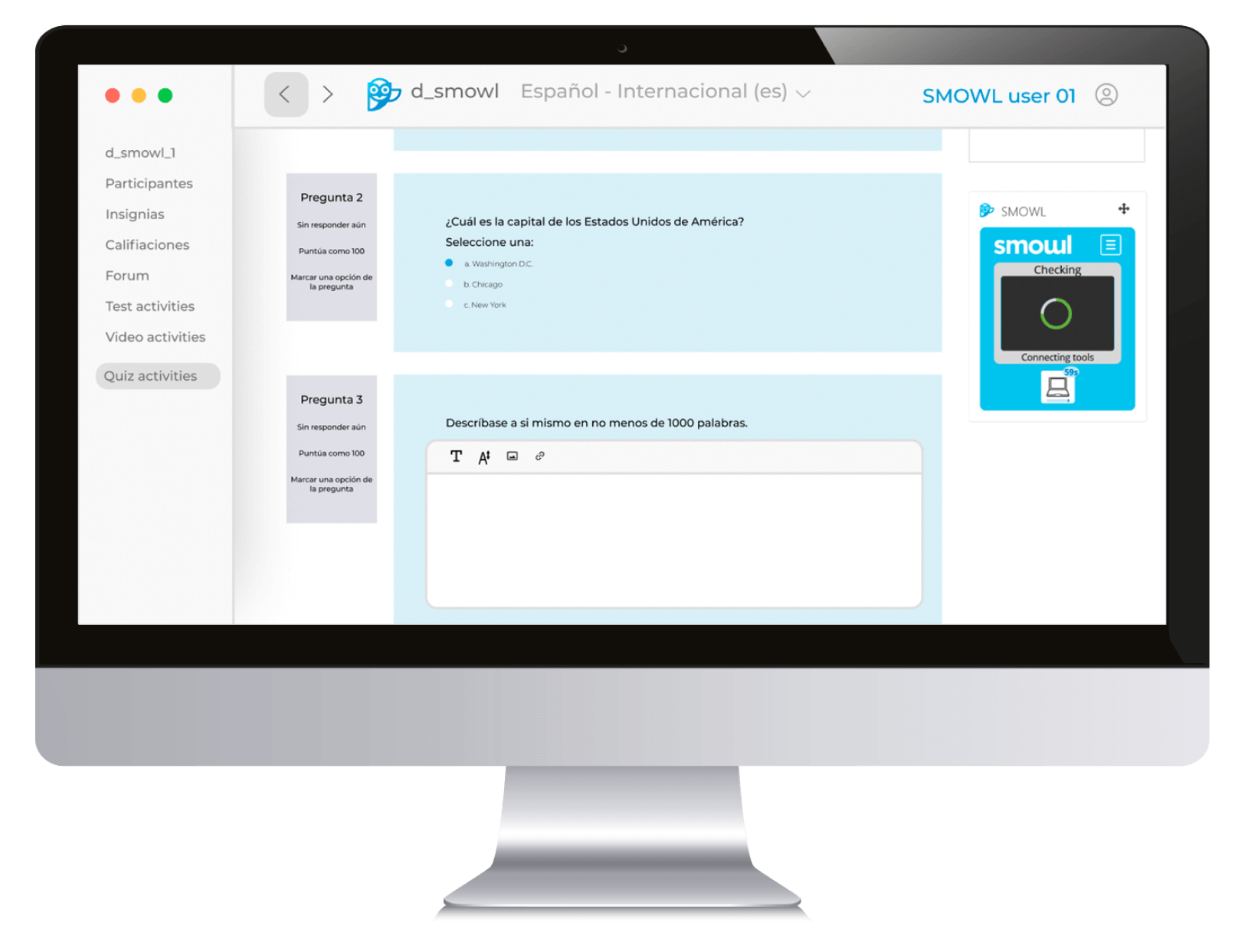
Fully aligned with this, our proctoring products help you to implement a gamified remote assessment that protects your students’ digital privacy and provides accurate reports on their activity.
If you prefer to learn about what we offer practically, you only have to request a free demo.
Updated on