Learners digital are more than students using a computer to acquire knowledge. Critical thinking or time management also define them.
But these are not the only characteristics that define them, so throughout this article we will explain what digital learners are and we will also share with you a detailed list of 11 characteristics that this type of learner has.
What is a digital learner?
A digital learner is one who bases their learning on systems that use technology to control their time management, location, process, methodology and tempo.
It is common knowledge that learning and education have a great impact on society, hence digital learning has a spectrum of action beyond the use of a computer.
In fact, it is a perfect combination of technology, content and teaching.

11 digital learners characteristics
In this section we want to share a list and develop more in depth, the 11 digital learners characteristics that we consider fundamental.
Collaborative
Talking about the connection between collaborative profiles and digital learners does not require too much explanation because the very nature of both terms makes their association as logical as productive.
The first thing to note is that collaborative learners handle digital and face-to-face communication with equal skill and familiarity.
In this sense, they are knowledgeable and master programs and applications in which they:
- Share ideas in teams.
- Assign tasks to each member of the work group.
- Discuss progress on the tasks of each project.
- Exchange documents in the cloud.
- Communicate through video calls.
- Handle different project management software.
This feature makes them develop empathy, active listening, negotiation skills, joint time management or organization, among many other aspects.
Do you want to stay on top of the latest trends in eLearning, EdTech, and Human Resources?
Fill out the form to receive our weekly newsletter with industry insights from our experts.
Creative and innovative
Creativity is the alma mater of many professional profiles and is a skill to be valued long before accessing the labor market.
Thus, a creative learner is characterized by always going a step beyond traditional learning and using innovative methods in their study processes, as well as valuing the importance of disconnection and brain breaks among other things.
Far from seeing challenges as processes that hinder or slow down their development, they interpret them as the best allies to continue learning and gaining knowledge.
They are not afraid to launch experiments, to learn and to assume mistakes if the results are not what they expected.
This ability helps them to develop other skills such as critical thinking, curiosity or commitment to continuous training.
Critical thinkers
As we have just mentioned, digital learners stand out for their critical thinking, in which the reasoning of their actions is key.
Although there are different definitions of this concept, in general it can be accepted as the learners’ ability to solve problems, make decisions, seek changes, learn by themselves and adopt critical measures as a result of active participation and reflection.
Critical thinking is characterized by using different perspectives and assumptions, isolating possible biases and questioning each problem under different prisms that allow a global composition of all possible options.
Global citizens
Digital transformation and ICT (Information and Communication Technology) have broken down geographical barriers and have turned us into global citizens.
At the educational level, this characteristic corresponds to the assumption of multifaceted study approaches in which knowledge, understanding and problem solving are sought with a clear weight of collective identity and universal values such as justice, equality, dignity and respect.
As citizens of the world, digital learners seek to educate and train themselves to add their personal contribution to achieve a peaceful world, with a better distribution of resources and respect for the environment.

Good time managers
One of the advantages associated with digitalization is that students can organize their study time and plan those moments when they are most productive.
In this sense, and together with being global citizens, the study time management allows digital learners to participate in training sessions outside of the restricted schedules and independent of the time zone of the country in which they reside.
Motivated
Digital education allows learners to handle their learning environments and methods and choose those that best suit their characteristics and needs as learners.
This personalization leads to greater motivation and involvement on the part of the learners who feel much more comfortable and motivated with the learning process in which they participate.
Adaptable
Adaptive learning has an infinite field of action and ranges from updates of the software used to learning new platforms through the acquisition of new knowledge on different subjects.
Instructional models such as Universal Design for Learning or UDL are precisely focused on seeking the versatility, accessibility and adaptability of learners taking advantage of their active role in knowledge management.
AI literacy
The latest digital changes have Artificial intelligence literacy at the forefront.
In fact, AI literacy not only refers to the digital learner mastering to handle AI-based tools, but also, given the multiple implications of the use of this type of technology, to be able to be critical with the information provided by these systems, to understand their limitations and to use them in an innovative way but always making ethics prevail.
Effective communicators
Given the benefits of the different technological options in terms of communication, digital learners must take advantage of them to establish effective communication channels with their peers or teachers.
Everyday examples of these channels are email or online educational platforms from which the student can receive quick feedback or even in real time for any of their concerns.
Another option is to use these communication channels to request technical help from their peers, even if it is unrelated to the subject being studied.

Empowered learners
A common characteristic of all empowered learners is their active participation in the learning processes in which they are involved.
This type of learners wants to take the reins of their learning and, therefore, establishes the educational objectives to be achieved, develops the skills, manages the knowledge and seeks the resources deemed necessary to achieve them.
To do so, they are willing to take the necessary risks and face the necessary challenges because they do not see these challenges as something negative, but as the best opportunity to continue growing.
Problem solving professionals
Digital learners are problem-solving oriented. This fits perfectly with their other skills related to critical thinking, creativity and innovation.
This problem solving ability from their student days will become one of the best references when they enter the job market and compete with other professionals.
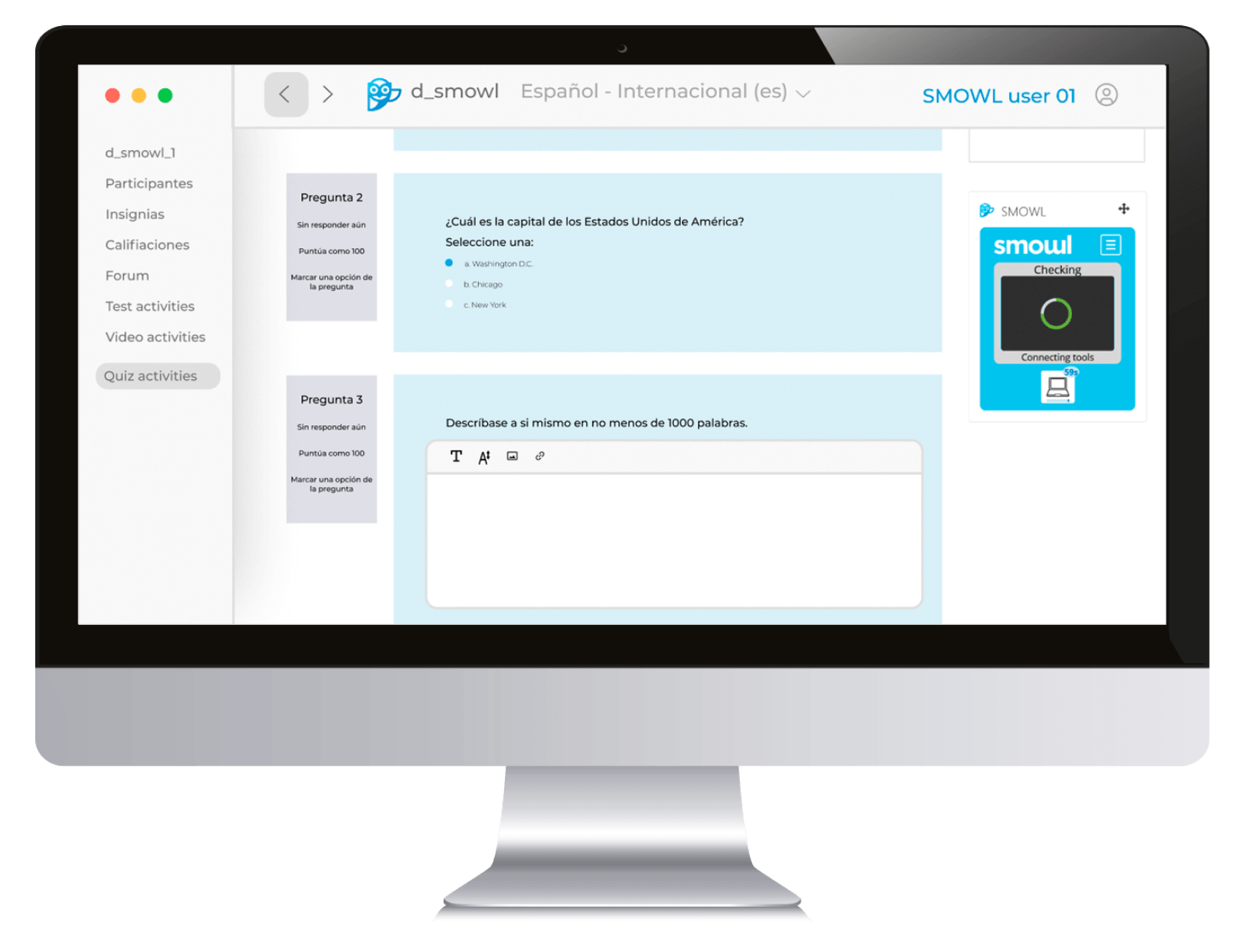
We want to let you know that SMOWL has the Official Moodle Certified Integration which makes our proctoring plans stand out from others that are not compatible with this LMS. Request a free demo with us and let us tell you more about the versatility of our proctoring software.
8 interesting facts about proctoring
Fill out the form and download the guide where we cover everything about online monitoring and help you choose the best software.