Personal learning environments are dynamic, learner-centered ecosystems that combine tools, resources, and networks selected and managed by the learner.
The COVID-19 pandemic revolutionized the way we approach learning and development, not only in traditional education, but also in corporate learning and personal development. The result was an acceleration in the adoption of personal learning environments (PLEs) in organizations around the world.
Today, many people participate in distance learning, and PLEs are more sophisticated and powerful than ever, offering a high degree of flexibility and adaptability.
For this reason, we are going to dedicate this article to delving deeper into the definition, importance, and examples of personal learning environments so that you can take advantage of their transformative power.
What is a personal learning environment
A personal learning environment (PLE) is the set of resources, tools, information sources, and people that a student uses to enrich their learning in an autonomous and personalized way.
If we refer to a more academic definition, based specifically on Graham Attwell’s article Ai, personal learning environments, personalization, pedagogy, and agency, we can talk about PLEs as strategies that recognize continuous learning in multiple contexts.
Thus, it is easy to understand that the main function of this educational ecosystem is lifelong learning, based on the goals, preferences, and needs of each individual. Each person will choose the most effective resources and tools.
In this ecosystem, where individuals organize their own learning in multiple ways (formal, informal, and virtual), the use of Information and Communication Technologies (ICT) predominates.
In this context, the need for transparency regarding the data collected (browsing history, study time, etc.) and control over data on algorithmic platforms (deciding what data is shared, managing personal information, etc.) is imperative.
Characteristics and core components of PLEs
Personal learning environments promote autonomous and flexible learning, so they need to be dynamic and adaptable to the student’s needs.
Thus, one of their most significant characteristics is that they help strengthen self-management and decision-making skills. Think of it as the person choosing for themselves what, how, and with whom to learn.
The main components of PLEs are very varied. The important thing is that they serve to acquire, consolidate, and share knowledge. Here are some examples:
- Physical and digital tools such as applications, platforms, social networks, blogs, or forums.
- Sources of information such as books, articles, online courses, videos, conferences, etc.
- Teachers, classmates, professionals, and all kinds of people with whom knowledge is shared and exchanged.

Differences between an LMS and a PLE
It is important to clarify that a PLE is not a Learning Management System (LMS). While an LMS provides a closed structure predefined by the institution (known as a one-size-fits-all approach, although some aspects can be customized) and more formal learning, the PLE is a system that encourages student autonomy.
In this way, it combines formal and informal learning in a continuous dynamic of self-directed knowledge acquisition and improvement by the student.
In short, if the LMS is a structured system that manages learning, PLEs are ecosystems that empower students to create and manage their own continuous learning experience.
Personalized vs. personal learning
This is another necessary distinction before addressing the different types of PLEs:
- Personalized learning is an educational approach that breaks away from the one-size-fits-all model. The teacher creates a personalized learning path for each student to work on their strengths, skills, or obstacles, considering their interests and needs. But, although it uses student information to personalize the experience, it maintains established academic standards.
- Personal learning is characterized by total control by the student, who chooses what to study, when, how, and where, without curricular or institutional restrictions. Therefore, it is a more spontaneous and natural form of learning.
However, although these are two different approaches, they can coexist and feed into each other. Learning personalization can build a bridge between institutional structure and personal autonomy.
Do you want to stay on top of the latest trends in eLearning, EdTech, and Human Resources?
Fill out the form to receive our weekly newsletter with industry insights from our experts.
Types of personal learning environments
We can make an initial distinction between the different types of personal learning environments in terms of the type of structure in which they are integrated. In this sense, we can talk about:
- Formal. This is a PLE that is integrated into structured educational contexts. Learning follows a defined curriculum and can lead to official certification. This is the case in university classrooms, corporate courses, or professional training programs. They usually use LMS or official educational platforms.
- Non-Formal. This includes educational experiences outside the official system, although they follow a certain structure. This is the case with professional workshops, seminars, or courses that may be offered by companies or associations. Although planned, it is also flexible. These resources are accessible in webinars or professional communities.
- Informal. These are unstructured and unplanned resources resulting from self-study, social interaction, or spontaneous curiosity. They do not have any program or evaluation and are typical of ubiquitous learning or u-learning. Examples include social networks, video platforms such as YouTube, podcasts, but also conversations with colleagues.
- Digital/virtual. These are built in internet environments and digital platforms. They can be websites, blogs, e-learning platforms, or any type of tool that allows you to acquire, share, and create knowledge online. They offer global accessibility.
These four types of PLEs can be combined in hybrid systems (both physical and digital), depending on each person’s needs. For example, you can use a resource for formal purposes (taking an online master’s degree) or for more informal learning, through online tutorials or by participating in conferences.
Beyond this classification, we can organize these environments by their purpose, i.e., whether they will be used for personal development, for specialization, or simply to explore new interests.
Why is personalized learning important? 9 strategic benefits of PLEs
The importance of personalized learning lies in how it adapts to the experience, needs, and style of each learner, achieving more meaningful and effective learning that empowers the person receiving it.
In this way, it offers greater motivation, better performance, and helps develop critical skills such as self-regulation, problem-solving, and collaboration.
For their part, personal learning environments have brought about a change in the model in which students consume information. They have evolved from consulting a library or using an LMS to establishing connections from a constantly expanding universe of resources.
Benefits of PLEs
These spaces allow a person to expand their knowledge, skills, understanding, and perspective. Thanks to self-regulation, they are able to build their own learning ecosystem.
In this sense, if you are wondering whether PLEs really work, you will find the answer in the main benefits they offer, which we list below:
- Self-regulation and empowerment of the student, who takes control and manages their learning process.
- Development of a culture of continuous learning, beyond the curriculum.
- Increased knowledge retention and transfer, as individuals are free to choose what they want to learn and under what circumstances.
- Respect for individual pace, adapted to each individual’s learning style.
- Reduced costs of centralized platforms, by using existing platforms and distributed resources. Here, Open Educational Resources (OER) are an important source of valuable information.
The benefits of PLEs are not limited to individuals; institutions and organizations can also reap advantages such as:
- Maximization of development opportunities by facilitating the creation of personal learning networks.
- Encouragement of experimentation with new tools and different approaches to learning.
- Strengthening strategic skills for students and workers, such as self-regulation, critical thinking, and individual responsibility.
- Promoting essential digital skills for people’s social and professional development.
Personal learning environments examples
Below, we would like to share with you three examples that will help you understand how environment affects learning.
PLE of a digital photography student
The first example of a personal learning environment we’d like to share is John’s, a digital photography student.
John, like his classmates, visits websites and blogs by professional photographers, as well as sharing his learning and work with other students, thereby obtaining feedback.
In addition, he has created an open group on a social network to upload his own photographs and build a broader information exchange network. As a result, he has enriched his learning, improved his technique, and even managed to sell a couple of photographs to a digital magazine.
As you can see, PLE can be a driver of learning development through personal experience, which in turn reinforces its relevance and, therefore, its consolidation.
PLE of an education professional
A second example is Olivia, an education professional who uses platforms such as Google Classroom to manage her classes and content. She uses Canva and Prezi to create dynamic presentations and engaging content, and applications such as Quizlet to make online assessments more dynamic.
Through LinkedIn, she connects with other teachers and education experts, follows the latest trends in education on Twitter, and exchanges best practices and resources through Slack communities and specialized forums.
To find educational resources, she listens to podcasts on active methodologies, neuroeducation, and new technologies applied to education, and accesses academic journals and ebooks.
Corporate PLEs
PLEs can also be incorporated into hybrid models that promote continuous development within an organization. For example, a company can combine e-learning modules with internal social networking tools that facilitate knowledge transfer within the company.
In addition, you can make a space available to your teams on the intranet with informative pieces such as microlearning videos so that they can improve their skills, consolidate protocols, or learn about innovative trends.
Now you know what we mean when we talk about an ecosystem: PLEs comprise all the resources, tools, applications, platforms, and communication channels that are used to access, acquire, transform, adapt, create, and share knowledge, and which function as a mechanism.

Challenges of the personal learning environment
PLEs require an essential skill: self-regulation. Without it, they can lead to a lack of continuity, especially when we consider that resources can change or disappear.
It should be noted that some students lack the metacognition necessary to be completely autonomous, meaning they are unable to reflect on their own learning and need to be guided with more structured formats.
In the same vein, some people lack the ability to evaluate the authority and validity of the information they find. This can be overcome by developing digital skills such as information management (which includes source validation, for example) and critical thinking.
Building your personal learning environment: 4 steps to success
Since a PLE is an open ecosystem that evolves over time, there is no single way to build it. You must design it to suit your needs, but for it to be successful, you need to plan it, select the strategy you are going to follow, and integrate it properly.
If you succeed, you will become part of a dynamic of continuous learning and will be able to obtain tangible results.
Starting point: self-assessment and planning
The first thing you need to do is to identify your starting point through self-assessment. To do this, identify your current skills and those you want to develop. Ask yourself what you want to achieve and what knowledge you want to learn or improve.
One tool that can help you is creating a learning map, which you can use to organize your goals into short-, medium-, and long-term time frames.
Of course, if you want the results to be as expected, work on SMART goals: specific, measurable, achievable, relevant, and time-bound.
Build your digital ecosystem with the right tools
Your personal learning environment can combine all kinds of technological tools, content resources, and social interaction platforms.
For example, you may need platforms and resources to cover these areas:
- Knowledge management tools. Applications that allow you to collect and organize information, such as Notion or Evernote, are useful.
- Platforms that offer educational content. Although it will depend on your needs, options such as Coursera, edX, LinkedIn Learning, or Khan Academy can help you.
- Communication and collaboration solutions. Slack or Discord communities allow you to exchange knowledge with like-minded people.
- Productivity applications. If you structure your learning as if it were a project, you will be able to measure productivity with platforms such as Asana, Trello, or ClickUp.
- Analytics to evaluate progress. If you have a blog or website, it may be interesting to measure its evolution and check what content your community likes best. To do this, you can use Google Analytics, for example. You can also use language models such as ChatGPT or Perplexity to help you reflect on and track your learning. You can ask them to ask you questions about a topic you have studied, which will help you work on gaps in your understanding.
More than the type of tools you use, the real value lies in how you build your learning universe, keeping in mind that the most important thing is continuity.

Connect with others to expand your knowledge
Don’t stay isolated in your PLE; open it up to others by developing your Personal Learning Network (PLN) and enriching it.
So, look for professional communities that meet your needs and profile, sign up for expert events and webinars, or exchange learning with peers to accelerate your progress.
These exchanges, in addition to strengthening your network of contacts, allow you to validate knowledge and find the motivation you need to continue learning.
Another advantage you will gain from this collaborative network is that it can serve as a quality filter against information overload.
Your PLE is a living ecosystem
Finally, remember that a personal learning space should evolve based on your own needs and those of the job market.
To avoid stagnation and keep your environment up to date, stay alert to new technologies and innovations in your sector, and analyze the return on investment of your efforts. Ask yourself if you are achieving the expected results or if you have acquired the skills you wanted to develop.
It is important to think of your personal learning environment as a knowledge gym where you choose which muscles you are going to work on, which machines you are going to use, which programs you are going to follow, and who is going to help you find motivation or inspiration.
PLEs and the importance of proctoring in digital education
If you are a teacher or trainer, you are probably wondering if it is possible to evaluate the learning achieved through the resources you have made available to your teams or students. The answer is yes, it is possible with the right tools.
One of the biggest challenges in consolidating a personal learning environment is striking a balance between the flexibility and autonomy of learning and the guarantee of quality and academic security.
As you have discovered in this article, PLEs help students and professionals organize their learning. To maximize results and enhance the value of learning, institutions can ensure the integrity of assessments in these environments through professional, non-invasive remote supervision that respects user privacy.
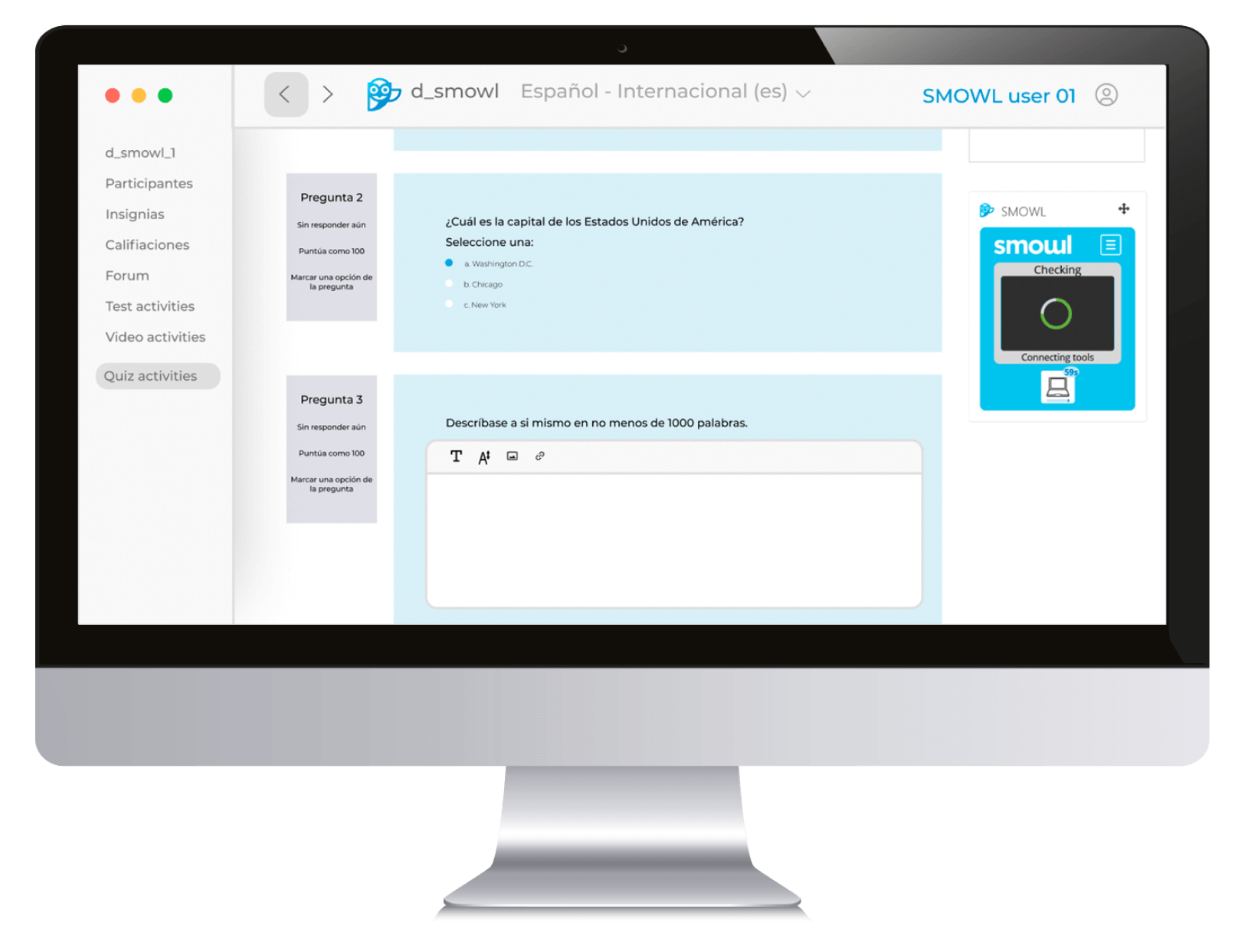
This is what we offer at Smowltech through our proctoring plans, an innovative tool that allows you to evaluate the return on investment of the educational spaces you enable for your students and employees, guaranteeing the security and integrity of the tests.
Thus, while the PLE empowers students to construct their own learning, SMOWL products ensure that this path is valid, creating bridges between autonomy and accreditation.
We invite you to request a free demo so that we can explain each of the solutions we can offer you and you can discover how they can be adapted to the growth rate of your projects.
Resources to help you create your personal learning environment
Below, we have compiled some resources that will help you when creating a PLE:
- Domain of One’s Own Project. This is an initiative of the University of Mary Washington where each student is assigned a personal space that becomes a digital portfolio where they can develop blogs, publish work, projects, and reflections.
- Pontydysgu. This is the research website of Graham Attwell, a pioneer in the field of PLEs.
- MIT OpenCourseWare. A large repository of courses on innovative educational technology design and creative learning environments that can inspire you.