The rise of digital education and artificial intelligence tools has transformed how technical skills are evaluated. Especially in tech-focused degrees where computer-based practical exams are essential, a key question arises: how can we guarantee fair and reliable evaluations?
The U-tad case study demonstrates that the answer lies in the strategic adoption of digital proctoring solutions for in-person programming exams, capable of monitoring student activity and ensuring academic integrity without compromising the educational experience.
About U-tad: tech training aligned with the industry
U-tad is a university specialized in technology, art, and design, whose mission is to prepare professionals ready to join the workforce from day one. Its academic model is based on practical learning, multidisciplinary teamwork, and a close connection to the business sector.
Their educational approach stems from a clear principle: students must learn in contexts as close to professional reality as possible. For this reason, in areas like programming, exams are not conducted on paper but directly on a computer, simulating real-world development scenarios.

The challenge: evaluating programming in the AI era
For years, U-tad has championed practical digital testing. However, the growing use of generative artificial intelligence tools posed new academic challenges:
- Risk of external assistance during exams.
- Difficulty in proving instances of fraud.
- Increased proctoring workload for faculty.
- Need to maintain objective evaluations.
The problem wasn’t just detecting suspicious behavior, but having verifiable evidence. The teaching team needed a technological solution that allowed them to monitor the student’s digital environment without interfering with the exam itself.
The solution: digital proctoring for in-person programming exams with SMOWL
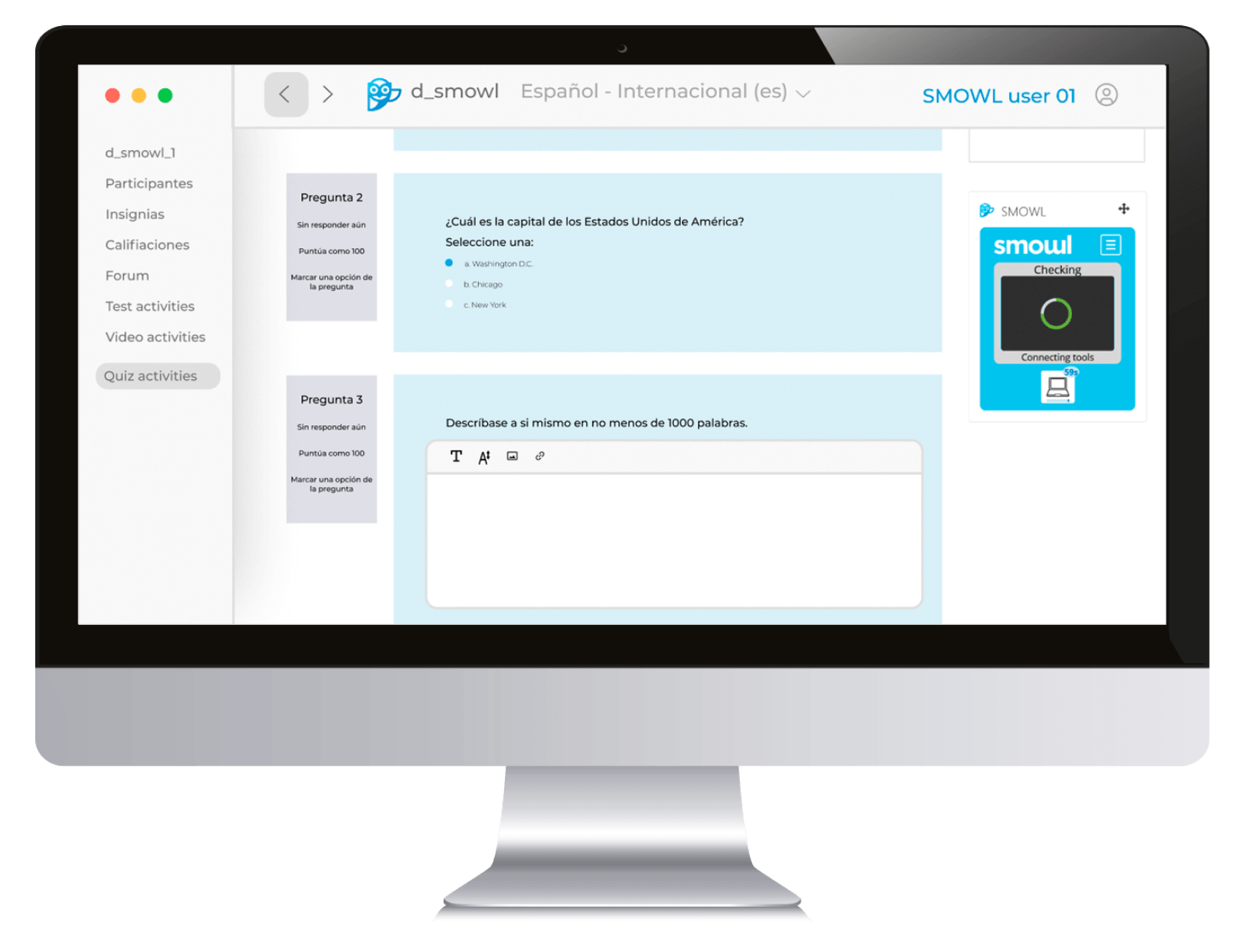
To solve this challenge, U-tad decided to implement SMOWL, a digital proctoring system designed to monitor computer activity during exams. This technology allows for real-time monitoring of what happens on the student’s device during in-person tests.
The key features that made a difference were:
- Visibility of open applications.
- Logging of active processes.
- Browsing history during the exam.
- Verifiable evidence for post-exam review.
These capabilities provide full visibility into the digital environment, which is fundamental when evaluating technical skills where the computer is the primary tool.
“Students prepare for exams differently because they are convinced they won’t be able to get outside help.”
— Alfonso Castro Escudero, Deputy Director of Engineering at U-tad
A progressive and controlled implementation
The adoption was carried out gradually, incorporating the tool into different exams and subjects. This approach allowed the university to:
- Adapt internal processes.
- Train faculty.
- Familiarize students with the system.
- Adjust technical protocols.
Based on U-tad’s experience, one of the key factors for success was maintaining a calm approach during the initial implementation phases and having a contingency plan for potential technical issues.
Do you want to stay on top of the latest trends in eLearning, EdTech, and Human Resources?
Fill out the form to receive our weekly newsletter with industry insights from our experts.
Results: benefits of digital proctoring for in-person programming exams
1. Fairer Evaluations
Digital proctoring ensures a level playing field for all students. No one can access external help without it being recorded, which reinforces trust in the grading system.
2. Peace of Mind for Faculty
The system automates digital monitoring, reducing the manual supervision workload and allowing instructors to focus on evaluating actual knowledge.
3. Improved Student Preparation
Knowing the environment is monitored changes the way students study. Students rely more on their own skills and prepare for exams with greater rigor.
4. Objective Evidence
One of the biggest breakthroughs has been the ability to show concrete data during feedback sessions, such as background applications being open. This increases transparency and avoids subjective arguments.
Before and after implementing proctoring
| Before | After |
| Difficult to prove fraud | Full digital control |
| Constant manual supervision | Verifiable evidence |
| Limited tools | Reliable evaluations |
| Uncertainty in assessments | Greater academic confidence |
Real pedagogical impact
Beyond control, the use of a digital proctoring system has had a direct impact on learning. When students know they must demonstrate their knowledge without external support, they develop deeper and more lasting skills.
This reinforces one of U-tad’s educational pillars: training professionals capable of performing from day one in a real work environment.
“It has been a help in conducting exams and allows teachers to not have to worry about whether students are looking for external help.”
Why digital proctoring is key in tech degrees
In technical degrees, evaluating without a computer makes no pedagogical sense. Programming, designing, or developing requires digital tools. Therefore, the real challenge is not digitizing exams, but doing so while maintaining academic integrity.
Digital proctoring in programming exams allows exactly that:
Practical evaluations + Reliable monitoring + Objective evidence.
This combination is essential for institutions that want to maintain high academic standards without giving up modern methodologies.

The future of digital evaluation
U-tad’s experience points to a clear trend: digital proctoring will become increasingly relevant in higher education, especially in STEM and technology fields.
It doesn’t just help prevent fraud; it enables new, more realistic evaluation formats aligned with the professional environment. This opens the door to hybrid, remote, and flexible models without losing academic rigor.
Recommendation for educational institutions
The U-tad team summarizes their experience with a simple but valuable piece of advice:
“For us, so far, it has been a positive experience.”
Their main recommendation is to plan the implementation well, train the faculty, and consider alternative technical scenarios. With these elements, adoption is smooth and the benefits are quickly realized.
Conclusion
The U-tad case proves that implementing a digital proctoring system for in-person programming exams not only improves oversight but also transforms the quality of the educational process. Thanks to this technology, the institution has achieved:
- Securer evaluations.
- Greater faculty confidence.
- Transparency in results.
- Better-prepared students.
In a context where digital education is advancing rapidly, SMOWL plans become strategic allies to ensure that learning and evaluation evolve at the same pace as technology.
You can request a free trial with 25 free licenses.