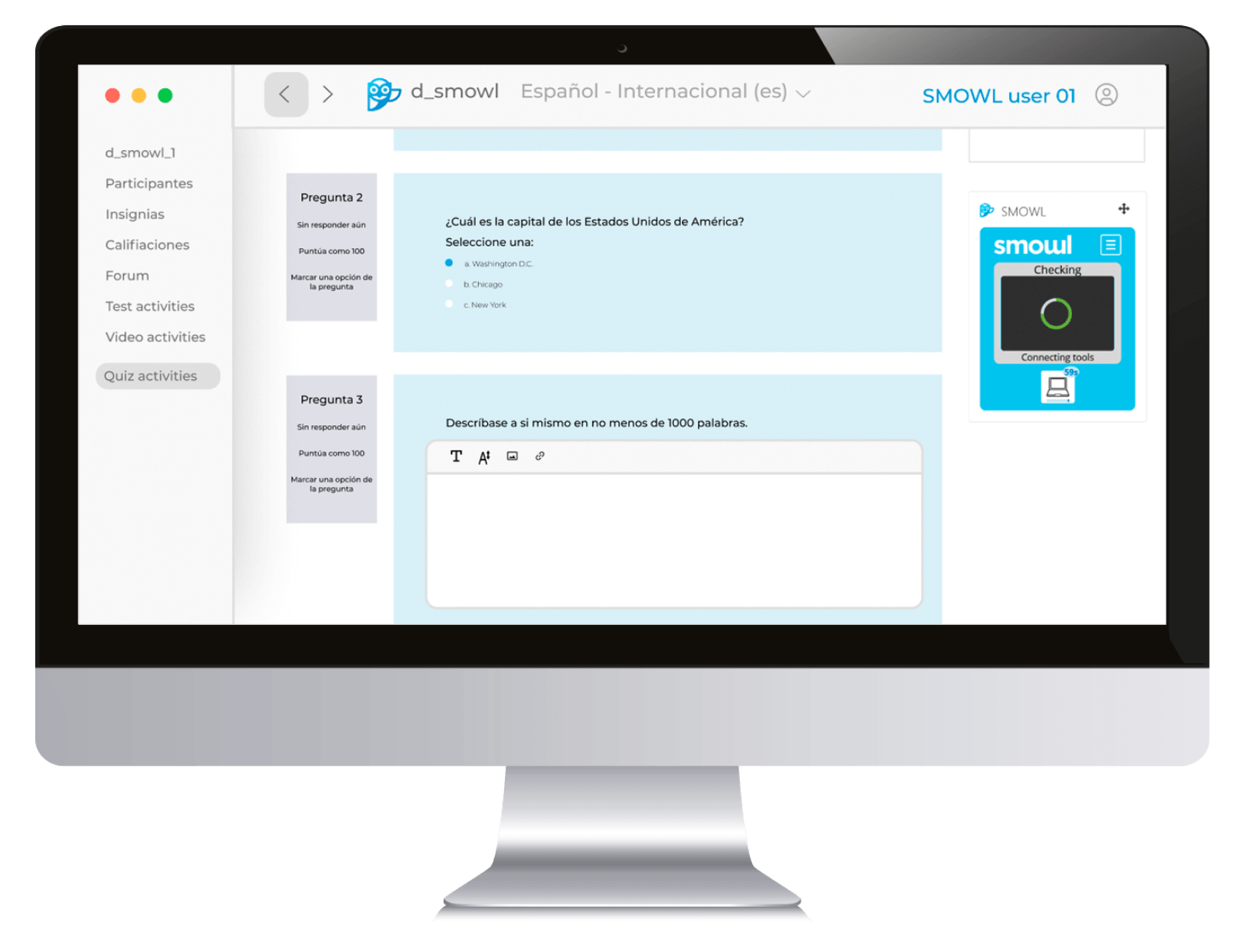
The rise ofonline education has increased the need fortools that ensure assessments are reliable, accessible, and fair. In this context, proctoring has become a key solution to help make sure digital exams reflect each student’s true performance.
A common question from institutions and students is: what exactly does a proctoring solution like SMOWL detect?
This article explains the types of evidence SMOWL records, how it supports academic integrity, and why it’s an important tool for modern digital assessments.
One important point to remember: SMOWL does not make pass/fail decisions or automatically judge students – it only generates evidence for instructors and administrators to review.
What Does SMOWL Actually Detect?
SMOWL is designed to identify situations or items that are not allowed during an exam. It does not interpret intent or make automatic judgments. Instead of analyzing gestures or inferring motive, SMOWL focuses on three pillars:
- People detection: identifies if more than one person appears on camera or if no one is present.
- Unauthorized object detection: spots items such as mobile phones, notes, books, or extra devices that may be prohibited.
- Computer monitoring: records evidence related to device activity, including software and applications in use during the exam.
In every case, SMOWL produces clear, reviewable evidence so instructors can revisit the exam session and make informed decisions.
Do you want to stay on top of the latest trends in eLearning, EdTech, and Human Resources?
Fill out the form to receive our weekly newsletter with industry insights from our experts.
People Detection on Camera
This is one of the most important parts of webcam-based proctoring. SMOWL can capture evidence when:
- More than one person appears in the camera frame.
- The person taking the exam does not match the registered user.
- No one is visible on camera (for example, if the student leaves the room).
- The student’s face is out of frame for an extended period.
For example: if a second person enters the room during an exam, SMOWL automatically captures a visual record that the instructor can review later to decide whether it was a brief interruption or unauthorized assistance. Again, SMOWL does not interpret intent: it simply records what happens so it can be reviewed.
Detection of Unauthorized Objects
Another key area of visual proctoring is spotting objects that could give someone an unfair advantage during the test. SMOWL can record evidence if the camera shows:
- Mobile phones.
- Handwritten or printed notes.
- Books or reference materials.
- Additional screens.
- Unauthorized headphones.
- External tech devices.
A clear example is a mobile phone placed near the keyboard. Even if the student doesn’t use it, SMOWL will create a visual record so the instructor can determine whether it breaks the exam rules. This capability helps preserve fairness by ensuring all students are assessed under the same conditions.

Audio detection during the exam
The audio component can generate evidence if sounds during a session suggest possible unauthorized interactions, such as:
- Voices from other people.
- External tutoring or coaching.
- Whispering or aloud reading of private exam content.
- Electronic devices emitting answers or messages.
SMOWL can flag whether one or more voices are present so instructors or administrators can review the recording later and decide if any action is needed.
SMOWL records the audio evidence: it does not interpret intent or issue penalties.
Computer monitoring: SMOWL’s most advanced layer
Device monitoring is a core part of SMOWL, especially thanks to SMOWL CM (Computer Monitoring), which detects actions on the student’s computer. Examples of evidence SMOWL CM can record include:
- Opening browsers or sites that aren’t allowed.
- Attempts to access search engines or external tools.
- Running additional applications or programs.
- Use of virtual machines.
- Detection of generative AI usage (ChatGPT, Gemini, Claude, etc.).
- Switching windows or toggling between screens.
- Connecting unauthorized external devices.
Depending on the institution’s chosen settings, SMOWL can operate in two main modes:
a) Record evidence only
The instructor reviews the recorded evidence afterward and determines whether the action was a rules violation, a technical issue, or an accidental mistake.
b) Automatically lock the browser via SMOWL EXTENSION
On plans that include Browser Lock, if a student leaves the exam window or executes a disallowed command, SMOWL EXTENSION can temporarily remove them from the test session. Even then, the institution decides whether the student may rejoin or be given another attempt.
SMOWL does not penalize students; it automates monitoring and evidence collection so educators can make fair, informed decisions and ensure the integrity of the assessment.
8 interesting facts about proctoring
Fill out the form and download the guide where we cover everything about online monitoring and help you choose the best software.
How SMOWL Influences Digital Assessments
Implementing SMOWL has changed how institutions run digital assessments, bringing clear benefits for both students and schools. SMOWL helps make online testing more reliable, fair, and trustworthy – which is essential as more exams move online.
Increase in Academic Integrity
The main goal of proctoring is to ensure assessment results truly reflect a student’s knowledge. By recording evidence of disallowed items or behaviors, SMOWL helps prevent situations that could compromise exam integrity. This strengthens:
- The validity of grades.
- Fairness among students.
- The reputation of academic programs.
- The credibility of awarded credentials.
In a world where many assessments are fully online, having a tool like SMOWL builds confidence in the whole process.
Reduced Student Stress
Although it may seem otherwise, many students welcome proctoring because it levels the playing field and reduces uncertainty. Knowing everyone follows the same rules creates a more transparent – and often less stressful – testing environment. Benefits include:
- Students feel protected against unfair situations.
- Greater confidence that their work will be judged fairly.
- Clear rules that reduce misunderstandings.
Accessibility and Flexibility
SMOWL enables exams from anywhere, offering an important alternative for students who:
- Live in remote areas.
- Have family responsibilities.
- Balance work and study.
- Have mobility challenges.
- Are international students.
Proctoring opens the door to more inclusive assessments tailored to real-life needs.
Technical Readiness and Compliance
To use proctoring effectively, it’s essential that institutions:
- Clearly communicate exam rules.
- Share technical requirements up front.
- Ensure privacy regulations are followed.
- Offer practice sessions so students can check their setup.
SMOWL stands out for its compliance with GDPR, CCPA, FERPA, and the EU AI Act, helping ensure a transparent and secure monitoring process.

SMOWL generates evidence… but does not suspend
This is important and worth repeating: SMOWL never suspends a student.
Its role is strictly to:
- Generate objective evidence.
- Organize information to make review easier.
- Support the instructor in making informed decisions.
The instructor or institution decides:
- Whether the evidence constitutes a real violation.
- Whether any action should be taken.
- Whether the student may continue, must retake the exam, or faces academic sanctions.
Even when automatic exam-locking features are enabled, the institution can always:
- Reopen the attempt.
- Grant a new access.
- Uphold its original decision according to internal policy.
SMOWL streamlines instructors’ work: it never determines the final outcome.
SMOWL: a path to safer, fairer, more accessible digital exams
Digital assessment needs tools that deliver transparency, security, and fairness. SMOWL provides exactly that: a system that records objective evidence without judging or punishing, protects student privacy, and helps institutions maintain strong academic standards.
In short:
- Detects people, unauthorized objects, and actions on the computer.
- Produces clear, reviewable evidence.
- Never grades or suspends – the educator always has the final say.
- Enables more flexible, inclusive, and modern education.
If your institution wants to move toward more reliable digital assessments, request a free SMOWL demo to see how we can transform your evaluation process.