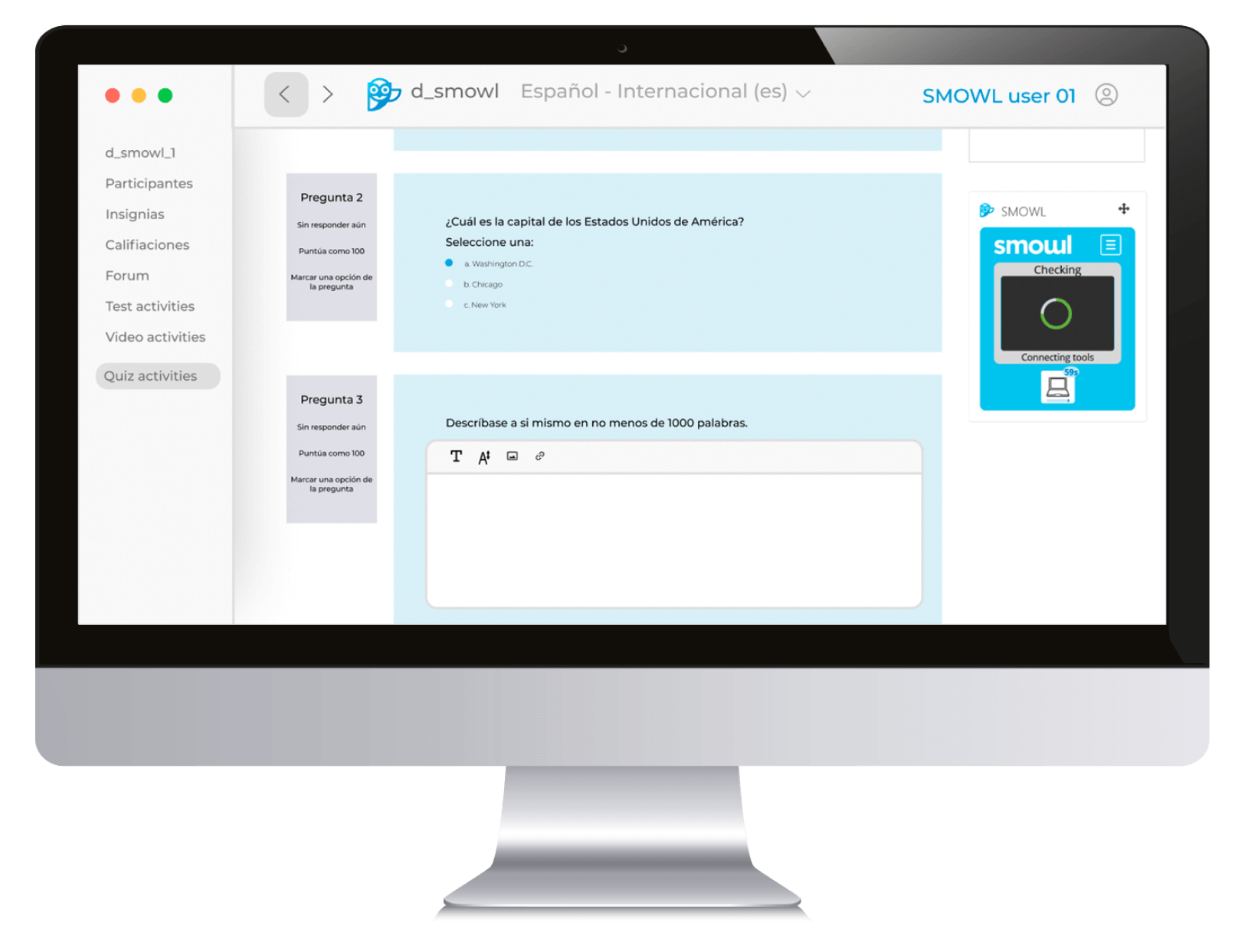
According to the SMOWL savings calculator, a university with 1,000 students can save around €63,000 a year (gross). That same calculation estimates that, every year, the university would avoid printing 160,000 sheets of paper, using 1.6 million liters of water, and releasing 11.14 metric tons of CO2 into the atmosphere.
On top of that, it would free up 1,080 faculty hours and save 8,000 kWh of energy. That figure includes faculty hours and travel—two line items that the example later in this article leaves out so we can focus strictly on the direct costs the university pays. In that narrower case, net savings land somewhere between €16,000 and €40,000.
To pin down exactly how much a university can save by moving exams online, you need to compare the total cost of the in-person model with the total cost of digitizing assessments and adding a proctoring solution.
The math should cover infrastructure (classrooms), invigilation, printing, logistics, travel, administrative workload, licenses, implementation, training, and support. The bottom line depends on student volume, the number of exam sessions, the cost of facilities, the licensing model, and the internal resources needed to run each format.
In this article, we’ll walk you through how to calculate the ROI of university proctoring, estimate the net savings of online exams, and figure out your payback period.
Proctoring ROI calculator: how to calculate your savings, step by step
Calculating the return on investment (ROI) of a proctoring system comes down to three steps:
- Put a number on what each in-person exam session costs.
- Estimate what online proctoring would cost.
- Compare both results against the upfront investment.
For a quick first estimate, the SMOWL savings and impact calculator helps you estimate the paper, faculty hours, travel, and emissions you’d avoid, based on your number of students and exams.
If you want the full ROI picture, you’ll also need to factor in classrooms, invigilation, administrative work, and the cost of the license. Here’s how to tackle each one.
What Is the formula for calculating ROI?
Return on investment (ROI) measures how much net profit each euro invested generates, expressed as a percentage.
Here’s the basic formula:
| ROI (%) = (total return – investment) / investment x 100 |
|---|
To make sense of it, let’s break down a few key terms:
- Total return: the costs you avoid during the period you’re analyzing—classrooms, invigilation, printing, logistics, travel, and administration.
- Investment: everything the online model costs over that same period. This should include implementation, licenses, support, and the internal hours spent reviewing flagged incidents.
- Net savings: the difference between the two, after subtracting the cost of the solution.
Another metric worth tracking is the payback period—how long it takes for the upfront investment to pay for itself. You can measure it with this formula:
| Payback period = upfront investment / operational savings per exam session |
|---|
Operational savings are the in-person costs you avoid by switching to online exams, minus the recurring cost of the online model for each exam session. It’s a good idea to measure operational savings per exam session so you can compare degree programs that run on different assessment calendars.
Before making an investment decision, the European Commission recommends stress-testing the project under both best- and worst-case scenarios. If the numbers still come out positive in the least favorable case, the project is more financially resilient—though risks and uncertainties don’t disappear.
A single exam costs between €4.26 and €6.88 per student for the classroom, invigilation, and paper alone. That estimate is based on public data: classroom rental rates from Universidad Carlos III de Madrid (UC3M), labor costs from Spain’s National Statistics Institute (INE), invigilation ratios from the Autonomous University of Barcelona (UAB), and printing rates from the University of Huelva. The calculation assumes a two-hour exam, 30 minutes of setup, and four pages per student.
In other words, if the recurring online cost per exam is lower than the avoidable in-person cost, you’re saving money on operations. How quickly you recoup the implementation cost will depend on your exam volume and cumulative savings.

The variables a university ROI calculator needs
Since Organic Law 2/2023 of March 22 on the University System took effect, Spanish universities have been required to maintain a cost accounting system (or an equivalent).
With that data in hand, here are the variables a university ROI calculator needs to produce a reliable result:
| Variable | How it’s calculated | Who can provide the data |
|---|---|---|
| Number of students | Students taking each exam | Registrar and academic administration |
| Exams, courses, and exam sessions | Students x courses with an exam x exam sessions | Academic planning and registrar |
| Classroom and facility hours | Classrooms in use x (exam length + setup and cleanup) x hourly facility cost | Facilities and space management |
| In-person invigilation | Invigilators per room x hours x hourly staff cost | Academic departments, faculty, and HR |
| Printing, logistics, custody, and storage | Pages x cost per page + backup copies + transport + storage, archiving, and secure disposal | Print services, building services, and records |
| Travel, per diems, and mobility | Miles/kilometers x mileage reimbursement rate + per diems and lodging for staff traveling to exam sites | Finance and business office |
| Administrative staff hours | Hours per exam session (scheduling, grade reports, incidents, appeals) x hourly cost | Registrar and assessment office |
| Licenses, integration, training, and support | Vendor proposal + internal IT and e-learning hours for implementation | IT, e-learning, and procurement |
| Review and incident hours | Proctored exams x % flagged x review minutes x hourly cost | Faculty and assessment office |
Which costs should you include when calculating proctoring ROI?
When you calculate ROI, you need to compare the total cost of running in-person exam sessions with the total cost of implementing and running proctored online assessments. That means accounting for every cost that changes from one model to the other—both upfront and recurring:
- In-person exam session costs, such as classrooms, invigilation, printed materials, support staff, technical support, cleaning the rooms used, and organizing the exams. A common mistake is comparing only the proctoring license against paper costs, when factors like invigilation weigh far more heavily in the final tally.
- Upfront costs of online assessment: integration with your LMS and authentication systems, configuration, training for staff and students, updating assessment policies, and running both processes in parallel during the transition.
- Recurring costs of remote assessment: licenses, support during exam sessions, human review of flags, and work hours from the internal teams involved, such as IT, e-learning, the registrar, and the assessment office.
Keep in mind that license costs can vary based on the number of students, how often and how long exams run, the level of proctoring, integrations, and support needs.
That’s why it pays to calculate ROI based on a pricing proposal tailored to your institution. With SMOWL proctoring plans, you can choose between two licensing models: per activity (a single proctored exam per student) or per user (unlimited activities during the contract period). This flexibility lets our clients match their plan to expected usage and estimate costs on a more concrete basis.
Online vs. in-Person exam costs—and why integrity matters
Online proctoring eliminates some costs, transforms others, and adds a few new ones. Either way, exam integrity requires supervision in any format—even when an in-person exam is paired with online proctoring, as in the Princeton University example we’re about to walk you through.
For 133 years, Princeton ran its exams without proctors. Its honor code, in place since 1893, relied on students’ pledge not to cheat and to report anyone who did. But in May 2026, the faculty voted—with just one dissenting vote—to have all in-person exams proctored by faculty and staff. So, as of July 1, 2026, in-person exams at Princeton are proctored.
Artificial intelligence and the rise of generative AI tools were the “tipping point,” as reported by the American Association of Collegiate Registrars and Admissions Officers (AACRAO). These technologies have made it easy to cheat in ways that are very hard to detect without someone in the room.
Given this reality, the question isn’t whether exams should be proctored, but how to do it in a way that protects academic integrity. When an in-person exam is taken on a computer, there’s an alternative to in-person proctoring: proctoring it digitally.
That’s exactly what SMOWL CLASS does—it’s Smowltech’s plan for in-person, computer-based exams. Here’s how it works: students take the exam in the classroom on a computer, and the institution decides the level of control. The plan lets you monitor computer activity (Computer Monitoring with SMOWL CM) or lock down the browser (Browser Lock with SMOWL EXTENSION).
As for ROI, in this hybrid scenario the classroom stays—and so do some facility costs. But exam printing, along with the custody and storage of paper exams, goes away. Plus, the university gets traceable evidence of what happened during the exam, which comes in very handy for grade reviews and appeals.
That’s why the meaningful comparison isn’t between a proctored model and an unproctored one—it’s between two ways of proctoring, each with its own price tag.
Costs that disappear or shrink with online assessment
Once you move to online assessment, exam printing, backup copies, physical distribution, custody, and paper storage almost entirely disappear. Room setup and travel also go down if you go 100% remote.
These are the most visible savings, but not the biggest. In the scenario used in this article, printing accounts for roughly 3% of the estimated in-person cost.
Costs that shift
Costs that shift include invigilation hours, which turn into technical support, incident management, and report review. Proctoring systems collect and prioritize evidence, but academic decisions are still made by people.
That’s also what the EU AI Act requires: it classifies AI systems that monitor exams as high-risk and makes their use conditional on requirements such as human oversight.
Costs that should stay in the calculation
Costs that typically belong in the calculation include the license, authentication systems, training, support for each exam session, human review of flags, and evidence retention with privacy safeguards.
You should also factor in integration with your learning management system (LMS) and access to alternatives for students who can’t take exams remotely.

Direct savings: facilities, travel, and printed materials
Managing classrooms, invigilation, travel, and printed materials is where you’ll see the most tangible savings.
Physical Infrastructure: venues, classrooms, and freed-up capacity
Every in-person exam session requires classrooms, lecture halls, computer labs, and sometimes off-site venues that come with opening, cleaning, and security costs. According to its 2026 rates, Universidad Carlos III de Madrid charges €200 a day for a classroom with up to 50 seats, plus a surcharge of up to 50% outside regular hours.
| Item | Example | Impact on ROI |
|---|---|---|
| Direct savings | No need to rent off-site venues or pay for extra custodial and cleaning staff | Reduces spending |
| Indirect cost | Extra shifts, after-hours surcharges, additional exam versions | Avoided, though usually charged to other budget lines |
| Freed-up capacity | Your own classrooms stay available during exam periods | Doesn’t reduce spending, but frees up space for other uses |
In-person invigilation, logistics, and travel
Invigilation is one of the biggest direct costs of any exam. To calculate it, multiply the number of invigilators per room, shift, and exam session by the hours worked and the hourly labor cost (about €26.18 on average, according to INE data).
On top of that, add the cost of coordinating support staff and transporting exams between buildings or campuses. Spanish public administrations reimburse staff travel at €0.26 per kilometer (roughly €0.42 per mile), plus per diems. Student travel only counts if the institution pays for it.
Paper, printing, custody, and exam storage
The cycle runs from printing and backup copies to archiving and digitization, retrieval for appeals, and secure disposal—plus toner, envelopes, and tamper-evident seals.
What you should really pay attention to is the cost of handling and custody hours, because printing itself tends to be cheap (around €0.035 per page, based on University of Huelva rates).
Administrative workload: savings measured in hours
Administrative workload is a factor that belongs in your ROI calculation. You can measure it by tracking how much time your teams spend preparing exam sessions, resolving incidents, and tracking down documentation.
For a more realistic result, separate spending that disappears from hours that are freed up for other tasks. Freeing up capacity doesn’t necessarily translate into a direct budget cut.
Automated reports: faster academic decisions
Online proctoring systems that centralize evidence let you review a specific case without having to piece it together from scattered files and email threads.
Going back to SMOWL’s AI proctoring solutions, they offer downloadable reports, access to evidence right from the LMS, and options to add notes and bookmarks. These incident review and documentation tools help you streamline your processes.
To get the most out of them, set shared criteria across courses: what gets reviewed, who reviews it, and how the outcome is documented. Automation does help organize information and ensure traceability, but always keep a human-in-the-loop approach, building in human judgment before any academic decision is made.
Operational savings: grading, incidents, and records
When it comes to the day-to-day operations of assessment, keep in mind that grading an answer isn’t the same as checking a submission, sorting documents, or retrieving evidence. Compare the in-person and online models using three metrics:
- Minutes spent on setup and wrap-up per exam session.
- Time spent managing and reviewing each incident.
- Hours spent finding, filing, and sharing documentation.
One key step is assigning clear owners to avoid duplicated work between faculty, the registrar, and assessors. Measure before and after using comparable exam sessions, and count the new digital tasks, too.
Sustainability: the return that doesn’t show up on the balance sheet
The environmental return complements the financial one, but it shouldn’t be added to your monetary savings without a methodology to back it up. The SMOWL calculator gives you ballpark estimates to start with.
Sustainability metrics a university can track
Here are some sustainability metrics you can include in your cost analysis:
- Sheets of paper, backup copies, and supplies avoided.
- Envelopes and physical shipments eliminated.
- Trips avoided, based on distance and mode of transportation.
- Classroom and venue hours no longer needed.
UC3M, for example, includes mobility, paper purchases, and waste in its calculation of indirect (Scope 3) emissions.
To round out this environmental picture, you’ll also need to account for the additional technology consumption. Be sure to rely on documented emission factors, such as those published by Spain’s Ministry for the Ecological Transition (MITECO) for its carbon footprint registry.
Do you want to stay on top of the latest trends in eLearning, EdTech, and Human Resources?
Fill out the form to receive our weekly newsletter with industry insights from our experts.
Real-world example: calculating proctoring ROI for a university
In the following illustrative example, we start with a hypothetical university of 1,000 students. Each student takes exams in ten courses a year, roughly equivalent to a 60-ECTS-credit academic year (6 credits per course, or about 30 US semester credit hours in total). The exams are split across two exam sessions, for a total of 10,000 proctored exams.
Baseline scenario (for illustration only)
Here’s the starting scenario:
| Item | Value | Data source |
|---|---|---|
| Exams per year | 10,000 | 1,000 students x 10 courses |
| In-person cost per exam | €6 | Range of €4.26 to €6.88, calculated using public data on classrooms, invigilation, and paper |
| Upfront implementation | €4,000 | Roughly 150 internal hours for integration, configuration, and training, at an average labor cost of €26.18 per INE data |
| Online cost per exam | €2, €3, and €4 | Pricing varies by solution and may include licensing, support, and incident review |
We’ve included an estimated online cost because pricing isn’t one-size-fits-all: it depends on volume, licensing model, and level of proctoring. In SMOWL’s case, with ten exams per student, the per-user license is the recommended option.
Either way, the calculation doesn’t include academic grading (which is the same under both models), travel, or environmental impact.
Results: net savings, ROI, and payback period
Continuing with the simulation, the in-person model costs €60,000 a year (10,000 exams x €6). Depending on what the online model costs, here’s how the numbers could shake out (remember, these are just estimates to help you understand how ROI is calculated):
| Online cost per exam | €2 | €3 | €4 |
|---|---|---|---|
| First-year online cost (including implementation) | €24,000 | €34,000 | €44,000 |
| First-year net savings | €36,000 | €26,000 | €16,000 |
| First-year ROI | 150% | 76% | 36% |
| Net savings in subsequent years | €40,000 | €30,000 | €20,000 |
| ROI in subsequent years | 200% | 100% | 50% |
| Payback on implementation | 0.20 exam sessions | 0.27 exam sessions | 0.40 exam sessions |
Here’s how to calculate the payback period on your implementation investment:
| Operational savings per exam session = exams per session x (in-person cost per exam – online cost per exam) |
|---|
Using the data from our illustrative simulation (10,000 exams across two sessions—so 5,000 per session—and €4,000 for implementation), the results would be:
| Online cost per exam | Operational savings per exam session | Payback period |
|---|---|---|
| €2 | 5,000 x (6-2) = €20,000 | 4,000 / 20,000 = 0.20 exam sessions |
| €3 | 5,000 x (6-3) = €15,000 | 4,000 / 15,000 = 0.27 exam sessions |
| €4 | 5,000 x (6-4) = €10,000 | 4,000 / 10,000 = 0.40 exam sessions |
In all three scenarios, the university saves money from year one and recoups the cost of implementing the new system within the very first exam session. The first-year return is lower because it has to absorb the €4,000 upfront implementation cost.
When you present the results for review, separate the spending that drops off the budget entirely (printing, off-site venues, overtime, etc.) from the staff hours and classrooms that are freed up for other uses.
What’s considered a good ROI for a university?
There’s no universal benchmark for a “good” ROI, but using the formula we shared at the beginning of this article, here’s how to read the results:
- 0% ROI: the costs you avoid equal the investment—you break even.
- 50% ROI: every euro invested generates €0.50 in net savings.
- 100% ROI: every euro invested generates €1 in net savings.
- ROI above 100%: every euro invested generates more than €1.
Beyond the ROI percentage, a complete analysis should also weigh the payback period, the uncertainties that could affect the project, and the operational capacity freed up for other work.
What does a 120% ROI mean?
A 120% ROI means that a €10,000 investment produces €12,000 in net profit. The total return comes to €22,000: you get back the €10,000 you invested plus an extra €12,000. For a university, that return comes from avoided costs.
The math: 120% ROI = [(22,000 – 10,000) / 10,000] x 100.

Why ROI shouldn’t be your only decision criterion
To see why ROI shouldn’t be the only yardstick for an education project, think about integrity. An assessment that loses credibility, shuts out some students, or falls out of compliance won’t be a good investment—no matter how great the ROI looks.
That’s why you need to weigh other factors alongside ROI, such as academic integrity, the student experience, accessibility, privacy, continuity of exam sessions, fit with each university’s assessment policies, and the quality of the evidence. That last one matters a lot, since evidence will be used in grade reviews, appeals, and audits.
With AI in the picture, integrity is front and center, as a 2025 Daily Princetonian survey makes clear: 30% of the 501 graduating seniors surveyed admitted to using ChatGPT on an assignment that explicitly prohibited it.
Student data privacy is another core issue. The Spanish Data Protection Agency (AEPD) maintains that online learning can’t justify a disproportionate reduction in students’ digital and privacy rights. To get this right, institutions must strictly comply with data protection regulations and respect students’ dignity and privacy in their own homes or surroundings.
What can cut into your online exam savings—and how to fix it
There are three factors that can eat into the savings from online exams, and knowing them is the first step toward effective solutions: not enough exam volume, the cost of implementing, supporting, and managing the online solution, and accessibility, privacy, and alternative assessment options.
Not enough exams or exam sessions
Implementing a proctoring system involves a fixed cost, so the fewer exams you proctor, the more that cost weighs on each one.
In our example, with €3 in operational savings per exam and €4,000 in upfront implementation costs, you’d need at least 1,334 exams to break even. In cases like these, it makes sense to run a pilot program before committing to a full rollout, or to adopt a hybrid model that reserves online proctoring for high-volume exams or distance learners.
Solution: scalable solutions like SMOWL let you adjust the level of proctoring and the licensing model to the actual number of assessments. That way, you avoid overpaying for one-off exam sessions or programs with low exam frequency.
Implementation, support, and change management costs
As we’ve covered throughout this article, you need to account for real costs such as integrating the proctoring tool with your institution’s LMS, faculty training, updating assessment policies, and maintaining both models during the transition.
Going back to our example, if the online cost were €4 per exam and implementation rose from €4,000 to €8,000, first-year net savings would drop to €12,000 and ROI would be 25%.
Solution: choose an online proctoring provider with certified integrations for the leading LMS platforms—like Moodle, Canvas, Blackboard, or Brightspace—plus onboarding training and 24/7 support for institutions, assessors, and students.
Accessibility, privacy, and alternative assessment options
One of the gaps that digitization can create shows up when a student doesn’t have a computer with a webcam, a stable internet connection, or a suitable space to take an exam remotely.
Given that Spain’s University Student Statute requires assessments to be adapted for students with disabilities, in-person or adapted alternatives need to be built into the budget from day one.
Privacy is the other factor you’ll want to sort out before calculating your savings. When proctoring includes identity verification using biometric data, such as facial authentication, the AEPD considers it a special category of personal data. According to its report on online assessment, student consent can only serve as the legal basis for that processing if there’s an equivalent alternative that doesn’t involve biometric data—for example, taking the exam in person, with the same length and difficulty. What’s more, declining should never cost a student their right to be assessed.
If a university opts for biometric verification, it—as the data controller—must carry out a data protection impact assessment (DPIA) with guidance from its data protection officer. That analysis also takes up internal hours that should be included in the calculation. The AEPD also stresses the need to assess the measures as a whole: several layers of control combined can end up being excessive, even if each one on its own is proportionate.
Solution: go with solutions that let you choose which layers of control to turn on for each exam (identity verification, webcam, computer monitoring, or browser lockdown). That’s exactly what SMOWL plans offer. With them, universities can match the level of proctoring to the real risk of each exam, use options that don’t involve biometric processing, and keep an in-person or adapted alternative available for anyone who needs it. Plus, our solutions are certified under Spain’s National Security Framework (ENS) and ISO 27001, ensuring the security of the information processed.
By now, you know that the smartest decision when implementing an online proctoring system strikes a balance between savings, safeguards, and operational feasibility. We invite you to use our savings calculator to get an estimate, check out our proctoring plans, and request a free demo to find the setup that best fits your needs.