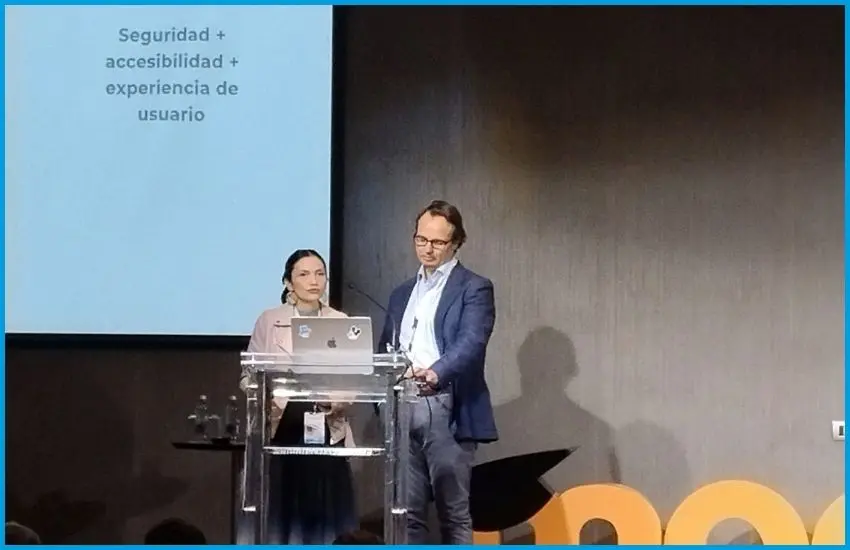
At the first MoodleMoot Chile, Smowltech and ReadSpeaker shared the stage to discuss something that goes beyond each solution individually: how to build a Moodle ecosystem where academic integrity and accessibility operate at the same level, with the same standard of quality.
It was not a product presentation. It was a conversation about certifications, what institutions can demand from the tools they integrate into their platforms, and why the Moodle ecosystem now offers guarantees that did not exist a few years ago. The moment had a special context: both companies had just been recognized as Moodle Certified Integration Plus.
What was brought to the table at MoodleMoot Chile 2026
MoodleMoot Chile 2026 was held on May 26 and 27 at the DoubleTree by Hilton Santiago-Kennedy Hotel, organized by MindFree, the country’s sole Moodle Partner. It was the first official event for this community in Chile, bringing together institutions, Moodle partners, and certified integrations around a shared goal: advancing the quality of online education within the Moodle ecosystem.
Its focus was not merely to showcase technological innovations. It was to highlight the network of key players that makes Moodle function at an institutional level: Moodle Headquarters (HQ), the partners that support implementation, and the integrations that expand the platform’s capabilities. A conversation about how they work together and what assurances this collaboration offers to institutions that rely on Moodle for their assessments.
Patricio Carrasco Medanic, co-founder and CCO of MindFree, explained it this way:
“As a Moodle Partner, at MindFree we accompany institutions in building platforms that respond to their educational challenges. Certified integrations are an important part of that work, and their value is enhanced when understood as part of an ecosystem, not as isolated tools. That is why, at the first MoodleMoot Chile, we wanted to center the collaboration among Moodle HQ, Moodle Partners, and certified integrations, inviting Smowltech and ReadSpeaker to present themselves not only for their solutions, but as key players in this ecosystem that, together, helps enrich the educational experience.”
Patricio Carrasco Medanic, co-founder and CCO of MindFree
That was precisely the conversation we brought to the stage: not two tools presenting their value proposition separately, but two certified integrations demonstrating how they complement each other within the same environment and what that means for the institutions implementing them.
What being Moodle Certified Integration Plus means
The Moodle Certified Integration Plus certification is part of Moodle HQ’s certified integration program, which defines different levels of validation and collaboration between Moodle and its technology partners. The Plus level goes beyond standard technical validation, incorporating additional Moodle services designed to offer an even better experience for institutions implementing the integration.
For an institution, this carries a concrete meaning. When you choose an integration with this certification, you are choosing something that has been tested, reviewed, and endorsed by the very team that develops Moodle. You have the backing of Moodle HQ behind it, along with the assurance that the integration will remain compatible and updated as the platform evolves.
Obtaining it also requires a commitment to ongoing maintenance. It demands that the integration be updated and audited periodically. This changes the equation for institutions because it significantly reduces the technical risk of relying on a third party integration.
The presentation we shared at MoodleMoot Chile was titled Two Solutions, One Standard of Quality. That title accurately summarizes what the Plus certification represents: a shared standard that allows both solutions to coexist smoothly within the same ecosystem, held to the same level of technical rigor, and backed by Moodle itself.
Integrity and accessibility: two pillars, one exam
The central thesis of our presentation was simple: integrity and accessibility are not two separate conversations held in different departments. They are two requirements of the same assessment process, and they must be resolved within the same environment.
An online exam that is not proctored puts at risk the validity of the certification granted by the institution. An online exam that is not accessible creates unnecessary barriers between the student and the demonstration of their knowledge. No institution can afford to fail on either front, and the good news is that they do not have to choose.
Do you want to stay on top of the latest trends in eLearning, EdTech, and Human Resources?
Fill out the form to receive our weekly newsletter with industry insights from our experts.
SMOWL: online exam proctoring integrated into Moodle
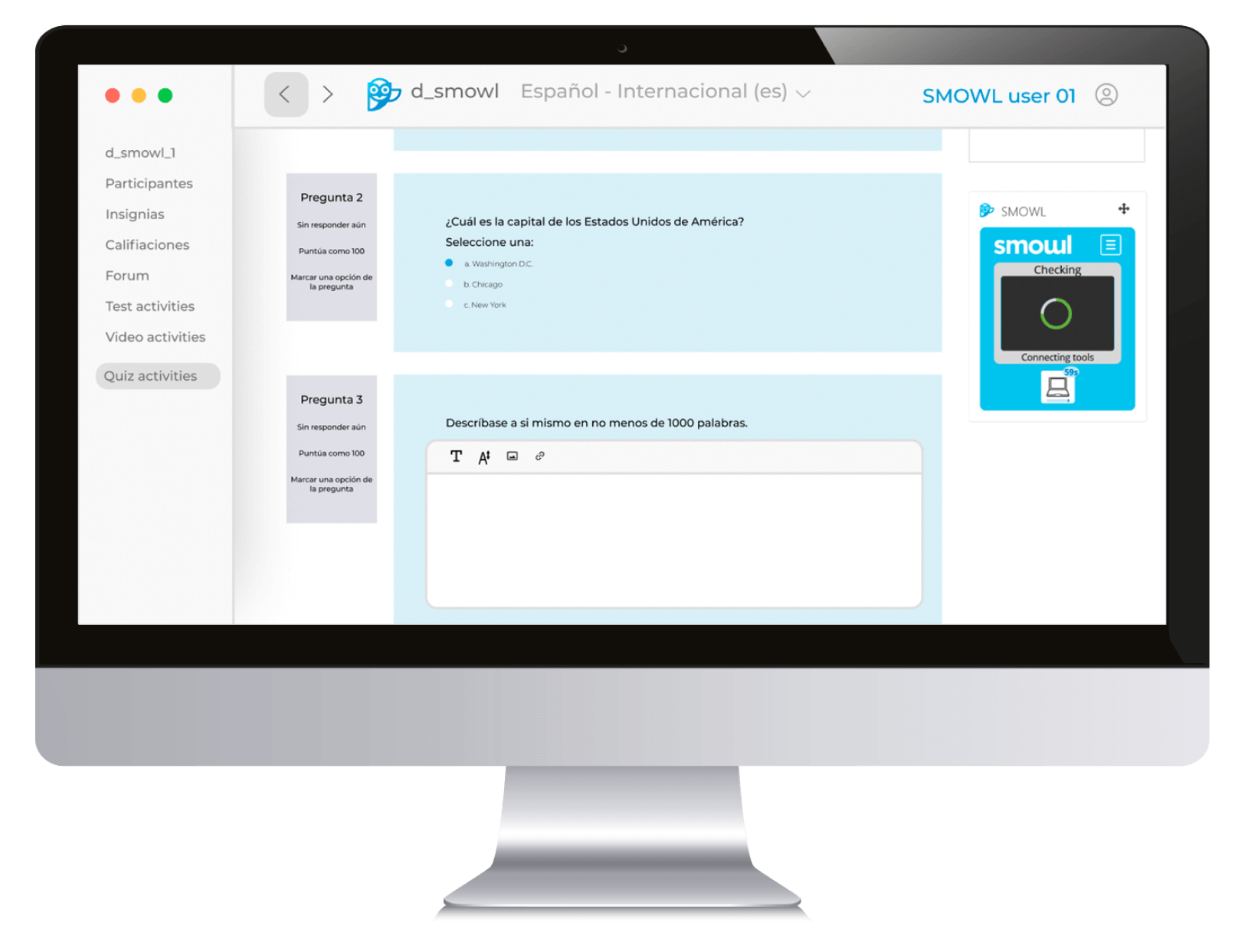
SMOWL brings the full proctoring cycle to the ecosystem: identity authentication prior to the exam, incident detection during the test using artificial intelligence with human review, and objective evidence generation upon completion.
Everything takes place within the Moodle environment, without the student having to leave the platform or install additional applications. The student experience is designed to be seamless and non intrusive: SMOWL accompanies the process without interrupting it or generating unnecessary friction.
Identity authentication is accredited to the High Level of the Spanish National Security Scheme (ENS), the public administration security standard in Spain, offering institutions the necessary legal robustness to defend their results against any claim. Our model reduces false positives and ensures that each incident is handled with clear criteria before it produces any consequences for the student.
If you would like to learn about our plans, you can explore the modality that best fits the volume and needs of your institution.
ReadSpeaker: native accessibility in Moodle
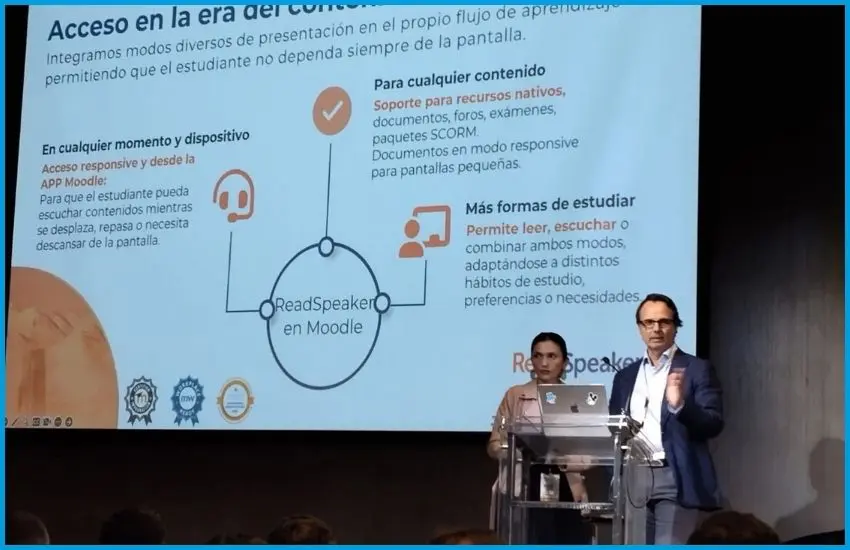
ReadSpeaker brings the accessibility layer to the exam content. Its text-to-speech technology allows students with dyslexia, low vision, or other reading difficulties to access content under the same conditions as the rest of the group.
But its value goes beyond specific needs: any student can use it to stay focused, double-check their understanding of a question, reduce fatigue during long exams, or follow content in a language that isn’t their first. Listening while reading is simply another way to process information, and many students choose it on their own.
It requires no special setup from the student or a prior adaptation request. It is available directly within Moodle, natively, to anyone who needs it, whenever they need it. This is the core idea of Universal Design for Learning (UDL): designing assessments for the diversity of the whole group from the start, instead of adapting them case by case. Accessibility stops being an exception and becomes an integrated feature available to everyone.
Together, SMOWL and ReadSpeaker make possible what more and more institutions are seeking: an online exam that is secure for the entity administering it, accessible for the student taking it, and sustainable for the teams managing it.
The impact on educational institutions
Implementing accessible online exams with proctoring has a direct and measurable effect across three key areas that matter to any educational institution:
Legal protection: Every assessment proctored with SMOWL generates a documented, traceable record of evidence. Without that traceability, any appeal or dispute can turn into a reputational issue with no quick solution.
Operational efficiency: Automating proctoring through AI reduces the workload on faculty and administrative staff without losing control of the process. Less time spent managing manual incidents, less coordination required to adapt exams on a case by case basis, and less friction in managing claims. The time gained can be redirected toward what truly matters: providing academic support to students.
Student retention. An assessment environment that works for everyone directly helps students complete their programs. Well implemented accessibility is not just an ethical imperative: it is also a retention lever with a real economic impact for the institution.
What attendees took away from MoodleMoot Chile
The conversation at MoodleMoot Chile confirmed something we hear frequently from institutions: the challenge is not just finding good tools. It is finding tools that work well together, that are genuinely integrated into the platform they already use, and that have the necessary technical support to remain sustainable over time without generating technical debt or fragile dependencies.
The Moodle Certified Integration Plus certification addresses that exact need. And the fact that both SMOWL and ReadSpeaker hold it is what makes it possible to approach the combination of proctoring and accessibility not as a complex integration project built from scratch, but as a decision backed by pre existing technical work and institutional validation.
For institutions working with Moodle that want to advance the quality of their assessments, the message from MoodleMoot Chile was clear: the ecosystem is already built. The tools are proven. The standard is shared. All you have to do is join.
Building trust in digital learning means ensuring no student is left behind and no institution has to take on preventable risks. Integrity and accessibility are not a dilemma. They are the standard.
How to start offering accessible online exams in your Moodle
One of the most frequent questions we receive from institutions is how to implement all of this in practice. The answer is more straightforward than you might think, precisely because both SMOWL and ReadSpeaker are certified integrations within the Moodle ecosystem.
There is no need to change your platform or invest in custom development. The integration is performed on the Moodle you already have, with onboarding processes supported by the technical teams of each solution.
The recommended starting point is to analyze your student body profile and the types of assessments you conduct. Those answers determine which features to prioritize and which proctoring modality best fits your case.
From this point forward, the implementation process is iterative and progressive. You do not need to activate every feature on day one. Many institutions begin with a pilot program, assess the results, and then expand the implementation based on what they learned.
Our team accompanies this process from the beginning, and you can request a free demo to discover the innovative solutions we offer to take your assessments to the next level.