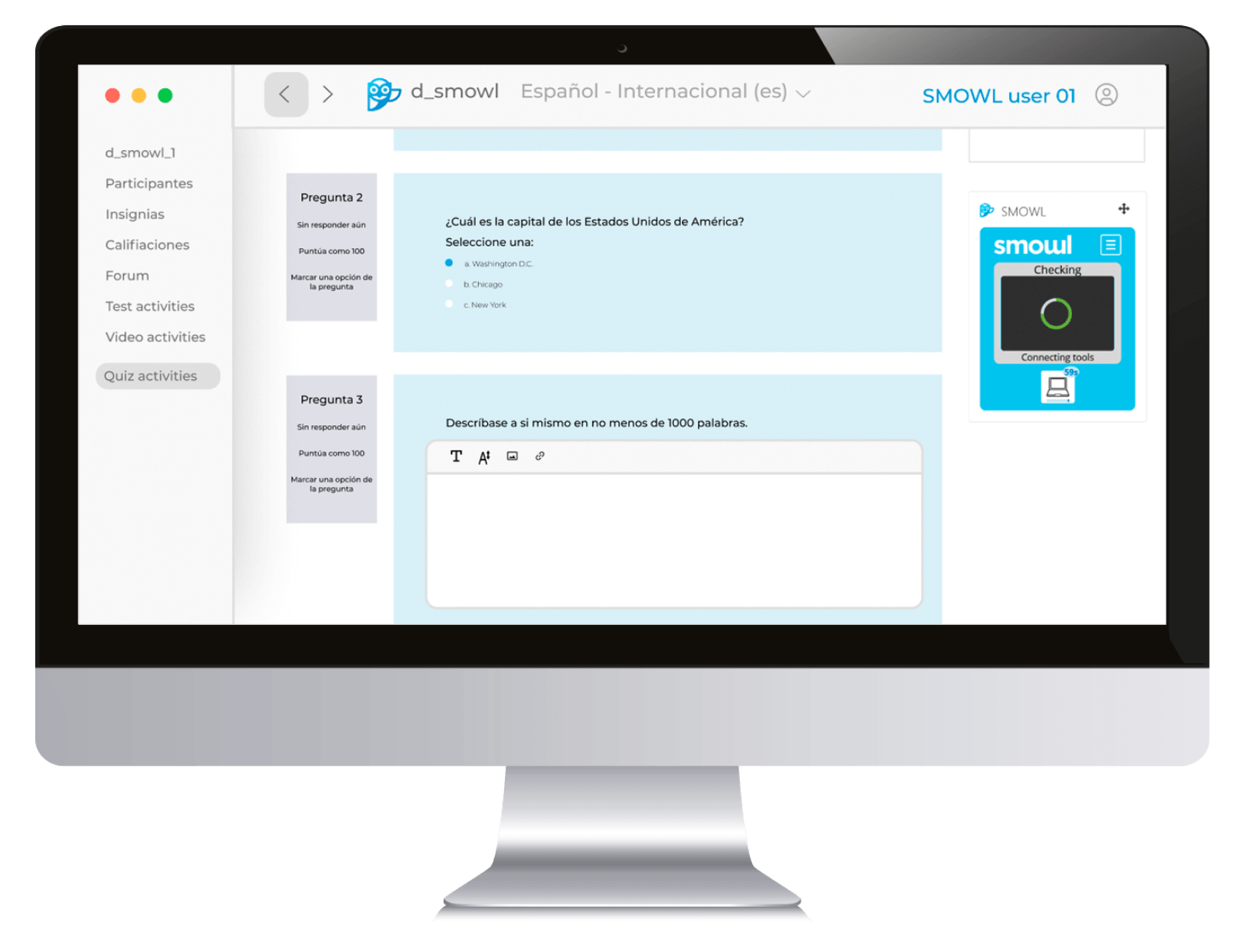
In recent years, AI proctoring has transformed digital assessment by ensuring fairer, more transparent, and more reliable processes. Its impact is reflected in every stage of the exam, ranging from prior identity authentication to real time supervision.
How does it work, and what does it detect in digital assessments?
Proctoring based on artificial intelligence is divided into two key moments in the evaluation process. First, it intervenes in user authentication before the test begins, helping to verify who is behind the screen.
On the other hand, it silently accompanies the progress of the test by analyzing the testing environment and device activity in real time, identifying audio and video while monitoring the computer and its activities outside of the evaluation.
Examinee authentication
Identity authentication is the first line of defense for ensuring integrity in digital assessments. It involves collecting and comparing biometric data or official documents with the user’s image captured via webcam.
1:1 Initial authentication
The system prompts the candidate to capture a live photograph (selfie) through their webcam and compares it with the ID document previously uploaded to the educational institution’s system.
Artificial intelligence comes into play through computer vision models by analyzing the face and extracting specific nodal points, such as the distance between the pupils, the contour of the chin, or the depth of the eye socket. The system then converts this data into a mathematical template or alphanumeric vector.
The AI calculates the mathematical distance between the biometric print on the ID document and the one from the live selfie. If the match exceeds the configured security threshold, access to the exam is validated.
Periodic checks on the user
Identity checks on the user do not end when the session begins. Throughout the exam, the system performs continuous facial recognition to confirm that the candidate’s presence remains genuine.
To protect network bandwidth and user privacy, the AI does not need to stream continuous video. Instead, it analyzes periodic image captures taken via the webcam at random intervals.
In each image capture, authentication algorithms extract the biometric print in real time and compare it with the baseline pattern recorded during the initial phase. If the match score drops or the face does not match, evidence is generated in the final report with a timestamp.
Similarly, these models detect prolonged absences, the presence of third parties in front of the camera, and changes in estimated posture or gaze direction.

Types of authentication and AI intervention
It is important to emphasize that artificial intelligence does not operate exclusively through biometric analysis. The technology is also implemented in non biometric workflows, where AI assists by verifying that the captured image has not been digitally altered before being validated by a human reviewer.
This versatility opens the door to different authentication modalities depending on the security, cost, and privacy needs of each test.
Based on these considerations, three main authentication modalities are available for online assessments, differing in terms of security level, required budget, and AI implementation:
- 100% automated AI authentication: The algorithm captures and analyzes the examinee’s biometric data, making an immediate decision to allow or deny access. This modality is best suited for high volume exams and lower stakes tests.
- AI assisted authentication with human review (Hybrid approach): Artificial intelligence performs the comparison and detects potential alterations, but a human reviewer gives final approval. This model provides the highest legal validity, eliminates user stress, and prevents unfair rejections caused by physical changes or algorithmic bias.
- Simple presence detection: The system confirms that a face is present in front of the webcam using generic algorithms, without comparing an ID document or generating a biometric print. This option is cost effective but vulnerable to premeditated impersonation.
Applicability during the assessment
Once the user’s identity is authenticated, artificial intelligence accompanies the progress of the test to ensure it is conducted under conditions of equity and integrity. Throughout the exam, proctoring technology combined with implemented AI, continuously analyzes four key dimensions of the digital and physical environment.
Visual recognition via webcam
During the exam, computer vision models process periodic image captures from the front facing webcam. This real time visual analysis helps verify that the candidate maintains focus on the assessment.
Artificial intelligence is trained to identify movements by the examinee away from their workstation, unusual head turns, and repeated glances away from the screen angle.
Similarly, neural networks recognize the presence of multiple people in the frame or the use of unauthorized objects in front of the camera, such as mobile phones, physical notes, headphones, or smart glasses.
Physical environment supervision
To elevate the security level in high stakes tests, proctoring allows for the integration of a secondary camera using a second device (such as a smartphone or tablet) easily connected via a QR code.
The AI processes the signal from this secondary feed to provide a peripheral view of the workspace. This makes it possible to check the desk and the sides of the computer.
This supervision detects external aids that fall outside the range of the main webcam, such as hidden printed materials, secondary monitors at side angles, or assistants present in the room. The AI meticulously detects what the human eye might fail to perceive or overlook.
Audio and acoustic environment supervision
Proctoring includes acoustic analysis that uses audio signal processing algorithms via the device’s microphone to evaluate the sound environment of the test.
The AI differentiates ordinary ambient noise (such as typing or breathing) from sound anomalies that exceed tolerance thresholds configured by the evaluators.
Key findings that can be detected include background voices, conversations in the room where the exam is taking place, reading aloud, dictating answers, or the use of voice assistants and synthetic audio.
Digital activity and computer control
Supervising digital activity on the student’s computer combines browser and operating system control to ensure the exam is answered using resources permitted by the examiners.
For this analysis, browser lockdown and integrity tools are available to restrict the opening of new tabs, switching between windows, and the use of keyboard shortcuts such as copy and paste.
In addition, operating system monitoring components detect applications running in the background, virtual machines, remote desktop tools, and real time queries to generative AI models (such as ChatGPT, Gemini, Copilot, among others).
Comparison with non AI supervision
The evolution of AI proctoring makes it possible to tailor digital assessments to the specific needs of each institution and test type. Comparing different models helps us identify the ideal combination to maximize trust, accessibility, and equity according to the requirements of each evaluation context.
Hybrid proctoring
Hybrid proctoring represents the fusion of technological precision and human judgment.
In this model, artificial intelligence performs the analytical collection of evidence in the background, while a human reviewer, proctor, or instructor examines the findings to make a final, fair decision based on criteria established by the institution.
These are the key scenarios for its application:
- Final and high stakes exams: University tests, official degrees, or professional certifications where institutional validity demands definitive human backing to ensure the highest reliability in exam supervision.
- Regulated processes and mandatory recertifications: In corporate or regulatory environments that require complete and auditable traceability.
- Contexts of diversity and inclusion: Assessments designed to offer a margin of flexibility to examinees, ensuring that any technical event is interpreted with human empathy and insight.
| Dimension | Automated supervision (AI) | Hybrid proctoring | Traditional proctoring (human) |
| Role of AI | Processes data and filters results according to pre-configured institutional rules. | Silently analyzes and organizes evidence for the human reviewer | Does not use AI or uses it as secondary support. |
| Role of human | Pre configures the AI and provides the exam parameters. | Makes the final decision by analyzing the recorded findings. | Provides live supervision or a complete review of the process. |
| Main benefit | Agility and speed in high volume testing. | Optimal balance between AI analysis, precision, and human empathy. | Proximity and direct interaction. |
| Scalability | High scalability, accommodating thousands of users simultaneously. | Highly scalable, optimizing the instructor’s review time | Ideal for small groups or individual sessions. |
| Ideal Context | Diagnostic tests or frequent assessments. | Final exams, certifications, and university admissions. | Personal interviews or oral/written evaluations. |

Objective reports vs. suspicion percentages
A differentiating aspect that highlights digital supervision is the way test results are presented, with the use of AI in the exam gaining more relevance. There are two main approaches for delivering information to evaluators:
- Statistical suspicion percentages: These are models that assign a percentage to the user (for example, “80% probability of looking outside the screen”). Although they offer a quick figure, they require the instructor to blindly trust an algorithmic calculation without necessarily seeing what happened during the test, in addition to leaving a statistical gap or a “probability of not having performed that action.”
- Objective reports with evidence: Systems that compile an analytical report with timestamps and specific images of events that occurred during the session (such as the detection of a second screen or an external sound). This evidence is gathered into a final report.
The use of objective reports transforms the evaluation experience into a transparent process with guarantees not only for the teaching staff but also for the student.
Instead of rating the candidate with a probabilistic percentage, the objective report provides the instructor with a clear and verifiable record of the facts. In this way, the impact of algorithmic biases is mitigated, protecting the examinee’s reputation and ensuring that the final decision is fair, well founded, and based on real evidence.
Where AI proctoring is most applicable: where is it used?
AI proctoring is invaluable in assessments where the legitimacy of results takes precedence, carrying a high legal, professional, and/or academic impact.
By processing analytical evidence and authenticating identity in real time, this technology makes it possible to assess a large number of students without compromising security or the user experience.
Certification exams
Having AI digital supervision in professional and corporate certifications is excellent due to its demand and level of rigor regarding exam traceability and integrity. In highly regulated sectors, a fraudulent assessment can compromise operating licenses or lead to regulatory penalties.
In this way, artificial intelligence supervision makes it possible to authenticate the candidate before the test and certify that they meet the required conditions throughout the entire session. Its application is fundamental in:
- Annual recertifications: Mandatory industry regulatory update tests that require auditable records before regulators.
- Professional and international accreditations: Remote state licensure exams. The use of AI supervision ensures that the assessed professional is truly the one who possesses the competencies.
- Screening tests and corporate recruitment: Entrance technical assessments to measure analytical skills, competencies, or techniques such as programming. The use of this technology mitigates the risk of identity impersonation or the unauthorized use of generative AI.
Do you want to stay on top of the latest trends in eLearning, EdTech, and Human Resources?
Fill out the form to receive our weekly newsletter with industry insights from our experts.
Entrance, final examinations, and degree exams
One of the major uses of AI proctoring is in higher education, precisely in high-stakes exams. These usually represent a decisive milestone in a student’s record, such as the end of a course or degree. An institution’s prestige and the validity of its degrees depend on these tests being conducted with equity and rigor.
Artificial intelligence proctoring software integrates directly into universities’ virtual campuses (LMS) to support the integrity of the following exams:
- Undergraduate and graduate final exams: Its participation in cumulative end of course assessments is fundamental when seeking to mitigate irregularities while maintaining a calm and accessible test environment for students.
- Master’s Thesis (TFM) and thesis defenses: In degree conferencing instances, the use of AI proctoring is essential since these are spaces where prior identity confirmation is indispensable for the official issuance of the degree.
- Admission and leveling tests: For remote university program entrance exams or language certifications, AI supervision is important, given that these tests require a fair and transparent evaluation process for candidates, along with the requirement to legitimately validate knowledge.
It should be clarified that AI proctoring is not exclusively limited to these scenarios, but it is a priority in them due to the high risk and strategic impact they represent. Protecting the integrity of these assessments not only prevents direct fraud during the exam and guarantees an equitable environment, but it also functions as a preventive shield against future complaints, appeals, or legal issues for the institution.
How to assess fairly and avoid false positives?
In AI supervision, ensuring an equitable evaluation means that minor distractions or involuntary gestures caused by tension do not turn into unfair penalties for examinees. Therefore, supervision technology acts as an analytical tool designed to provide transparency and protect the effort of the person taking the exam.
Learning system
AI proctoring solutions work through mathematical models and machine learning algorithms that process visual, auditory, and digital patterns during the exam. These systems analyze data continuously to refine their precision in detecting potential non-permitted actions.
During the course of the test, artificial intelligence monitors that the person taking the exam is who they claim to be, and identifies non-permitted items or behaviors. For this, there are two types of proctoring: a system that interprets the intentionality of the user’s action by issuing automated judgments, and other systems that do not issue any judgment, generating detailed reports and logs whose interpretation is left to a human supervisor.
Depending on the AI proctoring modality, there are different ways to prevent false positives. However, the most reliable one is the option that generates objective reports by compiling evidence with timestamps.
The technology never disqualifies or suspends a student; its function within the exam is to act as a neutral witness that organizes the information gathered during the session so that the human evaluator can analyze the context and make the final decision.
Similarly, the implementation of supervision schemes allows the candidate to complete their exam without any interruption from the system. This reduces student stress, guarantees equal conditions, and consolidates a secure, fair, and respectful digital evaluation environment.
International regulations and data protection
AI proctoring must be developed under rigorous legal frameworks to protect the privacy and fundamental rights of examinees. Therefore, international regulations ensure that data collection is limited strictly to evaluation purposes and carried out under digital security.
Artificial Intelligence act and GDPR
When AI supervision is used in European territory, EU legislation establishes the most demanding global standard for privacy and digital ethics.
However, to understand the legal framework of remote supervision, it is essential to differentiate the role of two regulations:
- General Data Protection Regulation (GDPR): This is the rule that strictly governs the processing of personal and biometric data. In this case, it regulates all data captured during proctoring sessions. It protects students by obliging institutions and technology providers to apply encryption and the principle of data minimization.
- Artificial Intelligence Act (EU AI Act): This regulates the technology itself and its level of risk. In this regard, Annex III of the law explicitly classifies AI tools intended for supervision, evaluation, and behavior detection as high-risk systems.
As proctoring is classified as a “high-risk” application, its algorithms must be developed in accordance with ethical standards to prevent discriminatory biases. At the same time, the regulation establishes that the final decision to validate or invalidate a test cannot rely solely on automated AI processing.
Human supervision and intervention in the final verdict is no longer a methodological preference, but rather a strictly mandatory legal requirement in the educational sector.
Regulations in the United States: FERPA and CCPA
In the United States, data protection is managed through sector specific laws and specific state regulations.
FERPA (Family Educational Rights and Privacy Act) is the federal law responsible for protecting the privacy of students’ educational records. Compliance with it is mandatory for educational institutions that receive funds from the United States Department of Education.
For artificial intelligence supervision to integrate within the framework of FERPA, it must operate under contract with the academic institution. This agreement ensures that the collected data is used solely for educational purposes and without access by unauthorized third parties. On the other hand, at the state level, the CCPA (California Consumer Privacy Act) protects personal information and sensitive data of California residents during digital assessments.

Integration and security: How to implement AI proctoring in your LMS
Implementing AI supervision requires this technology to adapt properly to the existing digital infrastructure of educational institutions or businesses. The key to successful adoption lies in the ease of integrating AI into virtual campuses, alongside proper maintenance backed by high security standards.
Native integration via LTI and API
This tool connects directly with Learning Management Systems (LMS) such as Canvas, Moodle, Blackboard, and Brightspace (D2L), among others, depending on the partnerships held by the proctoring provider. This connection is established through interoperability standards like LTI or via customizable APIs.
Thanks to this integration, examinees take the test on educational platforms they already know, without needing to access unfamiliar external environments. Likewise, evaluators manage exams and review evidence reports directly from the web portal where they work on a daily basis.
Information security and data privacy
At a technical level, the architecture of the AI proctoring system guarantees the protection of personal data through encryption. All information and evidence collected during the test are processed under strict international standards, such as the GDPR, FERPA, CCPA, or the European Union Artificial Intelligence Act.
The analytical reports and captures generated by the AI are stored securely in the cloud and are exclusively accessible to authorized instructors or organizational leaders. In this way, the institution maintains absolute control over the data and academic decision making.
What does the future hold for this type of technology?
In the future, AI proctoring points toward greater personalization and technical adaptability. Advanced solutions will allow institutions to flexibly configure supervision levels according to each exam, adjusting modules such as authentication or browser control.
Similarly, the advancement of machine learning algorithms will optimize real time behavior detection accuracy, minimizing false alarms and improving the fairness of the process. This will be joined by integration with immersive technologies such as virtual and augmented reality to supervise complex simulations in technical or medical fields.
The expansion of hybrid education and professional certifications will solidify AI proctoring as a necessary and accessible global standard. All of this development will be executed under a framework of ethical artificial intelligence and strict compliance with regulations, ensuring the elimination of algorithmic bias while always maintaining human judgment in the final decision.
If you want to examine which supervision modality best fits your evaluations, you can check SMOWL’s proctoring plans or speak with our team of experts to resolve any questions.
AI proctoring: Frequently asked questions
Do I need a special computer to use AI proctoring?
No special or high-end computer is required to use AI proctoring. You only need a conventional device with a basic internet connection, a webcam, and a microphone. The system is compatible with operating systems such as Windows 10+, macOS Big Sur+, and Linux (Ubuntu, Mint), as well as standard browsers like Google Chrome or Microsoft Edge.
In addition, the technology does not require streaming continuous video; instead, it analyzes periodic image captures taken at random intervals. This reduces bandwidth consumption by up to 90%, preventing computer sluggishness and ensuring stability even with simple home connections.
Do I need special software to use AI proctoring?
SMOWL integrates directly into the virtual environments or campuses that the organization already uses (such as Canvas, Moodle, Blackboard, or Brightspace) via LTI and API standards. For the user or candidate being evaluated, using the system is completely free of charge, with no need to purchase special software.
How is my personal data protected?
Privacy is guaranteed by operating under the European Union’s General Data Protection Regulation (GDPR), the strictest data protection regulation globally.
Sensitive data is handled as follows: the facial image is dissociated from the real name and linked to an encrypted alphanumeric code. In this way, servers process anonymous identifiers, and only the client institution knows the user’s real identity.
All information is stored encrypted in the cloud and is never sold, commercialized, or shared with third parties. Furthermore, the organization can define customized retention policies and remove records once the desired review period ends.
Who is AI proctoring intended for?
AI proctoring is designed for any institution or company that needs to assess knowledge or validate identities remotely with total fairness and trust. In the academic field, it is ideal for universities conducting admission tests, midterm exams, final exams, and online thesis or degree defenses.
In the corporate sector, it is key for Human Resources departments in remote recruitment processes and technical testing. Likewise, it is fundamental in regulated sectors that must carry out mandatory annual compliance and regulatory recertifications. Finally, it benefits examinees by allowing them to take their tests from any location without travel costs or time.
Which is better: A statistical suspicion percentage or an objective evidence report?
An objective evidence report has greater virtues than a statistical percentage. Percentage-based models assign a probabilistic figure that communicates an algorithmic calculation to the organization with a percentage margin that may be erroneous or contradictory to the initial hypothesis.
In contrast, the objective report provides an analytical report with timestamps and specific images of each detected event. This guarantees transparency, mitigates the impact of algorithmic biases, and provides a verifiable and irrefutable audit trail for potential inspections or legal requirements.
Does artificial intelligence automatically penalize or disqualify a candidate?
Artificial intelligence does not automatically penalize, suspend, or disqualify any student or candidate. Its sole role is to act as a neutral witness that collects, organizes, and labels evidence during the session.
The final decision on the validity of the exam is always 100% human, remaining the responsibility of the institution’s instructors, recruiters, or compliance officers. In fact, under regulatory frameworks like the European Union Artificial Intelligence Act (EU AI Act), human intervention in evaluation decisions with significant effects is a strict legal obligation.