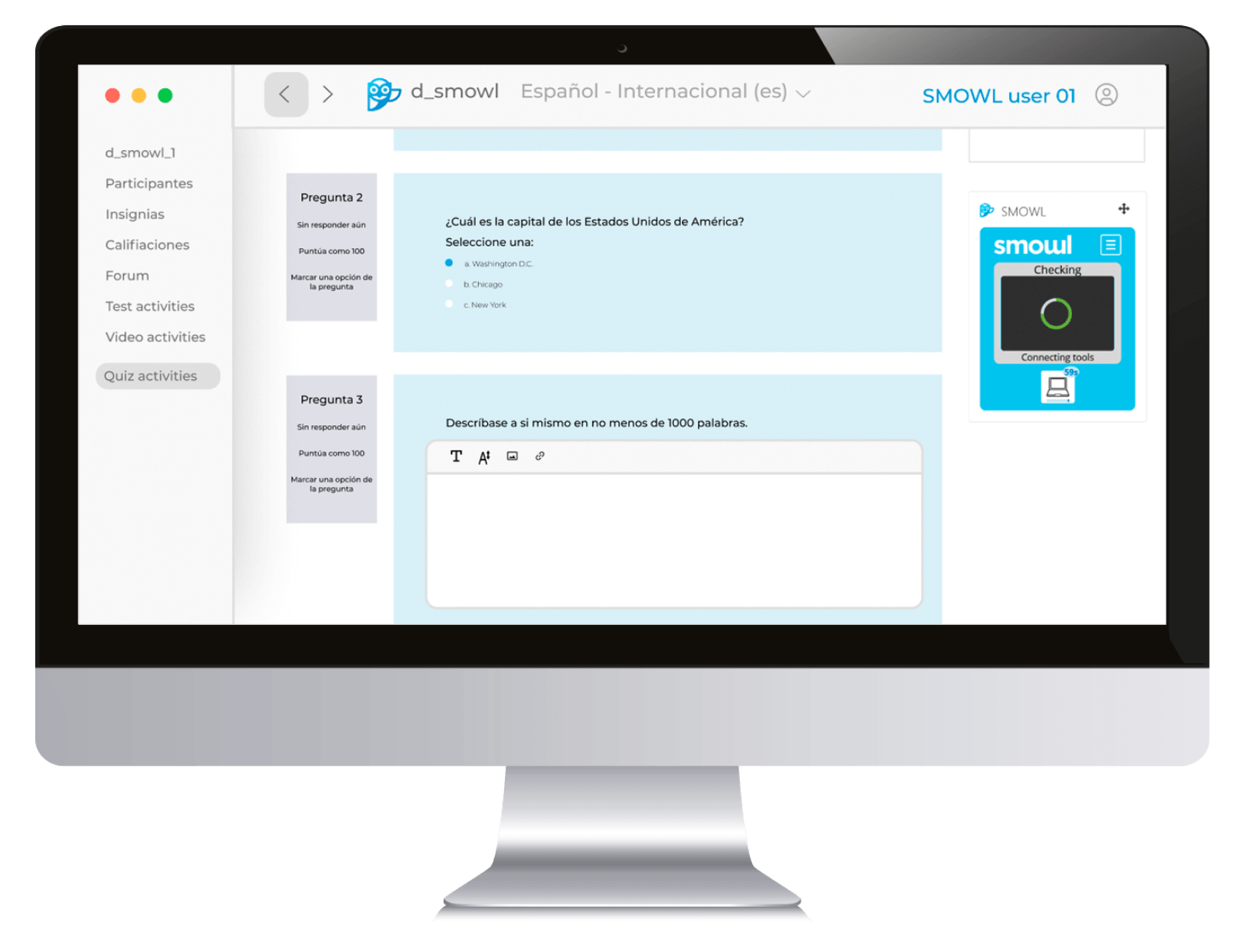
Asynchronous learning is an educational method that allows students to access content at their own pace and according to their schedule.
Its great flexibility encourages student autonomy, helps them develop critical thinking and empower themselves, although they may feel lonely and become demotivated.
So, we invite you to discover in detail what does asynchronous learning mean, and what its main advantages and challenges are. We will also share with you the best practices so that you can get the most out of them.

What is asynchronous learning?
Asynchronous learning is an educational strategy in which the instructor and the student interact at different times throughout the course, but without the exchange being simultaneous.
The way it works is simple: the teacher provides his or her students with an educational program made up of different units that they must complete at their own pace and whose contents they can consult whenever they need to.
Each of these units has specific resources associated with it that are assigned to the students (quizzes, audiovisual media, readings, etc.) and that they must consult and complete in order to progress until they finish the program.
By its very nature, this type of learning is common in a digital environment, as it offers multiple channels and formats for the curriculum to develop successfully, as well as providing the possibility of maximizing personalization. However, it can also take place in a physical environment where students can meet and consult the content.
Although the student has a certain degree of autonomy when it comes to planning his or her itinerary, this mode of learning is not free. In other words, the instructor is present at all times, providing students with the feedback they need, supervising them and evaluating them when necessary.
Interaction in asynchronous learning is not only hierarchical (between the instructor and their students or vice versa), but also transversal, meaning that students have forums, channels and boards through which they can also interact with each other.
Following this asynchronous learning definition, to continue delving into this educational strategy, we invite you to discover the differences between synchronous and asynchronous online learning.
Do you want to stay on top of the latest trends in eLearning, EdTech, and Human Resources?
Fill out the form to receive our weekly newsletter with industry insights from our experts.
Synchronous vs. asynchronous online learning
The first difference between synchronous and asynchronous learning models applied to the digital environment is the type of communication established between the instructor and the students.
While in synchronous learning the teacher-student relationship takes place in real-time, in asynchronous learning it takes place in a delayed manner.
This difference in communication is momentous and defines other aspects of learning, as you can see in the following table, which will also allow you to detect the strengths and weaknesses of each approach:
| Differences between synchronous and asynchronous education | ||
|---|---|---|
| Concept | Synchronous learning | Asynchronous learning |
| Interaction | Simultaneous with immediate feedback. | Time-shifted with limited feedback. |
| Tools and resources | Videoconferencing, live classes or chat sessions, as well as tools that allow simultaneous work from different locations. | Scheduled audiovisual material, pre-recorded videos and podcasts, online questionnaires, etc. |
| Content availability | Limited to specific times. | Once registered, students can consult the teaching material at will. |
| Flexibility | It is a lower level, classes follow a specific timetable to which students must adapt. | High, students choose when to study and at what pace to progress. |
| Sense of community | Strong because students collaborate in real time, creating bonds and promoting the exchange of ideas. | Weak unless appropriate strategies are implemented to strengthen it. |
| Reflection on the content | Limited by the dynamics and time of the group. | Profound, given that students can process the information by dedicating the necessary time to it. |
| Accessibility | Less because they have to follow a set timetable. | Very accessible, and ideal for people with complex schedules because it allows for ubiquitous learning. |
| Student profile | Students who prefer direct interaction and to progress in a structured way with defined timetables. | Self-motivated student with good time management skills. |
| Type of learning | Collaborative based on teamwork. | Self-reflective, it requires cognitive participation. |
The class based on asynchronous learning online: example
Classes based on asynchronous learning are structured so that students can follow them in a personal and independent way.
For this reason, in this educational strategy, designing learning takes on great relevance by offering learning experiences that are anchored in reality, memorable and effective.
How does it develop?
This type of learning often makes use of adaptable technological tools such as Learning Management Systems (LMS) such as Moodle, Canvas or Google Classroom.
These are computer programs that offer comprehensive management of distance learning, allowing the design, personalization, adaptation and updating of a training strategy.
Generally, the approach to an asynchronous class is usually as follows:
- The instructor prepares the units and uploads the material to a platform that students can access whenever they want once they have logged in.
- The classes can be recorded on video or audio, or in writing, and can be accompanied by all kinds of support materials such as infographics, PDFs, video presentations, etc.
- Students complete the activities and unlock the following units, which helps them become aware of their progress, achievements and obstacles.
- Sometimes the content is interactive, which makes it easier for the teacher to detect who is interacting on the platform and to send or schedule the sending of specific messages to motivate and guide their students.
- The teacher can monitor the student’s progress in different ways. For example, they can use comprehension questionnaires at the end of each unit, or check through reports who has seen the lesson, whether or not they have completed the assigned tasks, etc.
- Students have channels available to them to raise their doubts and questions, or request support from the teacher, as well as discussion forums in which they can interact with other students to share ideas, and reflections or raise their doubts.
- Remote assessments must ensure a level playing field for all students through appropriate accessibility and security systems that also respect student privacy and current regulations.

Examples of educational content for asynchronous learning online
The digitization of learning has opened up endless possibilities in terms of content creation and the diversification of communication channels that facilitate asynchronous learning.
To see the possibilities that the online medium can offer you, take a look at the following types of content that you can use in your asynchronous classes:
- Explanatory audio and video recordings, lectures, demonstrations of exercises or projects, or any other audiovisual material that can be archived.
- Text materials and case studies based on real situations.
- Quizzes and problem-solving.
- Concept maps to organize ideas and timelines that present chronological facts in a very visual way.
- Gamification (the introduction of game-based elements to energize a practice and stimulate students) to enhance active learning.
- Presentations made by students that they can share with the community from their digital portfolio.
- Discussion forums on specific topics, as well as simulations and virtual laboratories.
- Learning journals in the form of blogs or publications in which students can reflect on what they have learned.
Advantages of asynchronous learning
The advantages of asynchronous learning are really important, both for students and teachers.
Advantages of asynchronous learning for learners
Asynchronous learning offers students the possibility of taking the time they need to understand and assimilate tasks, making it more inclusive.
This is because it allows all profiles to advance in the acquisition of knowledge and experience in a way that is adapted to each individual’s pace and allows them to access the content as many times as necessary.
Likewise, students can also devote time to researching and building stronger arguments to defend their ideas in a debate or to consolidate learning before answering a specific question.
Thanks to all this, students develop greater confidence in their abilities, as they feel more secure when facing an assessment and, generally, this allows them to improve their results.
Another great benefit of this type of education is the particular use that students can make of the proposed content.
For example, they can re-watch recorded sessions to reflect on them or go into more detail, or they can also retrieve discussion threads to reinforce their learning or find comparative elements, examples, descriptions on a topic, etc.
In short, the very characteristics of asynchronous learning become advantages for students. This type of approach is:
- Democratic. It makes it easier for all students who need to do so to ask their questions to the teacher, whereas in a synchronous classroom, due to lack of time, there must be moderation and limitation of questions and comments.
- Flexible. Students are not compromised in their training in the face of unforeseen events that impact on their organization, such as a family emergency.
- Adaptive. Students can learn at any pace, as well as adapt the educational experience to a disability. In addition, this adaptability allows them to avoid so-called Zoom Fatigue, a tiredness that can arise when there is overexposure to virtual communication platforms.
- Profound. As students do not have to meet online simultaneously, they can participate in discussions more profoundly and reflectively, as they have time to meditate and look for complementary information on a topic.
- Aware. These strategies promote the autonomy and responsibility of the student who, by being aware of their learning, finds meaning in it and enhances their motivation.

Advantages of asynchronous learning for teachers
For instructors and teachers, asynchronous learning offers the possibility of creating more intentional training programs that can evolve according to the needs of digital learners.
So that’s the first advantage for teachers, the scalability of the content. There are more, as you can see in the following list:
- The resources are reusable, so teachers can optimize content creation and spend more time on support and supervision.
- LMS and remote supervision software, such as proctoring systems, provide performance reports that help make assessments more objective and fair.
- Teachers can promote independent learning that empowers students, as they must take responsibility for their learning. In addition, asynchronous learning encourages instructors to provide different approaches to the same content for their students through readings, videos, etc.
- The security of asynchrony avoids the stress of being exposed to connectivity problems inherent in live broadcasts, for both students and teachers.
- The possibility of creating creative and innovative content is motivating for teachers, who can improve their professional growth by developing skills in instructional design, multimedia production and digital tools.
Challenges of asynchronous learning
While it is true, as we have just seen, that asynchronous learning offers great benefits, it also poses significant challenges.
It is important that you are aware of them so that you can proactively turn them into challenges that help you improve the content of your programs. We have compiled the most significant challenges of this kind of education in the following list:
- Possible disconnection of students due to the lack of direct feedback.
- Distance from their peers by not participating in simultaneous collaborative activities.
- Lack of discipline when it comes to progressing through the program, as well as independent learning skills.
- Boredom and lack of motivation when feeling alone.
These challenges are undoubtedly considerable, but they can be overcome by creating activities and resources to guide learning, such as a Partner Relationship Management (PRM) strategy by email applied to education.
For example, you can create a series of messages that will be sent to each student automatically, although personalized, based on their interactions on the training platform.
For example, if a block is detected, they can send a message of encouragement and a reminder of the existing channels to raise their doubts or an article or video explaining study techniques, tips for improving, etc.
Don’t forget to congratulate students on their achievements, and encourage participation in forums and chats between students to keep the momentum going in ongoing discussions or to redirect topics of conversation.
You could even propose the creation of a digital magazine and ask everyone to participate! As you can see, there are practically no limits when it comes to improving the success rate of your training courses.
Synchronous vs. asynchronous: which is better for you?
At this point, it seems that an obvious question arises: “Which is better, asynchronous or synchronous learning?” The answer depends on factors such as the following:
- The availability of time, since synchronicity is more demanding in that respect.
- The type of interaction required by the program.
- The learning style you want to propose.
- Technological accessibility.
- The educational objectives.
For example, in a live class, interaction is immediate (synchronous) and allows students to have their questions answered. However, a recorded (asynchronous) class encourages deeper reflection on the proposed topic.
Likewise, an asynchronous forum allows information to be retrieved when necessary, while a direct exchange can bring participants closer to the practice and strengthen their commitment.
The training itself can be better adapted to one model or the other, depending on its nature. That is to say, if the subject matter needs to be more immersive, it may provide better results if it is synchronous.

The hybrid method as a key to success
For education experts, a third way is emerging: combining the benefits of asynchronous and synchronous learning to create a hybrid model.
Activities that combine these two approaches draw on the characteristics of both models to offer students a complete experience that allows them to access direct feedback and resources to reflect on knowledge at their own pace.
Due to their many benefits, many emerging pedagogies use both types of instruction, as is the case with the flipped classroom, which combines face-to-face education and distance learning thanks to the possibilities offered by information and communication technologies (ICT).
In short, asynchronous education combined with synchronous education provides an adaptive educational model that can also be strengthened by informal learning based on the acquisition of knowledge by means other than classroom training.
This winning triad can only happen when the student feels motivated to go further by their own means, and this happens when learning is inspiring.
Best practices in asynchronous learning for the best results
If you want to get the most out of asynchronous learning in your classes, keep an eye out for these three essential recommendations:
- Align with customized elearning. Create personalized learning paths and immersive, visual and vibrant activities for your students. For example, videos recorded in real and relevant environments to present a topic.
- Generate opportunities for exchange. Encourage peer-to-peer exchange to create an inclusive classroom thanks to virtual study groups and discussion forums. This will improve the learning experience and minimize the possible feeling of isolation of asynchronous learning.
- Adapt the assessments. In this type of methodology, assessments must be adapted to the necessary autonomy and flexibility. To enhance the personalization of the content, it is important to carry out an initial diagnostic assessment to analyze the starting point of your students.
During the learning process, you can implement formative assessments that accompany your students with continuous feedback to guide them.
Thirdly, comprehensive and continuous evaluation will allow you to monitor your student’s progress and adapt your strategies accordingly.
And finally, self-assessment is also a good tool for self-regulation of learning.
In every one of the different types of online supervision, creating safe environments that respect regulations is as important as finding solutions that integrate perfectly with the best LMSs on the market.
This is the case with Smowltech’s proctoring plans, and innovative and adaptable remote monitoring plans.
Discover all the solutions we can offer you to boost your training programs by requesting a free demo right now.
8 interesting facts about proctoring
Fill out the form and download the guide where we cover everything about online monitoring and help you choose the best software.