The history of education has always run parallel to the history of trickery. Since the first modern universities established evaluation systems, there has been a segment of the student body looking for the shortcut. But what was an artisanal and limited practice six decades ago has today become a systemic challenge driven by advanced computing.
At Smowltech, in our commitment to building trust in the digital world, we have observed how this mutation not only changes the way cheating is done, but completely redefines the concept of academic integrity. We are not facing a simple change of tools; we are facing a paradigm shift that requires an institutional response equal to the challenge.
Sixty years ago, cheating was a matter of proximity and paper. The classic cheat sheet or the exchange of papers in a crowded classroom were the enemies to beat. Over time, the photocopier and, later, the rudimentary internet of the 90s, facilitated “copy and paste.”
But today, the arrival of generative Artificial Intelligence has dynamited the traditional defenses of universities. The problem is no longer that the student finds the answer in a search engine, but that a machine generates it originally and uniquely for them in seconds.
This evolution forces us to ask ourselves: are institutions prepared to protect the value of their degrees in an environment where authorship has become blurred?
The evolution of academic plagiarism: a necessary retrospective
To understand where we are going, we must look back. In the 70s and 80s, plagiarism was analog. The risk to the institution was controllable through in-person vigilance. Dishonesty was usually an individual act, often detected by the inconsistency in the student’s writing style or by the simple chance of the teacher’s eye.

In this stage, the concept of academic integrity was already beginning to gain strength as the fundamental pillar of institutional reputation, although the methods to safeguard it were still very rudimentary and depended almost exclusively on personal ethics.
With the arrival of the new millennium, fraud became professionalized through contract cheating or the purchase of work from third parties. Essay mills became a global business, taking advantage of the lack of digital borders. Here, the challenge was to identify that the problem was no longer just the content, but the identity and authorship behind the screen.
The digitalization of teaching brought enormous benefits, but it also opened security gaps that text matching detection tools could barely cover. We were at the beginning of a technological arms race that has brought us to the current moment: the era of generative AI.
Why text detectors are no longer enough in the age of AI
For years, the standard response from universities was the use of plagiarism detection software based on database comparison. These tools worked under a simple premise: if a text is equal to another existing one, there is plagiarism. But generative AI has broken this logic.
Tools like ChatGPT produce synthetic content that does not previously exist in any internet database. There is no “match” to detect because the text is technically original, even if it was not created by the student’s intellect. Therefore, we insist that trusting the integrity of a faculty exclusively to these detectors is a high-risk strategy in the current context.

The end of the “matching” era
Traditional software looks for digital footprints of past texts. However, generative AI operates through probabilistic models that construct new phrases word by word. This creates a legal and technical vacuum where the student can submit work “clean” of traditional plagiarism but lacking their own intellectual effort.
It is fundamental that teachers know how to identify the signs that their students are using ChatGPT to understand that reactive detection has reached its limit. Technology has evolved so fast that the tools of the 90s can no longer protect the quality standards of the 21st century.
The invisible risk
The real danger is not just the cheating itself, but also the devaluation of the university degree. If the labor market perceives that an institution’s evaluations are vulnerable to AI, the reputation of all its graduates is compromised. As experts, we recognize that reputational damage is a long-term consequence that is often difficult to reverse.
Institutions must evolve towards evaluation models that not only look at the final result (what is submitted), but ensure the integrity of the entire evaluation process, guaranteeing that the knowledge truly resides in the student and not in an AI prompt.

Comparison of approaches: results detection vs. process supervision
| Characteristics | Traditional plagiarism detectors | SMOWL proctoring ecosystem |
| Object of analysis | The submitted document (static) | The evaluation process (dynamic) |
| Effectiveness against AI | Very low (AI generates original text) | High (detects the use of external tools) |
| Identity | Does not verify who performs the work | Continuous user authentication |
| Moment of action | Reactive (after submission) | Proactive (during and after test execution) |
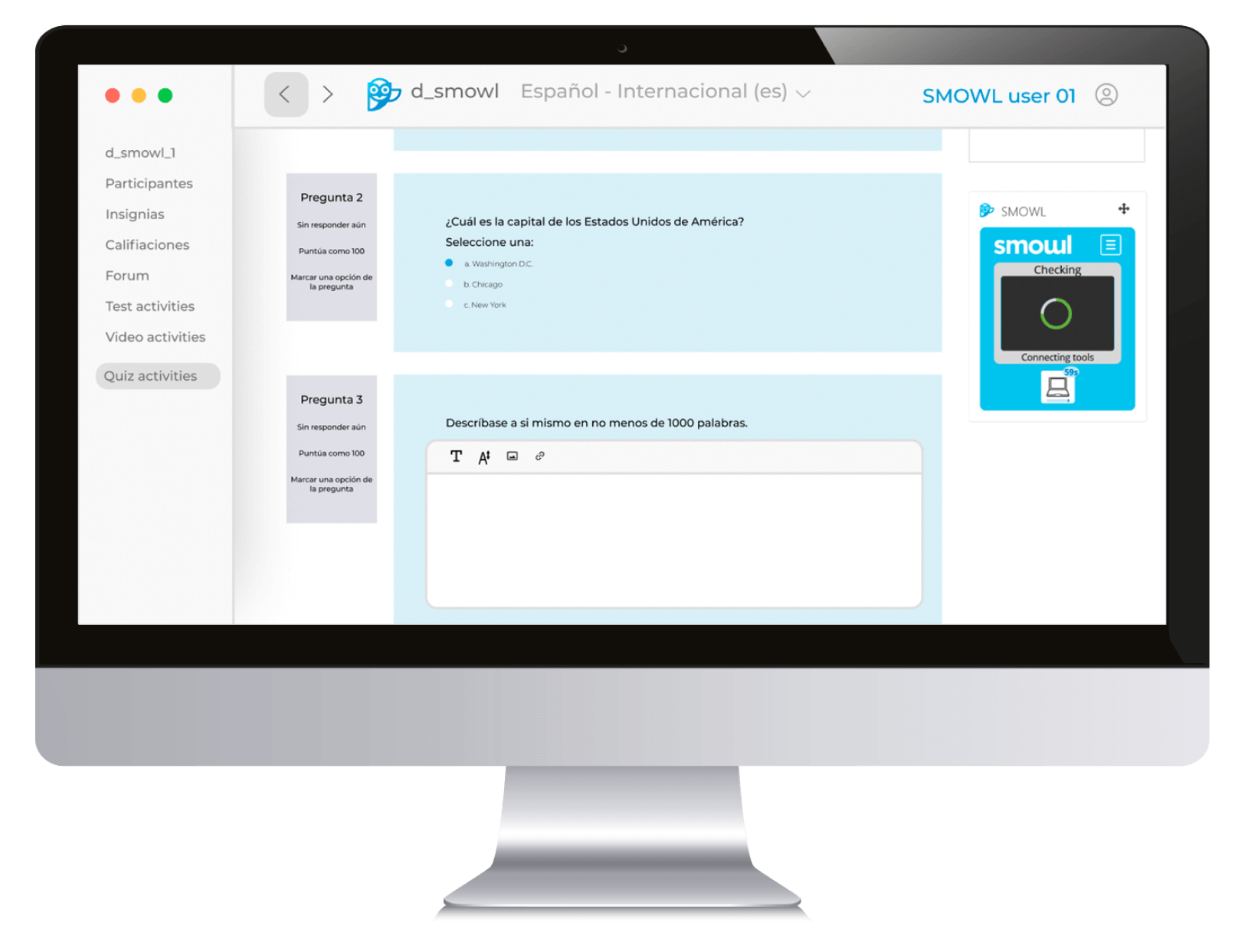
| Security | Limited to text databases | Supervision of screen, cameras, browser, computer, and peripherals |
How our proctoring solutions protect institutional prestige
Our vision at Smowltech has always been clear: technology should not be used to punish, but to enable an environment of trust.
Proctoring is not an invasive surveillance measure, but a security framework that allows universities to certify with complete certainty that their students have met the learning objectives.
By implementing our proctoring solutions, institutions are sending a powerful message to the market: “here, degrees have a real and proven value.” This approach is a vital part of any strategy for academic transformation that seeks to survive and stand out in the age of AI.
Academic integrity in the 21st century
We understand that modern academic integrity requires a holistic approach. It is not enough to block a browser; it is necessary to create an ecosystem where cheating is technically difficult and ethically discouraged.
Our solutions allow monitoring behavior during the exam without breaking the student’s workflow, integrating effectively into the academic day-to-day. This ensures that the evaluation is fair for everyone, protecting honest students from the unfair competition of those who try to use technological shortcuts such as copy-pasting from an AI.
Ethics and privacy
One of the biggest challenges we face is demystifying the perception of proctoring. In full compliance with FERPA and CCPA, our solutions are built with user privacy as a fundamental principle.
Supervision is carried out under the principle of proportionality, collecting only the necessary data to validate the test.
This ethical commitment is what allows us to collaborate with prestigious institutions that seek long-term solutions that do not generate friction with the students, but rather reinforce mutual trust.
Technical integration
Ease of implementation is key for a solution to be adopted. That is why the SMOWL ecosystem is natively integrated with the most used LMS on the market, such as Moodle, Blackboard, D2L, and Canvas. This allows teachers to continue working in their usual environments while adding a robust security layer.
We are improving integrity in online evaluations in institutions worldwide thanks to our simple and scalable deployment capacity, eliminating the technological barriers that previously prevented many faculties from making the leap to professional digital supervision.
Do you want to stay on top of the latest trends in eLearning, EdTech, and Human Resources?
Fill out the form to receive our weekly newsletter with industry insights from our experts.
Frequently asked questions about academic integrity and AI
Is proctoring compatible with the main international privacy protocols?
Yes, our solutions are designed with privacy by default. We work under the strictest standards of the European Union to guarantee that the processing of biometric and supervision data is secure, limited to the purpose of the evaluation, and transparent for the student.
Can AI detectors produce false positives?
Unfortunately, yes. Many studies indicate that AI text detectors often mark texts written by non-native speakers or with a very formal style as “artificial.” Therefore, we recommend not basing critical academic decisions solely on these scores and opting for process supervision.
How does proctoring help the university’s reputation?
By countering fraud with tools like SMOWL, the university certifies the quality and real knowledge of its graduates. This attracts better students, improves employability rankings, and ensures that the value of the degree remains intact against emerging technological threats.
The future of digital evaluation: building trust in a hybrid world
The evolution of academic plagiarism has taught us that we cannot stand still. The transition from the cheat sheet to artificial intelligence is just another chapter in the history of education, but it is perhaps the most critical to date.
As a team at Smowltech, we firmly believe that the solution is not to prohibit technology, but to use superior technology to safeguard the values that make higher education valuable: effort, critical thinking, and honesty.
If your institution seeks to take the next step and secure its future against the challenges of generative AI, now is the time to act. Our solutions are designed to accompany you in this transformation, ensuring fair, secure, and scalable evaluations.
Do you want to protect your institution’s prestige? Request a personalized demo of SMOWL and discover how we can help you build trust in the digital world.