At Smowltech, we spoke with Borja Garzón, a professional with 15 years of experience in education (12 in e-learning) and specialized in educational innovation. The conversation revolved around personalized learning and the role of artificial intelligence (AI) in the classroom, with a constant focus on ethical challenges, academic integrity, and accessibility.
In his words, AI is an opportunity to “do better what makes us more human,” as long as education leads the change.
Who is Borja Garzón
Borja introduces himself with modesty: he doesn’t call himself an absolute “expert,” but someone with many hours of flight time. Trained as Chief Learning Officer at TeamLabs, Mondragon Unibertsitatea, he supports universities, business schools, and companies in their learning processes.
His work ranges from designing training plans and creating learning environments to incorporating AI into the personalization of learning over the last three years.
His path into education began in an unusual place. He graduated in Environmental Sciences in 2008, with an initial goal to “save the planet,” very much in the spirit of Captain Planet. He worked on conservation projects, including in Costa Rica with sea turtles. There he realized that the projects with the greatest impact were those focused on education and awareness-raising: they didn’t just inform, they transformed.
Coming from a family of teachers, the seed was already there. He specialized in online education and educational technologies, convinced that the Internet opened a key door to reach more people.
The 2020 pandemic accelerated everything: the line between in-person and online blurred. And in 2021, with access to AI tools, Borja and his team saw that they could help tackle major challenges, including a central one: personalized learning.

What personalized learning is (and isn’t)
Borja is clear about common misunderstandings: personalization is not simply “adapting content.” It’s a design approach that starts “from minute one,” when needs are analyzed and learning objectives are defined. Its purpose is to align the process with each student’s strengths, needs, skills, interests, and even tastes. Learning doesn’t have to be boring, even if sometimes we must tackle topics that don’t excite us.
Why is it especially relevant now? Because of the context we live in: information overload, screens everywhere, attention deficits, and disinformation.
Amid that noise, Borja points to education’s main challenge: strengthening what makes us more human –critical thinking, curiosity, and creativity- so we can navigate complex contexts that are already the norm.
How can AI help us become more human?
AI can be a great ally, but Borja addresses the “elephant in the room”: it also carries risks.
One of the most obvious is the convenience of accepting AI’s answers at face value, giving up on thinking for ourselves. That’s why, he insists, education cannot look the other way or carry on as if nothing has changed. It has the responsibility to lead the transformation, not simply follow technology.
What does that leadership look like? Generating collaborative learning and learning to ask better questions. We live in an age of uncertainty where we often don’t even know the right questions. AI, he reminds us, is as much about asking good questions as it is about obtaining answers. Education can and should lead the way here.
AI-enabled innovations
Borja highlights two advances that make a difference today:
On the one hand, the ability to design content in minutes and in multiple formats.
From early childhood education to university, a teacher can quickly create videos, presentations, and support materials, and contextualize them for their classroom.
He gives a simple example: even in early years, you can generate content that connects with the group’s preferences (their favorite cartoons, for instance) to bring a concept closer to them.
On the other hand—and to him, more powerful—is the use of data. Even if it doesn’t seem like it, educational institutions already have a lot of data on student progress and behavior in the virtual campus, as well as their interactions with institutional services.
AI can help analyze this data, put it into context, and anticipate school failure by detecting areas for improvement and offering early indicators to intervene before issues become entrenched.
Privacy and data protection: priorities and limits
Privacy, Borja stresses, must be central. He talks about systems that not only comply with the law but also ensure that neither personal data nor the responses generated from them are used to train AI models.
He also advocates for models to be as open as possible so we can understand why one answer is given and not another. At the same time, he acknowledges that AI has a “black box” component we should be aware of.
Alongside privacy, he identifies another major challenge: academic integrity. Students are going to use AI; the goal is not to ban it, but to ensure they use it as an assistant, not to copy.
Here he uses a generational comparison: in his day, many relied on Encarta on CD-ROM. Detecting copy-paste was relatively simple. Online environments, however, make verifying authorship and originality more complex, especially when assessment is not in person.
To make honest and rigorous work easier, Borja argues that AI companies should include watermarks or metadata that allow AI-generated content to be identified easily.
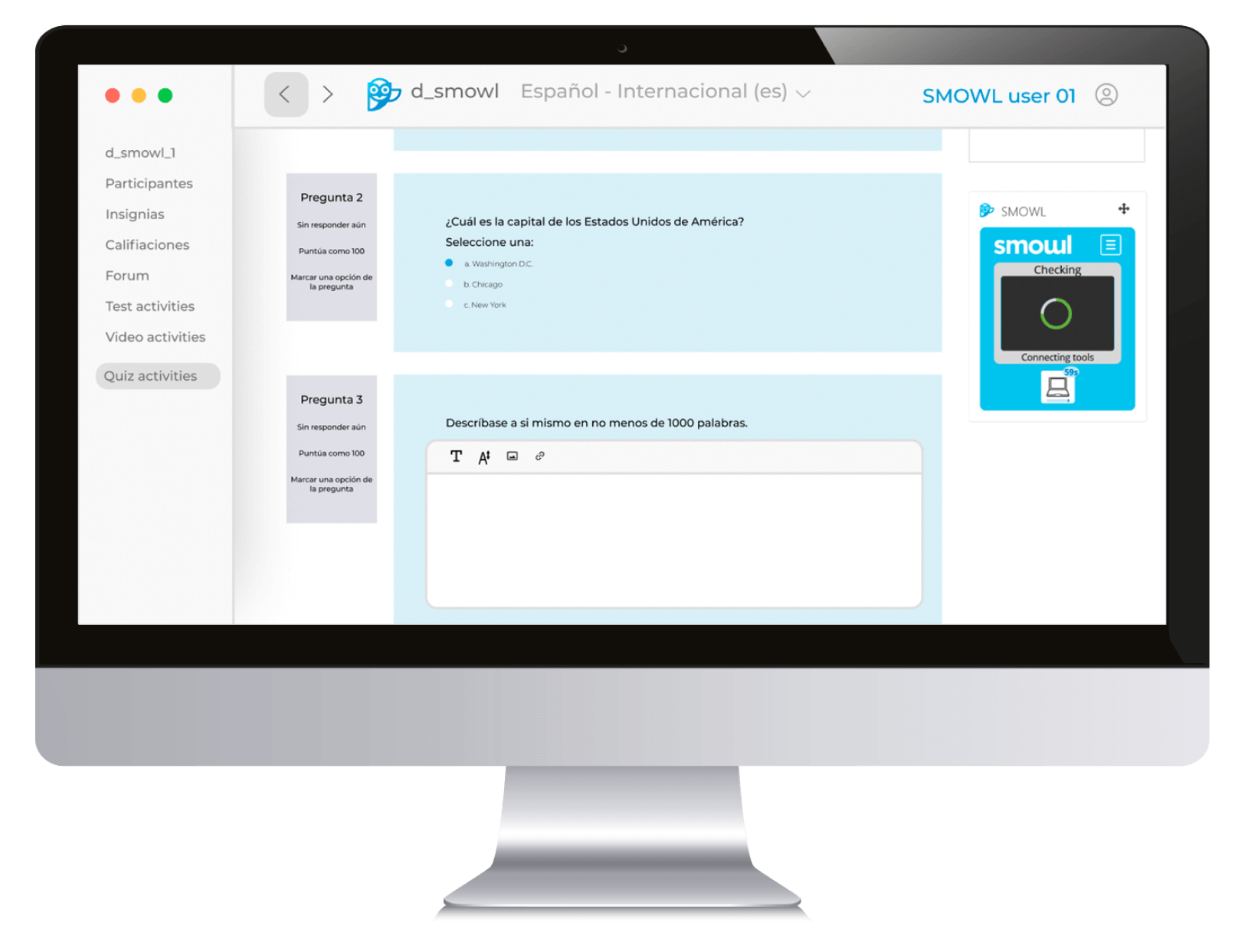
That way, proctoring tools like SMOWL could read those traces and help faculty and institutions apply their integrity principles without turning them into the “police” of the classroom.
Responsibility, he insists, is shared between technology and the educational community.
Do you want to stay on top of the latest trends in eLearning, EdTech, and Human Resources?
Fill out the form to receive our weekly newsletter with industry insights from our experts.
Is the teaching staff prepared?
Yes and no, he replies. The difference from previous revolutions (textbook, calculator, Google) is the speed. When a teacher masters one tool, another appears that makes presentations; then another that generates videos; then one that dubs the same video into another language almost perfectly. It’s hard to keep up.
Even so, most universities and centers are already moving. Many have offered context sessions or launched training programs on AI in education.
Some, like Universidad Carlos III, have published guidelines for TFG/TFM, including how to cite AI and how to use certain tools for instructional design or to verify academic integrity.
The system as a whole is in the process of defining these guidelines and putting them into practice.
Accessibility and inclusion: a space where AI shines
For Borja, attention to diversity and inclusion is one of the most beautiful and necessary fields for applying AI. Imagine a class with students with low vision or blindness. In the past, preparing a high-quality narrated version of a written material required time, voice-over skills, and sometimes getting over the embarrassment of recording oneself.
Today, with AI, you can generate a natural-voice narration in minutes and offer a more pleasant experience than that of a traditional screen reader.
Another point is the language barrier. Translating full documents, subtitling, and dubbing videos into other languages—all within minutes—is now within reach.
For Borja, “there’s no longer any excuse” not to adapt to the classroom’s real linguistic diversity when these options are available.
The deeper challenge: not getting used to blind efficiency
Borja admits a very human concern: getting too comfortable with AI’s efficiency. When it solves a task once and the result is good, the temptation next time is not even to read the answer carefully.
There, he warns, we lose something valuable: the serendipity of learning, the mistakes we also learn from, the side topics we discover while exploring. If we let ourselves drift, we could become less curious.
He catches himself in that impulse now and then and tells himself, “stop, review.” With irony, he adds: “I don’t want AI to do my job because I like it and I think I’m good at it. What I want is for it to do the dishes and iron for me.”
Proctoring and academic integrity: a component gaining weight
Regarding proctoring technologies, Borja believes that, traditionally, universities and business schools have not given them the importance they deserve. The reason is that many assessments were in person or designed as presentations and case studies, and it could seem sufficient.
But once the barrier between online and in-person is “broken,” and with devices integrated into assessments, proctoring becomes necessary to sustain academic integrity at scale.
He argues that it’s not scalable to rely on a professor with 100 students to know each person so well that they can detect irregularities based only on style or suspicion. A robust system is needed. In his view, current solutions comply with privacy “perfectly” because they operate within the educational ecosystem and don’t funnel data to external services.
He also highlights an important change: usability. The days of having to connect through a campus VPN, use a specific browser, or follow convoluted steps are gone. Today the experience is comparable to joining a video call.
That’s why he encourages people to “get over the fear” and try these tools: user experience has come a long way.

Impact case: Ukrainian subtitling to ensure educational continuity
One of the projects Borja remembers most fondly was born in a painful context: the war in Ukraine. Spain, like other countries, welcomed many refugees, including school- and university-age children and young people. They arrived with their lives and academic progress interrupted, and without Spanish.
In some cases, to avoid immediate issues, they were advised to move back several grades because of the language. But imagine, he says, a 14-year-old sitting in a class with 11-year-olds: it’s not the same as a few months’ difference at early ages. The social and academic mismatch is obvious.
The question was: how do we overcome the language barrier quickly? The answer lay in the online teaching community.
On YouTube, teachers share lessons covering almost the entire curriculum: mathematics, physics, biology, history. A group of professionals—Borja among them—contacted these teachers (the “edutubers”), obtained permission, and coordinated on a voluntary basis to generate Ukrainian subtitles using AI. The tool used also collaborated at no cost.
The work was meticulous: take each video, create subtitles in Ukrainian with a very high degree of accuracy, and upload them back to YouTube.
In about three months, they managed to subtitle a very significant portion of the primary and secondary curriculum, as well as introductory content from the first two years of university in general subjects.
The goal was practical: students could attend class in Spain and, once at home, watch the explanation in their own language to reinforce it.
With human translators, the project would have taken much longer—possibly more than a year—and required far greater resources.
Instead, thanks to AI and the commitment of teachers and volunteers, it was achieved at very low cost and with remarkable speed. It is, Borja acknowledges, an example of adaptation (rather than strict personalization), but with a transformative and direct impact on learning continuity.
Closing: an invitation to lead the change
To conclude, Borja sends a message to the entire educational community: participate actively and responsibly in the use of AI. It’s not enough to be concerned; we must take action. Education must lead this transformation and give it the importance it deserves.
If we do it well—if we use AI to learn better, to include more, and to uphold academic integrity—AI can help us be, precisely, more human.