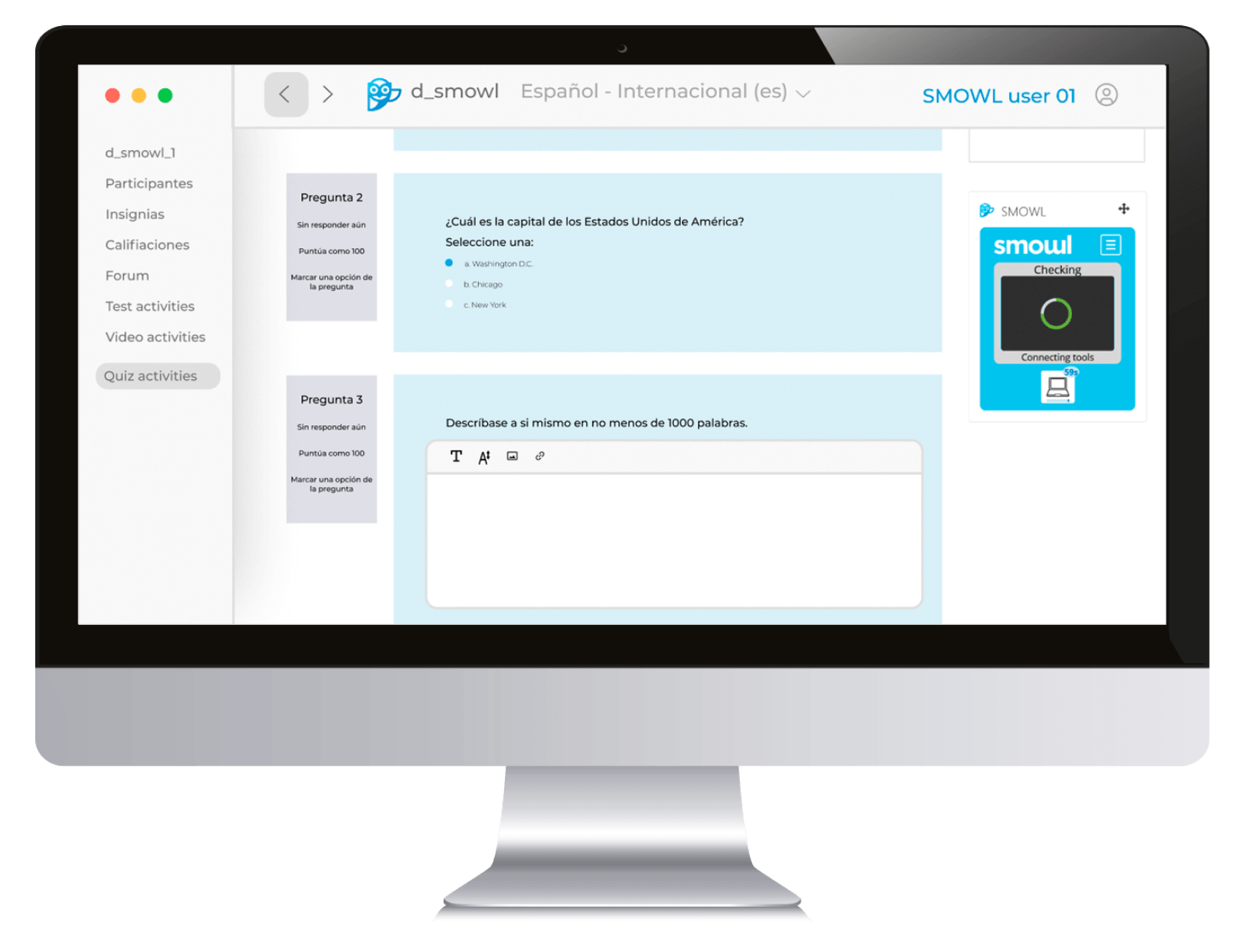
Choosing a digital proctoring solution is a strategic decision for any educational institution.
It not only affects assessment, but also the credibility of qualifications, the student experience, regulatory compliance, and the sustainability of the digital education model.
In this context, the opinions of those who have already traveled that path are the best possible reference.
At Smowltech, we work with more than 300 universities, business schools, training centers, and certification bodies around the world. Institutions with very different realities, but with a common need: toassess in digital environments without giving up academic integrity or trust.
This article collects and analyzes the real opinions of our clients. Not as a list of testimonials, but as a global view of the impact of digital proctoring when implemented with pedagogical, technological, and human criteria.
The role of proctoring in today’s digital education
Digital education has ceased to be an alternative and has become an established modality. However, for years, one of its major challenges has been assessment: how can one ensure that a test taken remotely has the same value as an in-person one?
This is where digital proctoring becomes a key element. But not just any proctoring. Institutions seek solutions that:
- Authenticate the students.
- Detect anomalous behaviors.
- Respect privacy.
- Are technically accessible.
- Do not generate unnecessary rejection or friction.
Our clients agree that the value is not only in the technology, but in how it is integrated into the educational ecosystem.

Latin America: growth, scale, and trust
In Latin America, the growth of distance education has been rapid and, in many cases, massive. This has required solutions capable of scaling without losing control or quality.
Colombia and its trust in technology
The experience of Universidad de La Salle (Colombia) is representative. Its Director of eLearning highlights the architecture based on machine learning as one of SMOWL’s major differentiators. It is not just about supervising, but about analyzing patterns and generating useful information for academic decision-making.
The reduction in attempts at fraud after implementation reinforces a key idea:
when assessment is solid, the entire institution gains credibility.
Furthermore, expanding the use of SMOWL to other programs shows that proctoring is not perceived as a one-off imposition, but as a long-term strategic tool.
User experience as a decisive factor
Institutions like École and UPAL agree on a fundamental point: ease of use. A proctoring system can be technically advanced, but if it creates friction for students or faculty, it ends up failing.
Opinions about SMOWL emphasize that intuitiveness and the support from the team are elements as important as the technology itself.
Peru: digital assessment as a pillar of institutional transformation
In Peru, several universities have understood that digital proctoring is not just an operational solution, but an enabler of new educational models.
Universidad César Vallejo, for example, integrated SMOWL as part of a broader digital transformation strategy. The result was maintaining high standards of academic integrity even in contexts with large student volumes.
Universidad Señor de Sipán goes a step further and defines the integration of SMOWL as a “milestone” in its educational history. Statements like these reflect that assessment is one of the pillars on which trust in digital education is built.
Europe: when proctoring is synonymous with quality and compliance
In the European context, and especially in Spain, regulatory demands are high.
The opinions of universities like Isabel I show how SMOWL has enabled compliance with quality agency requirements, making fully digital degrees feasible with guarantees.
The fact that 70% of students value work-life balance is not insignificant. It reinforces the idea that secure digital assessment not only protects the institution, but improves students’ lives.
From a more technical perspective, ESCI-UPF demonstrates that proctoring can go beyond the classic remote exam, even integrating into in-person or hybrid assessments in complex environments.
Certification and regulated training
In areas such as financial training or professional certification, the reliability of assessment is critical. Cecabank and Psicotec agree that SMOWL was not a temporary solution, but a tool that has come to stay.
This connects with a key idea: when proctoring works well, it stops being the protagonist and becomes infrastructure.

Educational innovation in Central and Eastern Europe
Germany, Romania, and Slovenia provide a complementary perspective. Highly technical institutions or those with a strong face-to-face tradition have found in SMOWL a way to modernize their processes without losing rigor.
Technische Universität Darmstadt has become a benchmark for how technological innovation can be integrated into complex assessments. In Romania, UVVG highlights ease of use and continuous authentication as essential elements to protect its academic prestige.
In Slovenia, the ability to customize and integrate with existing academic systems was decisive, showing that there is no single digital assessment model, but solutions adaptable to each reality.
Opinions from leadership: privacy, cost, and the future
When leaders speak, the focus is usually on three aspects: privacy, sustainability, and long-term vision.
Opinions from people like Mario Grande de Prado from Universidad de León or Ignacio Javier Tolosa from Evidentia University demonstrate that SMOWL achieves a complex balance: authenticating students without invading their privacy and doing so at an acceptable cost-benefit ratio.
Nuria Segovia-García, from IEP, introduces a particularly relevant reflection: proctoring is not a passing trend. It is a tool that is part of the future of digital education and, when used well, raises the quality of the digital education system.
Use cases that expand educational opportunities
One of the clearest impacts of digital proctoring is its ability to make programs viable that previously were not.
Universidad de Burgos is a paradigmatic example: degrees with low in-person demand found new life by also being offered digitally with supervised assessment. The result was a significant increase in students and the sustainability of academic programs that might otherwise have disappeared.
In organizations such as Fundación CIRCE, CAMPUS AENOR, or Opquast, proctoring made it possible to expand the reach of their certifications, reaching more people without sacrificing quality or recognition.
Do you want to stay on top of the latest trends in eLearning, EdTech, and Human Resources?
Fill out the form to receive our weekly newsletter with industry insights from our experts.
The technical view: when assessment becomes viable
From IT teams, opinions about SMOWL highlight a key point: operational viability. Digital assessment cannot depend on complex or fragile systems.
Technology leaders like the Chief Technology Officer of UCASAL emphasize that SMOWL makes teachers’ work easier, reduces technical barriers, and protects institutional prestige.
Even anecdotes, like the “watching owl,” reflect something important: when a tool integrates well, it becomes a natural part of the academic culture.
Global impact and social commitment
Beyond universities and training centers, SMOWL also has a relevant social impact. International training projects, institutions in areas with limited connectivity, and development-oriented organizations especially value its ability to adapt to complex contexts.
That in 2024 more than 502,258 people validated a qualification with SMOWL is not just a figure. It is proof that secure digital assessment can be a driver of social mobility and access to opportunities.
An honest look at the challenges of proctoring
Opinions about SMOWL also acknowledge challenges. Connectivity, access to devices, or the initial perception of surveillance are realities that cannot be ignored.
For this reason, SMOWL has opted for less intrusive models, such as capturing images instead of continuous video, and for working alongside institutions on the pedagogical communication of proctoring, explaining its purpose as a tool for equity rather than surveillance.
What our clients say, collectively
When analyzing globally the opinions of universities, training centers, and certification bodies that use SMOWL, a number of clear patterns emerge that repeat regardless of the country, institution size, or type of educational program.
These common points help explain why so many organizations have integrated digital proctoring as a structural part of their educational model.
Strengthening academic integrity
One of the most cited benefits is the significant improvement in academic integrity. Institutions agree that SMOWL helps reduce attempts at fraud and ensures that the person taking the exam is who they claim to be.
This not only protects the value of each assessment, but reinforces the credibility of the degrees and certifications issued, something especially relevant in digital and hybrid environments.
Additionally, the use of technologies based on behavior analysis and user authentication provides objective evidence that facilitates academic decision-making. In this way, integrity does not rely solely on trust, but is supported by consistent data and processes.

Real facilitation of digital transformation
Opinions about SMOWL show that digital proctoring acts as an accelerator of digital transformation, not as an obstacle. Many institutions note that, having a reliable assessment solution, they were able to move forward with digital or blended models more confidently.
SMOWL is not perceived as an isolated tool, but as an element that fits within the institution’s digital ecosystem, integrating with LMS platforms and adapting to different teaching methodologies. This makes digital transformation sustainable and scalable without compromising academic standards.
Expanding access to education
Another recurring pattern is SMOWL’s ability to broaden access to education.
By enabling secure remote assessments, institutions can reach students who were previously limited by geographic, work-related, or personal barriers.
Opinions emphasize that this expansion does not imply a loss of rigor, but quite the opposite: supervised assessment guarantees equal conditions for all students, regardless of where they are. In this way, digital proctoring becomes a tool for inclusion and educational equity.
Intuitive user experience
Unlike more intrusive or complex proctoring solutions, SMOWL is repeatedly described as an intuitive and easy-to-use tool. Both students and faculty appreciate that the assessment process does not become an additional source of stress or technical difficulties.
This good user experience is key to the adoption and acceptance of proctoring.
When technology supports the educational process without interfering, assessment flows more naturally, and the focus returns to learning rather than the tool.
Close, specialized support
Beyond the software, many opinions emphasize the accompaniment of the SMOWL team.
Institutions value having close, accessible, and specialized support, capable of resolving doubts, adapting the tool to their needs, and supporting implementation processes.
This collaborative approach builds trust and ensures that proctoring is not perceived as a technological imposition, but as a solution built together with the institution.
For many clients, this factor is decisive in continuing and expanding the use of SMOWL.
Resource optimization without losing quality
Finally, opinions agree that SMOWL helps optimize resources without sacrificing assessment quality. Reduced travel, process automation, and the scalability of digital assessments translate into savings in time and operating costs.
However, these savings do not come at the expense of academic rigor. On the contrary, institutions note that they can assess better, with more control and greater traceability, even in contexts with large student volumes.
This makes digital proctoring an efficient and sustainable long-term solution.
Why institutions trust Smowltech
Institutions trust Smowltech because it is not just a proctoring solution. It is a technological and pedagogical partner that understands assessment as an essential part of learning.
They trust SMOWL because it works, adapts, respects people, and shares a clear vision: an accessible, rigorous, and trust-centered digital education.
The opinions confirm it.
The path is marked.
The question is simple: is your institution ready to take the next step?
If the answer is yes, request a free demo and try SMOWL today.